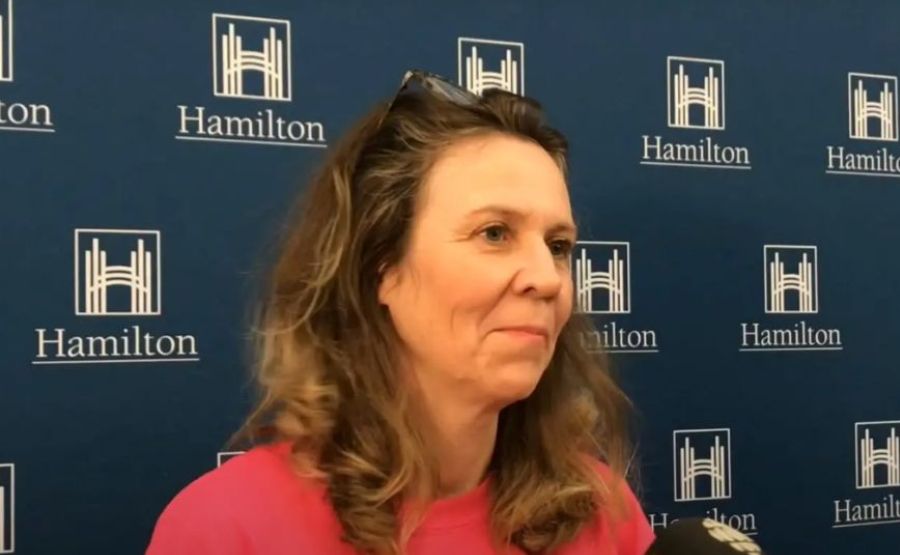
In a city that has spent decades arguing about how to build itself, Maureen Wilson chose a simpler argument: people should not die crossing the street. That conviction drove one of her most consequential acts in public life — and it tells you nearly everything about what kind of politician she is.
Wilson is the City of Hamilton’s Ward 1 Councillor, first elected in 2018 and re-elected in 2022 by a margin that left no ambiguity about how her constituents feel. She represents a ward bounded by the Niagara Escarpment, Hamilton Harbour, Cootes Paradise, and the Highway 403 corridor — a west-end, urban patch of roughly 29,850 residents that includes McMaster University, the Kirkendall neighbourhood, and the Chedoke-Cootes ecosystem.
She is not a politician who arrived from nowhere. She brought decades of civic experience with her. And yet, on council, she has remained something harder to maintain: independently minded.
Quick Bio
| Detail | Information |
| Full Name | Maureen Wilson |
| Role | Ward 1 City Councillor, City of Hamilton |
| First Elected | 2018 |
| Re-elected | 2022, with 75% of the vote |
| Ward | Ward 1 (Chedoke-Cootes), Hamilton, Ontario |
| Education | Master’s degrees in Urban Planning and Political Science |
| Professional Background | Urban planner; principal, UKSH; senior staff in Hamilton municipal government |
| Chief of Staff, City of Hamilton | 2000–2002, under Mayor Bob Wade |
| Office Address | 71 Main St W, 2nd Floor, Hamilton, ON L8P 4Y5 |
| Key Issues | Affordable housing, street safety, transit, climate, tenant rights |
| Committees (First Term) | Audit, Finance and Administration; Hamilton Board of Health; Affordable Housing Site Selection Sub-Committee; Advisory Committee for Immigrants & Refugees; LGBTQ Advisory Committee; Hamilton Centre for Civic Inclusion |
A City in Her Bones
Maureen Wilson did not arrive in Hamilton. She grew up there. The city shaped her, and she has spent the bulk of her professional life shaping it back.
She holds two graduate degrees — one in Urban Planning, one in Political Science — and built her career inside Hamilton’s local and regional government structures before ever running for elected office. She served as executive assistant to the regional chairman of Hamilton-Wentworth for three years. She held senior staff positions across Hamilton’s municipal apparatus.
When Bob Wade became Hamilton’s first post-amalgamation mayor in 2001, he chose Wilson as his Chief of Staff. She held that role for two years as the newly merged city — cobbled together from Hamilton, Ancaster, Dundas, Flamborough, Glanbrook, and Stoney Creek — tried to function as a coherent whole. It was a formative assignment. Wade’s task was to make people from different communities feel they had a stake in one shared city. Wilson watched that work up close.
She later described Wade, after his death in 2023, as someone who “brought a level of dignity to the office” and who believed that everyone had the right to be heard. It is not difficult to hear in that tribute a set of values she absorbed.
The Long Walk to Council
Wilson did not run for council immediately after leaving the mayor’s office. She spent years in the private sector as an urban planner and principal at UKSH, the planning firm. She stayed connected to the civic world through committees and school involvement, but she was not in the political arena.
In 2018, she entered the Ward 1 race. The ward was open — longtime Councillor Aidan Johnson was not seeking re-election — and 13 candidates competed to fill the seat. Wilson brought the most formal civic experience of any of them. She also brought a specific diagnosis of what Ward 1 needed: safer streets, functional transit, and housing that regular people could actually afford.
She won. And she got to work.
First Term: Building the Record
Wilson’s first term established her as one of Hamilton council’s progressive voices — but one grounded in professional knowledge rather than political posture. She sat on the Audit, Finance and Administration Committee, the General Issues Committee, the Hamilton Board of Health, and the Affordable Housing Site Selection Sub-Committee. She also participated in the Advisory Committee for Immigrants and Refugees, the LGBTQ Advisory Committee, and the Hamilton Centre for Civic Inclusion.
These are not ornamental appointments. They are where actual city business gets done, line by line and vote by vote.
Wilson also ventured into awkward ground about council governance during this time. Wilson spoke on the floor with extraordinary directness after the city’s Integrity Commissioner discovered that Ward 8 Councillor Terry Whitehead had harassed and intimidated city employees, including a transportation director with a “aggressive barrage of rapid-fire questions”. “For those who have been subjected to harassment and bullying, it eats into your pores,” she said. “You are in a constant state of fear.” Wikipedia’s account of the 2022 election describes Wilson calling the council’s eventual sanctions against Whitehead Hamilton’s “Me Too moment.” Council voted unanimously to support the commissioner’s findings.
Publicly, she was collegial and methodical. On issues of workplace abuse in the council chamber, she did not equivocate.
The Main Street Moment
The most visceral chapter of Wilson’s first term did not begin in a committee room. It began on Hamilton’s streets, where, through 2022, pedestrian after pedestrian was killed or seriously injured.
Main Street West — a five-lane, one-way artery running through the lower city — had long been identified in annual city reports as one of the most dangerous stretches of road in Hamilton for collisions, fatalities, and serious injuries. Year after year, staff documented the carnage. Year after year, little changed.
In May 2022, with 10 pedestrian deaths already recorded that year and public grief cresting into outrage, Wilson and Ward 3 Councillor Nrinder Nann brought a motion to council. Wilson and Nann framed the conversion not as a traffic study but as emergency action — their motion called it exactly what it was: an immediate safety intervention. “The question is, do we wait until we are compelled to do it, and while we wait, more people die?” Wilson said on the floor.
Outside city hall that day, protesters chanted “Hey hey, ho ho, killer streets have got to go.” Inside, the council voted 12 to 2 to approve the two-way conversion of Main Street.
The victory was real. What followed was slower than either Wilson or the public had hoped. By early 2024, city staff estimated construction would not be complete until 2028 — roughly six years after the motion passed. Wilson pushed back, asking employees to research a quicker schedule and equal-directional lanes instead of the two-east, one-west arrangement that detractors said was too similar to the status quo. Unofficial collision data suggested that interim safety measures had already cut crashes on Main by around 40 percent, which was meaningful, but the full conversion remained incomplete as this article was written.
The Main Street story is instructive. Wilson won the argument. The bureaucratic machinery moved at its own pace. That gap — between political will and implementation reality — defines much of city governance, and Wilson has navigated it with visible frustration.
Re-election: A 75 Percent Mandate
The 2022 municipal election offered voters a clear test of Wilson’s first term. Two challengers ran against her — Ian MacPherson, a mortgage agent who opposed the Main Street conversion, and John Vail, an accountant who had previously run in Ward 2 and whose ward residency during the Ward 1 campaign was questioned.
Wilson took 75 percent of the vote.
That number deserves a moment. Municipal elections rarely produce landslides. Ward 1 has an engaged, educated electorate — proportionally younger and better-educated than most Hamilton wards — and it did not give Wilson a soft margin. It gave her an instruction. “I have listened. I have learned. You want me to lead,” Wilson wrote in a post-election statement. “I am not infallible.”
That last clause is the honest part.
Housing: The Long Game
If street safety produced Wilson’s most dramatic moment, housing has consumed the most of her sustained attention. The problem is severe and well-documented. Hamilton lost approximately 16,000 modestly priced rental units — those priced at $750 per month or below — over the decade before 2024, as investors purchased aging rental stock and converted it to higher-margin units through renovations that displaced existing tenants.
Wilson has approached this through several channels. She supported the Affordable Housing Site Selection Sub-Committee in her first term. She has advocated for city-owned land to be used for affordable housing development, pushing back against council colleagues who blocked housing construction on city-owned parking lots in downtown Stoney Creek in 2024. She has supported bylaws against “renovictions” — the practice of displacing tenants through repairs and then hiking rents following displacement — which Hamilton adopted as part of a 2023 suite of tenant-protection measures.
Her 2022-2026 platform includes specific commitments: expanding the rental licensing pilot program city-wide, creating a family-friendly housing policy requiring a minimum percentage of three-bedroom units in new multi-family projects, and reinstating a housing-first encampment protocol. Hamilton adopted a target of 47,000 new housing units by 2031. Wilson has also acknowledged that the overwhelming majority of those units will come from private development — and that Hamilton ranked last out of 23 municipalities in land use approval times in a 2024 report. She named it a problem publicly rather than deflecting it.
On encampments specifically, Wilson has consistently argued that encampment policy does not cause homelessness and cannot solve it. The causes, in her framing, are structural: housing market conditions and decades of under-investment in public housing. When council voted 10 to 2 in 2021 to repeal the bylaw that had permitted encampments in public spaces, Wilson was one of the two dissenting votes.
She was also one of those who, by 2024, advocated for the city’s shift toward permanent housing investment over emergency protocols. The 2025 tax budget allocated $192 million for housing and homelessness programs. Wilson simultaneously pushed the province to fund its share, signing on to the Ontario Big City Mayors’ “Solve the Crisis” campaign.
Transit and the LRT Question
Hamilton’s proposed light rail transit line — a 14-kilometre corridor from McMaster University to Eastgate Square — has been one of the most contested infrastructure debates in the city’s recent history. Wilson has supported LRT consistently from her first campaign in 2018.
Her argument for transit reflects her planning background. She has framed accessible transportation as housing policy — affordable mobility is, she has argued, inseparable from housing affordability. People who cannot get to work on a bus cannot afford to live downtown. In a 2018 debate, she described looking at transit through a “gender-purposed lens” — noting that over 60 percent of transit users in Hamilton are women, and arguing for safer, better-lit transit stops as a basic equity issue.
She has opposed “area rating” for transit, a Hamilton practice in which residents of different parts of the city pay different rates for transit service — a policy she has called unfair. Her 2022-2026 commitments explicitly call for ending area rating.
Fiscal Conduct: The Small Signal
One small fact about Wilson’s time on council deserves mention because it says something real about how she operates.
As of a 2025 public disclosure, Wilson had made no expense claims for four consecutive years. Since her 2018 election, she had submitted claims only once — in 2020, to share the cost of a public lecture on the relationship between LRT and property tax. The annual remuneration and expenses report is a legal requirement in Ontario. Wilson’s entry showed nothing.
This is not a dramatic finding. But fiscal restraint at the councillor level, in a city where public trust in institutions is sometimes fragile, is a concrete expression of how she defines accountability. She named it publicly rather than waiting for someone else to.
Where She Lives and How She Works
Wilson and her husband raised three children in Ward 1, all of whom attended schools within the ward. She walks or bikes to work. She publishes a regular ward newsletter that covers everything from watermain replacements to tree bylaws to town hall recordings.
The newsletter is not a political document in the narrow sense. It is operational — it tells residents what is happening in their streets and parks and councils. It is also a form of accountability, because it creates a paper trail of commitments and updates that constituents can check.
Ward 1 covers the Kirkendall and Westdale neighbourhoods, runs along the base of the Niagara Escarpment, and borders Cootes Paradise — one of Hamilton’s most significant natural wetland areas. The ward’s ecosystem politics intersect with its housing politics and its transit politics in complex ways, and Wilson navigates all of them simultaneously.
A Politician Who Chooses Specific Fights
Wilson is not a councillor who avoids conflict. She voted against the 2021 encampment bylaw repeal when 10 of her colleagues voted for it. She pushed back publicly when the Main Street implementation timeline stretched toward 2028. She has described a colleague’s workplace bullying as something that “eats into your pores.” She has called housing development approval delays a problem her own city needs to own.
At the same time, she is careful with the fights she picks. Her dissents are grounded in policy positions, not personal grievances. Her public statements carry the precision of someone who spent years in government bureaucracy before moving into elected politics.
She is not uncomplicated. The gap between her housing commitments and what has actually been delivered reflects the structural limits of municipal governance — limits she has publicly acknowledged. She pushed for faster timelines. The timelines did not always accelerate.
The honest measure of a councillor is not whether every initiative succeeds. It is whether they chose the right things to fight for and fought for them honestly. By that measure, Maureen Wilson has an earned record.
Final Words
Maureen Wilson’s political career has been defined far less by headlines and more by stamina. From advocating for safer roads and affordable housing to promoting public transit and responsible governance, she has consistently focused on the problems affecting everyday life in Hamilton without delay. Her storied past in urban planning and municipal government gave her true technique for public providers, as well as earned her all the help and scrutiny of her desire to make a name for herself.
Every action she has taken has not progressed as quickly as she had hoped, and while the city’s biggest pressing situations remain unresolved, Wilson’s report shows a council member willing to deal with favorites to avoid them in difficult cases. Whether the problem is pedestrian protection, affordable housing, transit expansion, or social inclusion, she has built her reputation on consistent advocacy and policy-driven decisions.
As Hamilton continues to grow and evolve, Maureen Wilson remains one of the city’s most influential municipal voices, shaping conversations about what kind of network Hamilton wants to be and how to get there.
FAQs
1. Who is Maureen Wilson?
She is the elected City Councillor for Ward 1 (Chedoke-Cootes) in Hamilton, Ontario. She was first elected in 2018 and re-elected in 2022 with 75 percent of the vote in her second municipal election.
2. What ward does she represent?
Ward 1, an urban ward in Hamilton’s west end, bordered by the Niagara Escarpment, Hamilton Harbour, Cootes Paradise, and a green corridor near the former Dundas boundary. Its roughly 29,850 residents include McMaster University’s community and a higher-than-average proportion of younger and newcomer residents.
3. What is her educational background?
She holds two Master’s degrees — one in Urban Planning and one in Political Science. She was the principal of UKSH, a planning firm, and a professional urban planner prior to her council campaign.
4. What did she do before becoming councillor?
She held senior positions in Hamilton’s local and regional government structures, including serving as executive assistant to the regional chairman of Hamilton-Wentworth. From 2000 to 2002, she was Chief of Staff to Mayor Bob Wade, Hamilton’s first post-amalgamation mayor.
5. What is the Main Street two-way conversion and why does it matter?
In May 2022, Wilson and Ward 3 Councillor Nrinder Nann moved to convert Main Street from one-way to two-way traffic following a wave of pedestrian deaths and injuries. Council approved the motion 12 to 2. It was one of the city’s most significant street safety decisions in years, though the full construction timeline has extended toward 2028.
6. Why did she win 75 percent of the vote in 2022?
Her 2022 re-election result followed a first term focused on street safety, affordable housing, and progressive transit policy. Two challengers ran against her, and Ward 1’s engaged, educated electorate returned her with an overwhelming majority.
7. What is her position on affordable housing?
She has consistently prioritized building, acquiring, and preserving affordable housing. She has supported anti-renoviction bylaws, rental licensing programs, and city-owned land being used for affordable development. She has also acknowledged publicly that Hamilton ranks poorly on development approval timelines, calling it a problem that needs addressing.
8. What is her position on transit?
She is a consistent supporter of Hamilton’s proposed LRT line and of the city’s BLAST transit network. She has called accessible transit a form of housing policy, arguing that mobility and affordability are inseparable. She opposes Hamilton’s area-rating system for transit funding, which she considers inequitable.
9. What committees does she serve on?
During her first term she served on the Audit, Finance and Administration Committee, General Issues Committee, Hamilton Board of Health, Affordable Housing Site Selection Sub-Committee, the Advisory Committee for Immigrants and Refugees, the LGBTQ Advisory Committee, and the Hamilton Centre for Civic Inclusion.
10. Has she ever voted against the majority of the council?
Yes. In 2021, she was one of two councillors who voted against repealing the bylaw that permitted homeless encampments in public spaces. Her position was that the policy addressed a symptom rather than the structural causes of homelessness.
11. What does her expense record look like?
As of her March 2025 public disclosure, Wilson had made no expense claims for four consecutive years. Her only claim since 2018 was a shared cost for a public lecture in 2020. She has described fiscal responsibility with public funds as a core principle of her work.
12. Does she live in Ward 1?
Yes. Wilson and her husband raised their three children in Ward 1, all of whom attended schools within the ward. She walks or bikes to her office at Hamilton City Hall.
13. What is her current term running until?
Her second term, for which she was elected in October 2022, covers the 2022–2026 council period under Hamilton’s four-year municipal election cycle.
Explore more, learn more, and think deeper with Theory Magazine.