
Here’s a question that sounds dead simple — but the answer will actually surprise you.
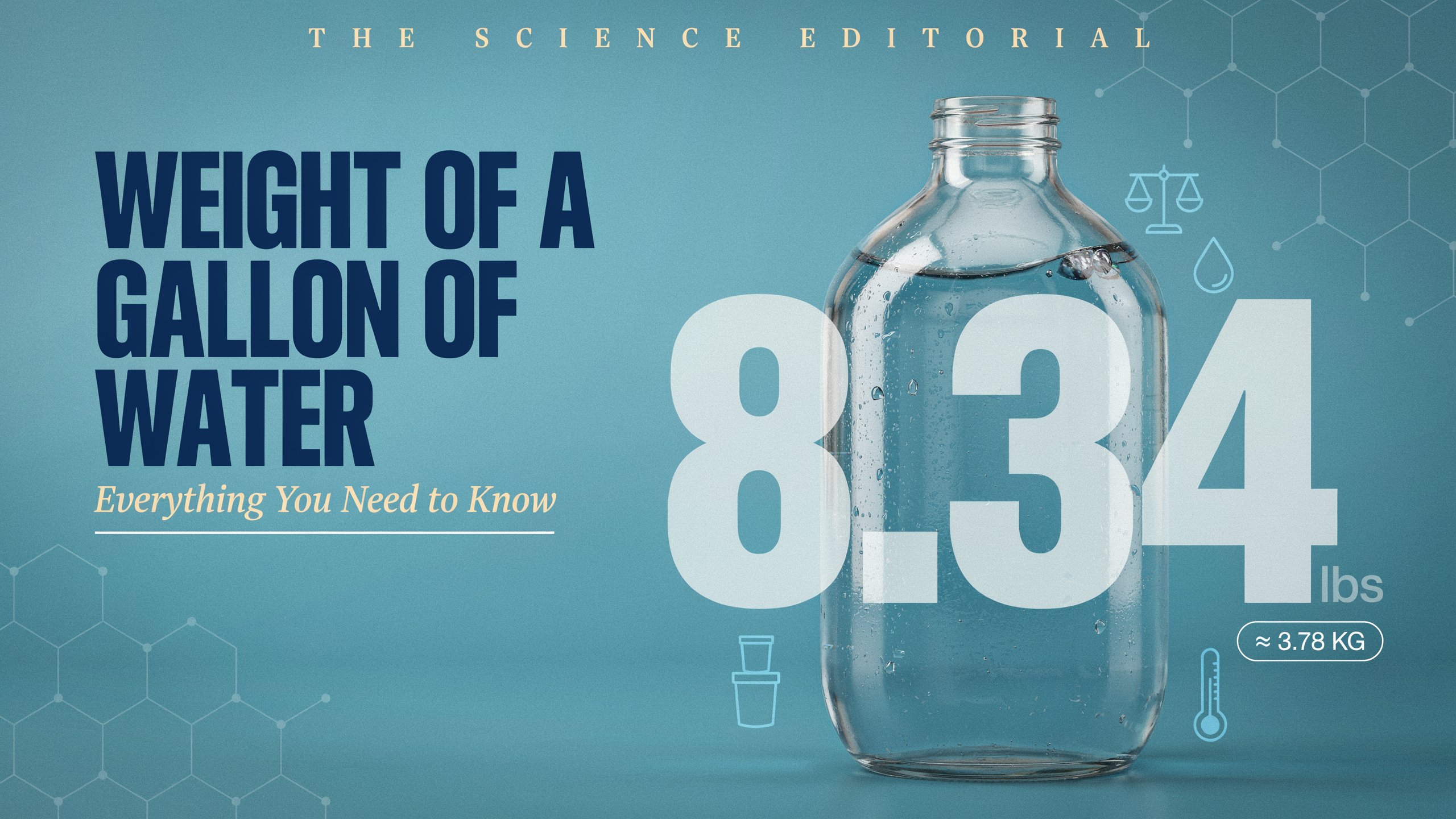
Pick up a gallon jug of water from your fridge. It feels heavy, right? Heavier than you expected, maybe. You just lifted 8.34 pounds without even thinking about it.
That number — 8.34 pounds — is the core answer. However, there is much more to it. Temperature changes it. Salt changes it. Whether you’re in America or the UK changes it. Even where you are on the planet technically changes it.
Let’s walk through all of it.
Quick Reference
| Volume | Weight (US) | Weight (Metric) |
| 1 US gallon | 8.34 lbs | 3.78 kg |
| 1 UK Imperial gallon | 10.02 lbs | 4.55 kg |
| 5 US gallons | 41.7 lbs | 18.9 kg |
| 10 US gallons | 83.4 lbs | 37.8 kg |
| 1 liter | 2.20 lbs | 1.0 kg |
| 1 cup (US) | 0.52 lbs | 236.6 g |
| 1 US gallon of seawater | ~8.56 lbs | ~3.88 kg |
| 1 US gallon at boiling (212°F) | ~8.00 lbs | ~3.63 kg |
The Basic Answer — and Why It Isn’t Perfectly Round
One US gallon of water weighs 8.34 pounds at room temperature. That’s 3.78 kilograms.
You might wonder why it isn’t a nice round number like 8 pounds. The answer is simple: nobody designed the gallon with weight in mind. A US gallon was defined as 231 cubic inches of space — that’s it. It was a volume measurement from the start, not a weight measurement.
So when someone eventually weighed 231 cubic inches of water, the answer came out to 8.34 pounds. A little awkward, but that’s the real number.
If you want a neater system, look at the metric side of things. One liter of water weighs almost exactly 1 kilogram. That clean relationship was built on purpose — the metric system was literally designed around water.
See also “Trace Walkthrough: Your Complete Guide to Escaping Every Room“
Does Temperature Really Change How Much Water Weighs?
Yes. And this is where things get genuinely interesting.
Think about what happens when you heat something up. The molecules inside start moving faster and spreading apart. When they spread apart, the same number of molecules takes up more space. More space for the same amount of stuff means lower density. And lower density means less weight per gallon.
So hot water weighs less than cold water. Not by a huge amount, but it’s real.
Here are the actual numbers side by side:
- At 39.2°F (4°C) — the coldest liquid water gets before ice forms — a gallon weighs about 8.345 lbs. This is water at its heaviest liquid state.
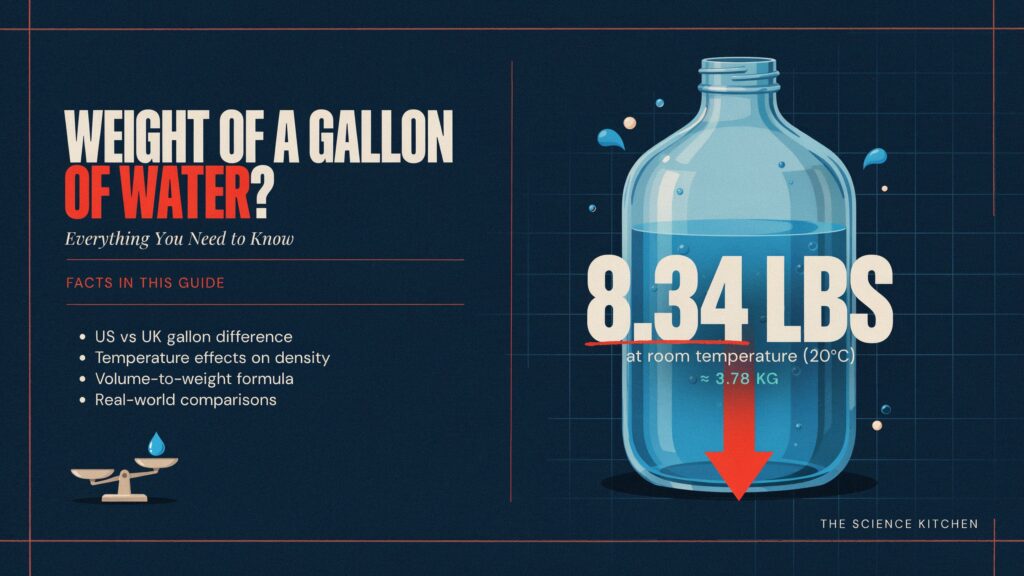
- At 68°F (20°C) — normal room temperature — a gallon weighs about 8.33 lbs.
- At 212°F (100°C) — fully boiling water — a gallon weighs only about 8.00 lbs.
That gap from coldest to boiling is roughly a third of a pound per gallon. For one jug, that barely matters. For 1,000 gallons in an industrial tank, that difference becomes 330 pounds.
Now here’s the weird part that trips everyone up: if you keep cooling water past 39°F and it starts to freeze, it actually gets lighter again. Ice floats on water. That seems backward, but it’s one of water’s most unusual and important properties. Almost every other liquid gets denser as it freezes. Water does the opposite.
The Sweetest Temperature Fact in Science
Water is densest at exactly 39.2 degrees Fahrenheit — or 4 degrees Celsius.
That specific temperature matters enormously for life on Earth. Here’s why.
When a pond or lake gets cold in winter, the water at the surface cools down first. Since that cooled water is denser, it sinks to the bottom. Warmer water rises to the surface. This keeps happening until the whole pond reaches about 39°F.
After that, the water near the surface cools below 39°F and starts to become ice. But now here’s the twist — that nearly-frozen water is actually less dense than the 39°F water below it. So it stays on top. Then it freezes solid into a lid of ice over the lake.
That ice lid acts like an insulating blanket. The water underneath stays liquid. Fish survive the winter. Life continues.
If water behaved like every other liquid, lakes would freeze solid from the bottom up. Almost nothing would survive winter in cold climates. The entire biology of cold regions would be different.
One temperature. One unusual property of water. Enormous consequences.
US Gallon vs UK Gallon — A Mistake People Make All The Time
This is where things get confusing fast, especially if you’re reading guides online without checking which country wrote them.
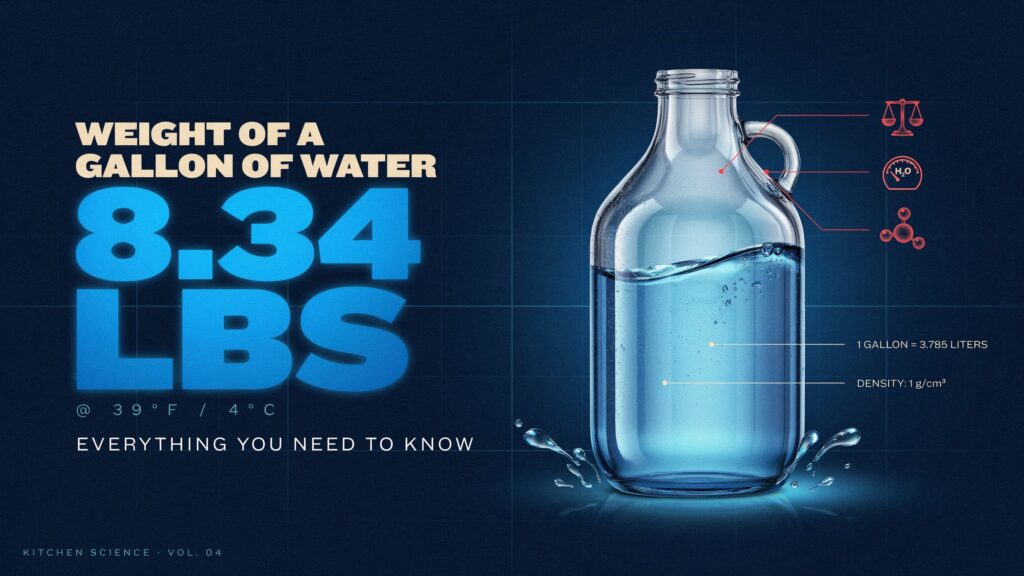
A US gallon holds 3.785 liters and weighs 8.34 pounds.
A UK Imperial gallon holds 4.546 liters and weighs 10.02 pounds.
That’s nearly a 20% difference in size and weight. These are not the same measurement wearing the same name. They are genuinely different units.
If you find a British aquarium guide that tells you “a 30-gallon tank weighs 300 pounds full,” and you’re working in US gallons, that calculation is off by almost 50 pounds. That matters if you’re worried about floor strength.
The US gallon was officially defined in 1824 as part of an effort to standardize measurements across American states. Britain developed their Imperial system separately. The two systems both kept the word “gallon” and both walked away with different values.
Always check. If you’re buying equipment, planning a water tank, or shipping liquids across borders, confirm which gallon you’re working with.
What Happens When You Add Salt to Water?
Ocean water doesn’t weigh the same as the tap water in your kitchen. That ocean water has salt dissolved in it — about 3.5% by weight on average. And that dissolved salt adds real, measurable mass.
A gallon of seawater weighs approximately 8.56 pounds. Fresh water at the same temperature weighs 8.34 pounds. That’s roughly a quarter-pound difference per gallon.
It might not sound like much, but it matters in several real situations:
- Floating in the ocean feels easier than floating in a pool. Seawater is denser, so your body displaces more weight per inch it sinks — meaning you float higher.
- Marine engineers designing ships or offshore platforms calculate buoyancy using saltwater weights, not freshwater weights. Get this wrong and a vessel sits at the wrong waterline.
- Reef aquarium owners need to monitor the salt content of their tanks constantly. Too much or too little salt changes the density — and that directly affects the animals living in it.
Hard tap water also weighs slightly more than distilled water, due to dissolved calcium and magnesium minerals. It’s a tiny difference — maybe 8.35 pounds versus 8.34 pounds — but in laboratory work, it’s enough to account for.
The Weight of Water in Real Life Situations
Let’s bring all these numbers down to earth with some real examples you might actually face.
The 5-gallon water jug: That standard blue jug sitting in your office water cooler holds 5 gallons. At 8.34 pounds per gallon, it weighs 41.7 pounds. If you’ve ever hauled one of those from a store to your car, that weight felt exactly right, didn’t it?
The 50-gallon water heater: Most homes have a water heater holding 40 to 50 gallons. A 50-gallon unit, when full, holds over 417 pounds of water — before you even count the weight of the tank itself. That’s why these things need solid floor support and proper installation. A poorly mounted water heater on a weak floor is a real structural risk.
A standard swimming pool: A residential in-ground pool holding roughly 10,000 gallons contains about 83,400 pounds of water. That’s over 41 tons. The soil around and beneath the pool takes on that entire load. Pool builders design around this number from day one.
A 10-gallon fish tank: Looks innocent on the shelf. But 10 gallons of water weighs 83.4 pounds, plus the glass, gravel, filters, and decorations. A “small” aquarium often tips the scale past 100 pounds total. That’s worth knowing before you put one on a wobbly desk.
Your daily water intake: Health guidelines often recommend drinking about half a gallon of water per day. That’s roughly 4.17 pounds of water flowing through your body every 24 hours. Thinking about it that way makes hydration feel more concrete.
Why Does Any of This Actually Matter?
Knowing water’s weight isn’t just trivia. People build things and plan things around it constantly.
Builders and engineers calculate water weight when designing rooftops, floors, and water storage systems. A flat commercial roof that collects rainwater during a storm can accumulate tens of thousands of pounds of water unexpectedly. Buildings have collapsed from exactly this.
Firefighters need to know how much water weighs when filling tanker trucks. A truck rated for 20,000 pounds can only carry about 2,400 gallons of water — get greedy loading the truck and you exceed safe weight limits on roads and bridges.
Farmers using irrigation calculate water weight when setting up pumping systems and pipes. Move too much water too fast and the pipes fail. Know your numbers and the system runs for decades.
Hikers and backpackers count every ounce in their packs. 2.2 pounds is the weight of a liter of water.Carrying 3 liters means carrying 6.6 pounds just in water. That’s not nothing over a 15-mile trail.
Shipping companies list liquid shipments by weight, not volume. A truck carrying 500 gallons of water is hauling over 4,100 pounds of product before you even count the containers.
Water Compared to Other Common Liquids
Water sits right in the middle of the weight range for common liquids. Some things are heavier per gallon. Some are lighter.
- Milk: about 8.6 pounds per gallon — slightly heavier than water because of dissolved proteins and fats
- Seawater: about 8.56 pounds — heavier due to salt
- Whole blood: about 8.7 pounds per gallon — heavier than water
- Gasoline: about 6.0 pounds per gallon — noticeably lighter than water
- Motor oil: about 7.5 pounds per gallon — lighter than water
- Honey: about 12 pounds per gallon — much heavier
- Diesel fuel is lighter, weighing roughly 7.1 pounds per gallon.
This comparison explains a few familiar things. Gasoline floats on water because it’s lighter. Oil doesn’t mix with water and sits on top for the same reason. When honey sinks in a glass of water, that’s density doing exactly what the numbers predict.
The Altitude Question — Does It Change Anything?
Here’s a question most people never think to ask: does water weigh less at the top of a mountain?
Technically, yes. At higher altitudes, Earth’s gravitational pull is slightly weaker. Weight is a measure of gravitational force acting on mass — so at higher elevation, gravity pulls a tiny bit less, and objects weigh a fractionally smaller amount.
In practice, this difference is so small it doesn’t matter for everyday use. A gallon of water on top of Mount Everest weighs about 0.3% less than a gallon at sea level. That’s about 0.025 pounds. You’d never feel it lifting the jug.
For everyday cooking, drinking, irrigation, or construction, you can safely ignore altitude entirely.
The Quick Mental Math Trick
Want to quickly estimate the weight of any amount of water without a calculator?
Round 8.34 to 8.3 pounds per gallon.
Then multiply:
- 2 gallons: about 16.6 lbs
- 5 gallons: about 41.5 lbs
- 10 gallons: about 83 lbs
- 100 gallons: about 830 lbs
- 1,000 gallons: about 8,300 lbs
For metric users, it’s even simpler. One liter equals one kilogram. Ten liters equals ten kilograms. Fill in any number of liters and the kilograms match it exactly. That elegance is deliberate — the metric system was designed specifically to work that way.
Common Myths Worth Clearing Up
Myth 1: “A gallon of water weighs exactly 8 pounds.” No. It weighs 8.34 pounds. Rounding down to 8 seems harmless, but across large quantities — a 500-gallon tank, for instance — that rounding error becomes 170 pounds. That’s the real weight that real structures have to hold.
Myth 2: “Hot water weighs more because it has more energy.” Wrong. Hot water weighs less per gallon than cold water, because the heated molecules spread out and take up more space. The same volume of hot water holds fewer molecules than cold water.
Myth 3: “Ice weighs less than water.” Also wrong. A cup of ice and the water it came from weigh exactly the same. Freezing changes the shape and density of water — it expands and becomes less dense — but freezing doesn’t remove any mass. Ice weighs less per unit of volume, but the same per unit of mass.
Myth 4: “A UK gallon is the same as a US gallon.” Absolutely not. The UK gallon is about 20% larger. This is a common mistake in internet searches, and it causes real errors in aquarium sizing, recipe conversions, and shipping calculations.
Final Words
A gallon of water weighing 8.34 pounds doesn’t sound dramatic. But that number sits at the center of everything from civil engineering to your morning hydration routine.
Water is heavier than most people expect when they think about it in large quantities. That 10-gallon fish tank is actually almost 100 pounds. That 50-gallon water heater holds more than 400 pounds. That pool in the backyard contains enough water to weigh more than a loaded semi-truck.
The temperature of water, the salt dissolved in it, and which country’s “gallon” you’re using all shift that number slightly. In small amounts, those differences barely register. In large systems — buildings, ships, trucks, reservoirs — they become critical engineering inputs.
Water is ordinary. It’s in your kitchen right now. But when you actually understand how it behaves, it turns into one of the most surprisingly complex and important substances in everyday life.
Next time you pick up that 8.34-pound jug from your fridge, you’ll think about it a little differently.
FAQs
1. What is the weight of a gallon of water?
One US gallon of water weighs 8.34 pounds (3.78 kg) at room temperature (about 68°F / 20°C). This is the standard number used in everyday calculations.
2. Does hot water weigh more or less than cold water?
Cold water weighs more per gallon. When water heats up, its molecules spread apart, taking up more space. More space for the same amount of water means lower density and lower weight per gallon. At boiling point, a gallon weighs only about 8.00 pounds — roughly a third of a pound lighter than cold water.
3. What is the heaviest a gallon of water can be?
Liquid water is heaviest at 39.2°F (4°C). At that temperature, a US gallon weighs about 8.345 pounds. Below that temperature, water starts moving toward freezing and actually becomes less dense again.
4. Why does ice float on water if they’re both H₂O?
When water freezes, its molecules lock into a crystal structure that takes up about 9% more space than liquid water. More space for the same mass means lower density — so ice floats. This property is almost unique to water among common substances.
5. How much does a UK Imperial gallon of water weigh?
A UK Imperial gallon holds 4.546 liters and weighs about 10.02 pounds (4.55 kg) at room temperature. That’s roughly 20% heavier than a US gallon because a UK gallon is simply larger.
6. Why is the weight of a gallon not a round number?
Because a gallon was defined as a volume — 231 cubic inches — not designed to produce a convenient weight. When you fill that volume with water and weigh it, you get 8.34 pounds. Nobody planned it that way.
7. Does saltwater weigh more than fresh water?
Yes. Seawater contains about 3.5% dissolved salt by weight, which adds measurable mass. A US gallon of seawater weighs roughly 8.56 pounds versus 8.34 pounds for fresh water.
8. How much does a 5-gallon water jug weigh?
About 41.7 pounds of water — plus the jug itself. The plastic container typically adds another pound or two, so a full 5-gallon office water jug weighs close to 43 pounds total.
9. Does water weigh less at high altitude?
Technically yes — by a very tiny amount. At high elevations, gravitational force is fractionally weaker, so the same mass weighs slightly less. For any practical, everyday purpose, this difference is too small to matter.
10. How much does a gallon of water weigh in kilograms?
About 3.78 kilograms for a US gallon. In the metric system, 1 liter of water equals 1 kilogram, so one US gallon (which is 3.785 liters) weighs almost exactly 3.785 kg.
11. Does mineral water or tap water weigh differently than pure water?
Slightly. Hard tap water contains dissolved calcium, magnesium, and other minerals. This raises its density a tiny amount — perhaps bumping a gallon from 8.34 to about 8.35 pounds. For most purposes, this is not detectable without precise instruments.
12. How much does 100 gallons of water weigh?
About 834 pounds (378 kg). This matters practically for anyone planning a large fish tank, a water storage barrel, or a rainwater collection system.
13. Is a gallon of water heavier than a gallon of milk?
No — milk is slightly heavier. A gallon of whole milk weighs about 8.6 pounds versus water’s 8.34 pounds. The difference comes from the fats, proteins, and sugars dissolved in milk that are denser than pure water.
14. How does water density compare to gasoline?
Gasoline is significantly lighter. A gallon of gasoline weighs about 6.0 pounds versus water’s 8.34 pounds. That’s why spilled gasoline floats on water rather than sinking.
15. How do I calculate the weight of any amount of water quickly?
Multiply the number of gallons by 8.34 to get pounds. For metric, multiply liters by 1 to get kilograms — it’s that clean. For large volumes, this mental math holds accurate within 1% at normal temperatures.
Explore more, learn more, and think deeper with Theory Magazine.