
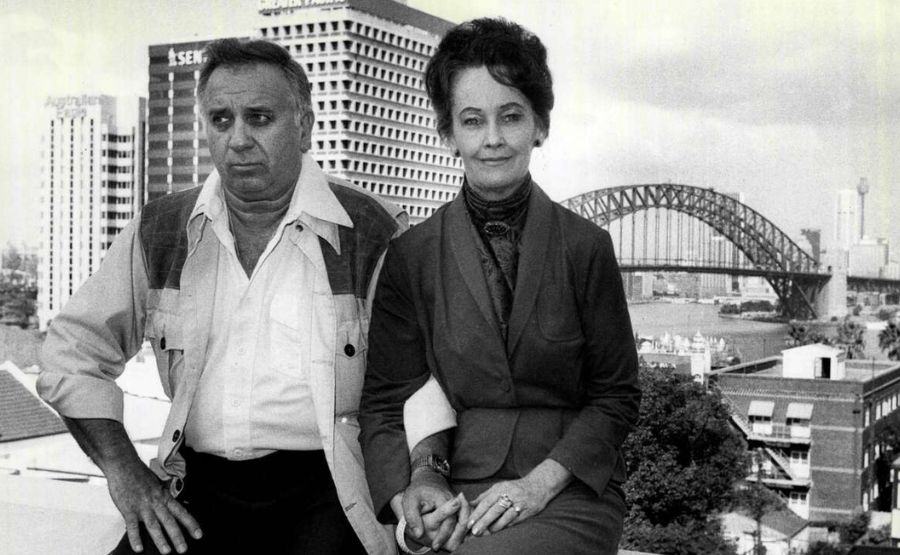
Every major Hollywood horror franchise of the last decade traces its roots back to one couple from Bridgeport, Connecticut. Ed and Lorraine Warren were not actors, not screenwriters, and not studio executives. They were paranormal investigators — and whether you believe every word they said or none of it, their impact on American culture is impossible to dismiss.
Quick Bio
| Detail | Ed Warren | Lorraine Warren |
| Full Name | Edward Warren Miney | Lorraine Rita Moran (Warren) |
| Born | September 7, 1926 | January 31, 1927 |
| Birthplace | Bridgeport, Connecticut | Bridgeport, Connecticut |
| Died | August 23, 2006 (age 79) | April 18, 2019 (age 92) |
| Resting Place | Monroe, Connecticut | Monroe, Connecticut |
| Married | May 22, 1945 | May 22, 1945 |
| Children | One daughter, Judy | One daughter, Judy |
| Roles | Demonologist, author, lecturer | Clairvoyant, light trance medium, author |
| Organization | New England Society for Psychic Research (NESPR), est. 1952 | Same |
| Total Cases Claimed | Over 10,000 | Over 10,000 |
| Religion | Devout Roman Catholic | Devout Roman Catholic |
Two Children From the Same Block
The story begins in Connecticut, where two children born less than a year apart grew up just three blocks from each other, seemingly unaware that their futures were already intertwined.
Edward Warren Miney came into the world on September 7, 1926. By his own account, his childhood was not ordinary. He claimed that at age five he witnessed the apparition of a deceased woman who had previously lived in his family’s home — a pinpoint of light that expanded until it took the shape of a human figure. Whether this was imagination or something else, the experience left a permanent impression. It also planted the seed of an obsession.
Lorraine Rita Moran was born three blocks away on January 31, 1927. Her early life was shaped by a strict Catholic upbringing — and by something she kept secret from her family. From the age of seven or eight, she said she could see auras surrounding people. She described colors around individuals that seemed to correspond to their character, their health, even their spiritual state. Telling her parents, she feared, would only convince them she was troubled.
Two children. One neighborhood. Two separate encounters with the unexplainable. And neither of them knew yet that those experiences would become the foundation of a shared career.
See also “Cindy Paulson: The Seventeen-Year-Old Who Stopped a Serial Killer“
A Movie Theater, a Marriage, and a War
In 1944, sixteen-year-old Lorraine Moran went to the Colonial Theatre in Bridgeport with her mother and two friends. The usher who showed them to their seats was a sixteen-year-old boy named Ed Warren.
Ed offered to walk the group home after the show. He offered to buy sodas. Lorraine ordered an ice cream soda, which cost five cents more than what he suggested. Ed later joked, with genuine warmth, that he always suspected she was a gold digger from that very moment.
It was a teenage romance that might have remained just that — except that Lorraine claimed something else happened on their first date. She said she experienced a vision: she saw Ed as a much older man, and she felt an immediate certainty that she would spend the rest of her life with him.
Within a year, Ed enlisted in the United States Navy as World War II escalated. His ship was sunk. He was granted thirty days of survivor’s leave and came home to Connecticut. He and Lorraine got married on May 22, 1945. They were both eighteen years old. On January 11, 1946, their daughter Judy arrived.
The Warrens had no money, no professional plan, and no roadmap. What they had was each other — and a shared fascination with houses where strange things were said to happen.
Paintings, Haunted Houses, and an Unusual Career Beginning
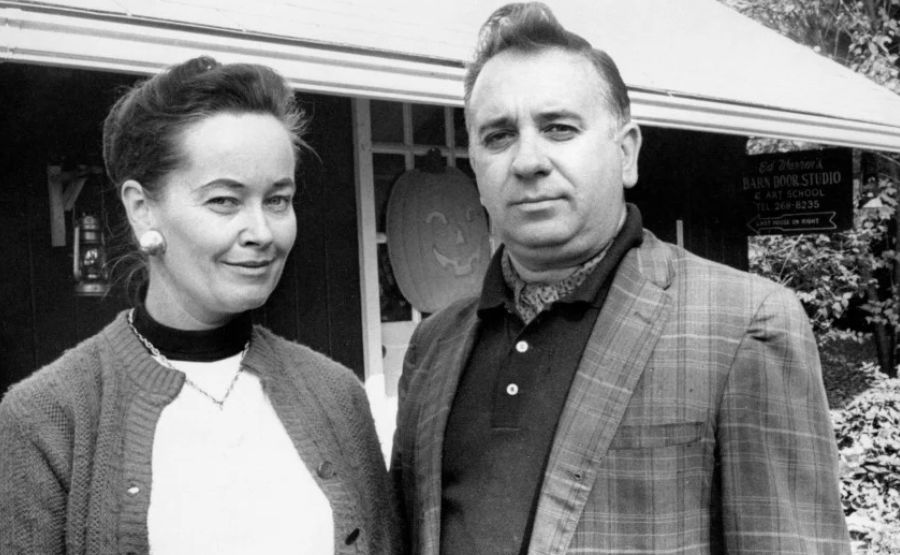
Before Ed became a demonologist, he studied art. After his Navy service, he worked briefly as a city bus driver in Monroe, Connecticut, and pursued painting as a possible profession. He sold landscapes to tourists across New England. But his eye kept drifting to a different kind of subject.
Ed began seeking out houses with reputations for haunting — finding them through newspaper reports and local gossip. He and Lorraine would drive to these properties, sketch them from the outside, then knock on the door. Their pitch was simple: they would offer the sketch in exchange for information about whatever the residents had experienced.
If the story was compelling, Ed painted the house in full and sold the artwork. They spent roughly five years crossing the United States this way — trading art for ghost stories, living cheaply, and building a mental library of reported supernatural events.
Lorraine, despite her lifelong sensitivity to auras, was not yet a true believer in ghosts. She initially suspected that many of the people they interviewed were either imagining things or manufacturing drama for attention. Her own conversion, as she described it, came gradually through repeated exposure — through cases that accumulated detail and corroboration until the skepticism became harder to maintain than the belief.
Building an Institution: The NESPR and the Occult Museum
In 1952, the Warrens formalized their work. They founded the New England Society for Psychic Research — known as NESPR — which became the oldest organized ghost-hunting group in New England.
The NESPR was more than a name on a business card. The organization brought in medical professionals, university researchers, members of law enforcement, and clergy to participate in or observe investigations. The Warrens believed that professional credibility required professional company, and they worked deliberately to ensure that others with formal expertise were present at their most significant cases.
That same year, Ed and Lorraine established the Warren Occult Museum in the basement of their home in Monroe, Connecticut. The collection grew investigation by investigation. A cursed necklace said to choke anyone who wore it. A self-playing piano. Human skulls. Religious artifacts confiscated from dangerous rituals. A copy of the Necronomicon. And, eventually, the item that would outlast everything else in the public imagination: a Raggedy Ann doll named Annabelle.
The museum operated as a public attraction for decades. It officially closed in 2019 following Lorraine’s death — shut not just by grief, but by local zoning regulations that had long complicated running a public exhibition in a residential neighborhood.
The Annabelle Case: How a Raggedy Ann Doll Became a Cultural Icon
In 1970, two young nurses in Hartford, Connecticut, reported that their Raggedy Ann doll was behaving strangely. It moved between rooms on its own. Notes written in a child’s handwriting — “help me” — appeared on scraps of paper. One of the nurses claimed she found the doll in positions it could not have assumed by itself.
A medium was consulted and told the women that the doll harbored the spirit of a deceased girl named Annabelle Higgins, who had died on the property years before. The women, moved by this, tried to welcome the spirit. The activity reportedly worsened.
When the Warrens arrived, Ed declared that the doll was not hosting a benevolent child spirit. It was, in his view, being used by a demonic entity to gain the trust of the nurses — a manipulation technique he described as a classic strategy of inhuman presences. He and Lorraine removed the doll, performed an exorcism, and placed it in the Occult Museum behind a locked glass case that bore a printed warning.
Critics pointed out — fairly — that there was no independent verification of any of the events surrounding Annabelle. No footage. No physical evidence. The entire story rested on the Warrens’ account and the nurses’ testimony. But the doll became, arguably, the single most famous artifact in paranormal history. The Annabelle film series alone has grossed hundreds of millions of dollars worldwide.
The Perron Family: Rhode Island, 1971
In January 1971, Roger and Carolyn Perron moved their family — including five daughters — into a large farmhouse in Harrisville, Rhode Island. The family reported unusual experiences from the beginning: objects relocating without explanation, smells that appeared and vanished, presences felt in empty rooms.
The Warrens investigated and concluded that the farmhouse was haunted by multiple entities, including the malevolent spirit of an accused witch from the early nineteenth century. The case continued for years. The Perron family eventually left the property in 1980, and their eldest daughter, Andrea Perron, later wrote extensively about the experience in a three-volume memoir.
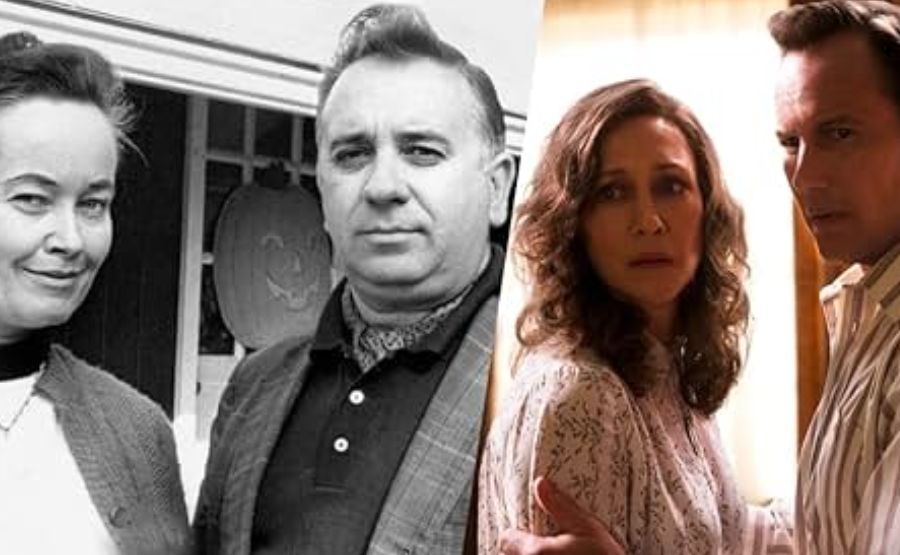
James Wan’s 2013 film The Conjuring dramatized this case and turned it into a global phenomenon. The movie earned over $319 million on a $20 million budget. It launched what became the most commercially successful horror franchise in cinema history — a universe worth more than $2 billion, encompassing nine films including The Nun, multiple Annabelle installments, and The Conjuring: Last Rites, released in September 2025.
Amityville: The Case That Changed Everything
No investigation shaped the Warrens’ public profile more decisively than Amityville.
In November 1974, twenty-three-year-old Ronald DeFeo Jr. murdered six members of his own family inside their home at 112 Ocean Avenue in Amityville, New York, using a rifle. The crime was horrifying enough on its own. What followed made it something else entirely.
In December 1975, George and Kathy Lutz moved into the house with their children. Within twenty-eight days, they fled. They described escalating supernatural events: disturbing visions, physical illness, objects moving, a demonic presence that seemed to attach itself to the family with particular ferocity.
In March 1976, a local television crew invited the Warrens to participate in a televised séance at the house. Other investigators present that night reported experiencing nothing unusual. Journalist Marvin Scott, who attended, later recalled his crew spending most of their time wondering when they could eat their sandwiches. Lorraine, however, described the experience as the closest she ever hoped to come to hell itself.
During this vacation, the Warrens never got to know the Lutz family. Their connection to the case was, at its core, a single televised event. Yet over subsequent years, they positioned Amityville as one of their central investigations — a cornerstone of their public identity.
The case has since been examined exhaustively by skeptics. The Lutz family’s account has been widely questioned, and some investigators have concluded that the haunting was substantially or entirely fabricated. The Warrens’ critics argued that they latched onto an already-sensational story and amplified it for professional benefit.
Their supporters argued that the couple genuinely believed what they were saying — and that belief, however unverifiable, was sincere.
“The Devil Made Me Do It”: The Arne Johnson Case
In 1981, Ed and Lorraine Warren became involved in a case with genuine legal stakes. Arne Cheyenne Johnson stood trial for the murder of his landlord in Brookfield, Connecticut. His defense attorneys attempted to argue that Johnson had committed the crime while in a state of demonic possession — influenced, they claimed, by a demonic entity that had first targeted an eleven-year-old boy named David Glatzel during an exorcism the Warrens had participated in.
It was the first time in American legal history that a defense of demonic possession was formally presented in court. The judge rejected it. Johnson was convicted.
The case nonetheless became one of the Warrens’ most widely discussed investigations — and eventually the basis for The Conjuring: The Devil Made Me Do It, released in 2021. David Glatzel’s brother Carl later disputed the Warrens’ account, filing a lawsuit and alleging that the couple had exploited his family’s genuine distress for financial gain.
The Enfield Poltergeist: A Case They Did Not Investigate
The Enfield Poltergeist of 1977 to 1979 is one of the most documented alleged hauntings in European history. In a council house in Brimsdown, north London, the Hodgson family — particularly two young daughters named Janet and Margaret — reported extraordinary phenomena witnessed by police officers, journalists, and researchers from the Society for Psychical Research.
Ed and Lorraine Warren traveled to England in 1977 to examine the case. What is less often mentioned in their public presentations is what happened when they arrived: the Hodgson family had not invited them, and the investigators already on site turned them away. The Warrens did not enter the house. They did not conduct an investigation. They observed from outside and returned home.
The Conjuring 2 portrays them as central figures in the Enfield case. The actual record shows a brief, uninvited visit that ended at the front door.
The Skeptics: Fraud, Blarney, and Contested Evidence
The Warrens attracted serious, sustained criticism throughout their careers — not only from casual detractors, but from trained investigators and credentialed researchers.
Perry DeAngelis and Steven Novella of the New England Skeptical Society examined the Warrens’ evidence and described it as worthless. Skeptical researchers Joe Nickell and Benjamin Radford investigated the Warrens’ best-known cases — Amityville and the Snedeker haunting in Southington, Connecticut — and concluded both had been invented, not experienced.
The Snedeker case produced a particularly damaging account. The Warrens had co-written a book about the Snedeker family haunting with horror author Ray Garton. Garton later stated publicly that when he raised concerns about the Snedekers’ contradictory and inconsistent stories, Ed Warren brushed them aside. According to Garton, Ed’s advice was straightforward: the family members were unreliable, so he should simply invent whatever details were needed to make the book sell.
Garton became one of the Warrens’ most vocal critics. His view of Lorraine, stated bluntly in an interview, was that he would not trust her to confirm basic facts.
The New England Skeptical Society concluded that the Warrens operated, at best, as entertainers telling meaningless ghost stories — and at worst as deliberate fraudsters who exploited frightened, vulnerable people for money and notoriety.
The Warrens disputed these characterizations throughout their lives. Lorraine in particular maintained until her death that every case they pursued was genuine, every entity they described was real, and their Catholic faith gave them both the moral authority and the spiritual protection to do the work they did.
The Darkest Chapter: Judith Penney and the Allegations of Abuse
In 2017, The Hollywood Reporter obtained sworn legal declarations and recordings from litigation surrounding The Conjuring franchise. What those documents described bore almost no resemblance to the devoted, faith-driven couple portrayed by Patrick Wilson and Vera Farmiga on screen.
A woman named Judith Penney stated under oath that in the early 1960s, when she was fifteen years old and Ed Warren was in his mid-thirties, he initiated a romantic and sexual relationship with her. Penney said she moved into the Warren household and lived there for approximately forty years. She described the relationship as involving physical and emotional abuse, including forced abortions.
She further alleged that Lorraine Warren was fully aware of the arrangement throughout its duration. According to Penney, Ed referred to her openly — including in front of Lorraine — as the love of his life. Publicly, the Warrens introduced Penney to others as a local girl they had taken in, describing her informally as a niece.
Penney was reportedly arrested in 1963 for residing in the Warren home, as Connecticut law at the time prohibited a single woman from living with a married man.
Lorraine Warren’s attorney stated that the family denied Penney’s characterization of the relationship. The attorney’s position was that the Warrens had opened their home to a young woman in need of support, not that they had concealed a decades-long affair.
Warner Bros., which built a multi-billion-dollar franchise on the Warrens’ image, became aware of the allegations within weeks of The Conjuring‘s release in 2013. The studio continued producing sequels that portrayed the Warrens as a conventionally faithful married couple.
These allegations were never tested in criminal court. Ed Warren died in 2006, before the sworn declarations became public. The truth of what happened inside that household remains contested. But the allegations exist on the public record, and any complete account of the Warrens must acknowledge them.
Faith, Method, and What They Actually Believed
Lorraine Warren and Ed Warren were devoted Roman Catholics. This was not a performative identity — it shaped every aspect of how they conducted their work.
They believed, explicitly and completely, that demonic forces were real, that they operated according to principles described in Catholic theology, and that faith was the primary protection against them. Ed carried a crucifix into every investigation. Lorraine used holy water. They regularly requested the presence of priests when cases involved suspected possession.
They also believed that possession was not random. In their view, demonic entities targeted individuals who had weakened or abandoned their faith — people who had dabbled in occult practices, used Ouija boards, or created spiritual openings through moral or spiritual collapse.
Whether this framework reflected genuine theological conviction or a convenient narrative that made their stories more dramatic is something only they could have known. What is clear is that they maintained it consistently over fifty years, in private and in public, until the end of their lives.
Ed Warren died on August 23, 2006, in Monroe, Connecticut, at the age of seventy-nine. He had suffered health complications in his final years that largely removed him from active investigation.
Lorraine Warren continued working — lecturing, consulting, and appearing publicly — until very close to her death. She passed away quietly on April 18, 2019, at age ninety-two, at the home in Monroe she had shared with Ed for most of their lives.
The Legacy: A Franchise, a Museum, and a Divided Verdict
Their son-in-law, Tony Spera, now leads the New England Society for Psychic Research. He spent decades working alongside both Warrens and was trained directly by them in their investigative methods. He serves as curator of the Occult Museum collection — which, though no longer open to public tours due to local zoning restrictions, remains under his custody in a secured location.
The Warren Occult Museum closed in 2019. Plans have been discussed for a properly zoned future facility, but no public venue has yet been established.
The Conjuring franchise they inspired has become the highest-grossing horror film series in history, surpassing $2 billion across nine films. Vera Farmiga’s portrayal of Lorraine earned the actress serious critical attention. Ed, played by Patrick Wilson, came to represent the moral, brave paranormal investigator in movies.
The students the Warrens trained — investigators including John Zaffis, Lou Gentile, and Dave Considine — built their own careers in the field. The Warrens created the template that made paranormal investigation a recognizable profession, inspiring television series, podcast industries, and amateur investigation groups across the English-speaking world.
Their critics — and the critics are numerous, credentialed, and serious — argue that this legacy is built on fabrication. That vulnerable families in crisis were fed dramatic narratives. That the evidence was weak or manufactured. That the public profile came at the cost of honesty.
Their defenders argue that the Warrens offered something that mainstream science could not: a framework for understanding experiences that fell outside the explainable. That the families they helped felt helped. That belief, even if unverifiable, has value.
Both arguments contain truth. That is the honest verdict.
Final Words
Ed and Lorraine Warren occupied a strange and contested territory in American life. They were neither the saintly heroes Hollywood made them, nor the cartoonish fraudsters their harshest critics described.
They were two people from the same Connecticut neighborhood who found each other young, built an unconventional life together, and spent fifty years at the intersection of genuine human fear and unanswerable questions. They produced evidence that skeptics dismissed and believers treasured. They wrote books that sold widely and were later questioned by the authors who helped write them. They were devout Catholics who allegedly maintained deeply un-Catholic arrangements in their private home. They trained a generation of investigators while facing accusations of exploiting the very families those investigators were meant to protect.
What remains — beyond the movies, beyond the museum, beyond the arguments — is that Ed and Lorraine Warren made tens of millions of people think seriously, if only briefly, about what might exist on the other side of what we can see and measure and confirm.
That is not nothing. In actuality, it is a significant amount.
FAQs
1. Were Ed and Lorraine Warren real people?
Yes. Edward Warren Miney and Lorraine Rita Moran Warren were real American paranormal investigators born in Bridgeport, Connecticut. They are not fictional creations. The Conjuring films dramatize real cases associated with their careers.
2. How many cases did the Warrens claim to investigate?
Over their five-decade career, they claimed to have investigated more than 10,000 paranormal cases — ranging from brief consultations to multi-year engagements.
3. What did Ed Warren actually do professionally?
Ed described himself as a self-taught demonologist — someone who studied demonic entities and their methods. He also lectured extensively at universities, wrote books, and co-founded the New England Society for Psychic Research in 1952.
4. Was Lorraine Warren a real psychic?
Lorraine claimed to be a clairvoyant and light trance medium who could see auras and sense spiritual presences. There is no scientific verification of these abilities. She maintained them as genuine throughout her life, and many families she worked with found her presence meaningful.
5. Did the Warrens actually investigate Amityville?
They attended a televised séance at the Amityville house in March 1976, but they never met the Lutz family and did not conduct a traditional investigation. The extent of their involvement has been significantly overstated in popular accounts.
6. Is the Annabelle doll real?
The original Annabelle is a Raggedy Ann doll, not the porcelain figure depicted in the films. It is stored in the Warren Occult Museum collection, currently under the custody of Tony Spera. The doll’s supposed activity has never been independently verified.
7. Were the Warrens criticized by other professionals?
Extensively. Investigators including Joe Nickell and Benjamin Radford concluded that the Warrens’ most famous cases were fabricated. The New England Skeptical Society characterized them as either meaningless storytellers or dangerous fraudsters. Horror author Ray Garton, who worked with them directly, publicly questioned their honesty.
8. What is the Judith Penney allegation?
Judith Penney stated in a sworn legal declaration that Ed Warren began a relationship with her when she was fifteen and he was in his mid-thirties, that the relationship lasted approximately forty years, and that Lorraine Warren was aware of it throughout. Ed’s family denied this characterization. The accusations were never put on trial in a criminal court.
9. What happened to the Warren Occult Museum?
The museum operated in the basement of the Warrens’ Monroe, Connecticut, home from 1952 until it closed in 2019 following Lorraine’s death. Local zoning restrictions prevented its continuation. The collection is now secured under Tony Spera’s custody and is not currently open to the public.
10. Who carries on the Warrens’ work today?
Tony Spera, who is married to the Warrens’ daughter Judy, now directs the New England Society for Psychic Research. He continues lecturing and investigating, and serves as curator of the artifact collection.
11. How much money has The Conjuring franchise made?
As of 2025, the Conjuring Universe — which includes nine films such as The Conjuring, The Nun, and the Annabelle series — has grossed more than $2 billion worldwide, making it the highest-grossing horror franchise in film history.
12. Did the Warrens have any formal academic or scientific credentials?
No. Ed was self-taught in demonology and held no academic degrees in theology, psychology, or any relevant science. Lorraine held no formal qualifications in psychology or parapsychology. Their authority rested on claimed experience, religious conviction, and decades of case files — none of which were subjected to peer review
Explore more, learn more, and think deeper with Theory Magazine.