Let me tell you something most people get completely wrong.
They think finding a job on LinkedIn means scrolling through job listings, clicking Apply, and waiting. That is like walking into a party, dropping your business card on the floor, and hoping someone picks it up.
LinkedIn is not just a job board. It is the biggest professional networking machine on the planet. And if you use it right, it does not just help you find jobs — it makes jobs find you.
Over 1 billion people are on LinkedIn right now. More than 58 million companies have profiles there. And more than 95% of recruiters use LinkedIn as their main tool to find new hires. That number alone should tell you something important: the people who can change your career are already looking. Your job is to make sure they can see you.
This guide will walk you through the whole thing — from getting your profile ready, to finding jobs, to writing that scary first message to a stranger. Step by step. No confusing jargon.
Quick Facts
| Feature | Detail |
| Platform Founded | 2003 |
| Total Members (2026) | Over 1 billion |
| Companies Listed | 58+ million |
| Recruiters Using LinkedIn | 95%+ |
| People Hired via Connections | 35.5 million and growing |
| Profiles with Photos | Get 21x more views |
| Interview Invites Sent | 122+ million through the platform |
| Response Rate: Personalized Msgs | 3x higher than generic ones |
| Best Time to Apply | Within 24 hours of posting |
| Free Job Search Limit | First 1,000 results per search |
Step One: Stop Applying and Start Preparing
Here is the honest truth nobody wants to hear.
Your LinkedIn profile is your first interview. A recruiter spends about seven seconds on your profile before deciding if you are worth their time. Seven seconds. That is less time than it takes to tie a shoe.
So before you touch the job listings, fix your profile. Everything else depends on this.
Start with your photo.
Profiles with a clear, professional headshot get 21 times more views than profiles without one. A fancy photographer is not necessary. You need good lighting, a clean background, and a friendly expression. That is it.
Then write your headline like your career depends on it — because right now, it does.
Most people write something like “Marketing Manager at ABC Corp.” That tells a recruiter almost nothing useful. Your headline is the most searched piece of text on your whole profile. LinkedIn’s algorithm gives it five times more weight than any other section.
Instead of your job title, put what you do and for whom. Think about it this way: if a recruiter types three words into LinkedIn’s search bar, would those three words appear in your headline?
A headline like “Digital Marketing Manager | B2B SaaS | Helping Teams Grow Revenue Through Content” is searchable, specific, and interesting. “Marketing Manager” is not.
Your tale takes place in the About section.
You have 2,600 characters in this section. Only the first 200 or so appear before someone has to click “See more.” Put your most important message in those first two lines. What do you do? What results do you create? Who do you help?
Write it like you are talking to a person, not a machine. Use simple, clear language. Drop in keywords naturally — the job titles, tools, and skills that recruiters in your field would search for.
Skills matter more than people think.
LinkedIn’s research shows that profiles with five or more relevant skills are 27 times more likely to appear in recruiter searches. Add your top skills. Then ask a few colleagues to endorse them. Endorsed skills carry more weight in search rankings.
Update your location.
This sounds so basic it feels silly to mention. But many people forget to update their city when they move, or they leave it blank entirely. Recruiters filter by location constantly. If your location is wrong or missing, you are invisible to half the people searching for you.
See also “Travel Itinerary Template Google Sheets: Your Complete Guide to Trip Planning That Actually Works“
Step Two: Turn On the Right Signal
Once your profile looks good, you need to let recruiters know you are looking.
LinkedIn has a feature called Open to Work. It puts either a green frame around your photo (visible to everyone) or a hidden signal visible only to people who pay for LinkedIn Recruiter licenses.
Here is the important part. If you are currently employed and do not want your boss to see that you are job hunting, choose the “Recruiters Only” setting. Over 900,000 recruiters use LinkedIn Recruiter daily. They will see your signal. Your current employer will not.
To turn it on, go to your profile page, click the “Open to” button, then select “Finding a new job.” From there you can choose who can see it.
You can also mention it directly in your headline. Many recruiters search for phrases like “open to opportunities” directly in the search bar. Having it in your headline makes it even easier to find.
One more thing. Some people worry that the “Open to Work” banner looks desperate. Recruiters mostly disagree. It is a practical signal that saves everyone time. Use it.
Step Three: Use the Jobs Tab the Smart Way
Now we get to the actual job searching part.
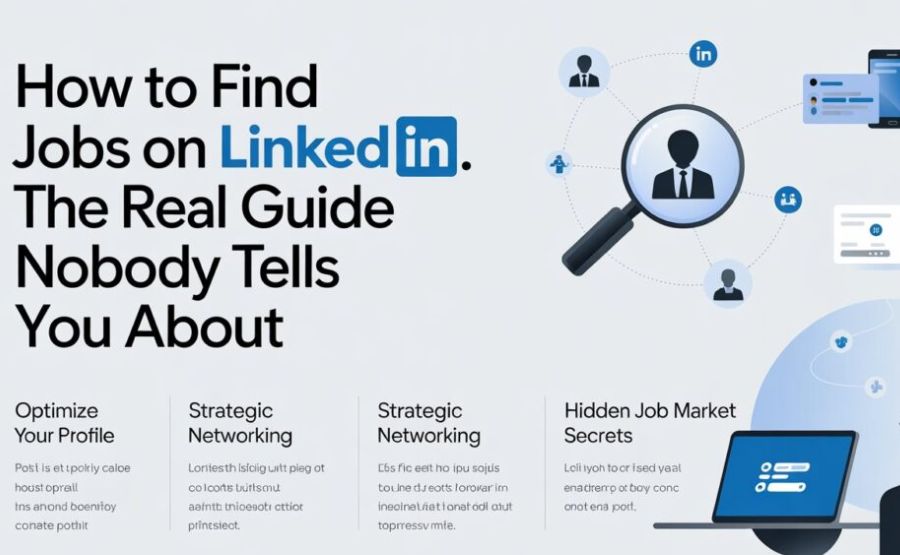
On your LinkedIn homepage, click the Jobs symbol at the top. You will land on a page with a search bar and a list of recommended jobs. The recommendations are based on your profile, so the better your profile is, the better these suggestions will be.
Type in a job title, a skill, or even a company name. Then use the filters — this is where most people give up too quickly.
Filters that actually matter:
- Date Posted: Set this to “Past 24 hours” when you can. The earlier you apply, the better your chances. If you apply two days after a job goes up, you might already be applicant number 500.
- Under 10 Applicants: This filter is gold. It shows you brand-new postings with almost no competition yet. Use it every morning.
- Easy Apply: This lets you apply directly on LinkedIn without visiting the company’s website. Good for speed. We will talk more about this in a minute.
- Remote / On-site / Hybrid: Self-explanatory, but use it. Do not waste time scrolling past jobs in the wrong format.
- Experience Level: Entry, Associate, Mid-Senior, Director. Set this to what actually matches where you are in your career.
Once you have filters set that work for you, save that search. LinkedIn will send you an alert every day or week when new matching jobs appear. Set your most important role as a daily alert. Set broader “just in case” roles as weekly.
Step Four: Boolean Search — the Secret Weapon
This part sounds scary. It is not.
Boolean search just means you can use simple words to make your searches smarter. Here is what that looks like in practice.
Type: “product manager” AND “remote” — this gives you results that include both those terms.
Type: “marketing” OR “growth” — this gives you results with either word.
Type: “developer” NOT “senior” — this removes results with the word “senior” so you only see entry or mid-level roles.
You can combine these. For example: “data analyst” AND (“remote” OR “hybrid”) NOT “senior” — that is a very targeted search that takes about ten seconds to build.
Most people on LinkedIn never do this. Which means the people who do have less competition on every single result page.
Step Five: Easy Apply vs. Applying Directly
When you find a job that interests you, you will usually see one of two buttons: Easy Apply or Apply.
Easy Apply means you can submit your application right there on LinkedIn. It pulls your profile information and lets you upload a resume. The whole thing takes under a minute.
Apply redirects you to the company’s own website, where you fill out a full application.
Here is the honest comparison.
Easy Apply is great for speed and volume. It is good for roles where lots of people are hired (customer service, sales, junior-level positions), when you are applying early, and when the job is a strong match for your existing profile.
It is not the best choice for senior roles, very competitive companies, or applications where you have something specific to say. For those, taking the extra ten minutes to apply directly on the company’s website often makes your application feel more deliberate.
One important rule for both: never send a completely generic application. Even with Easy Apply, you can upload a tailored resume. Personalize your first screen question answers. Mention the company by name if there is a text box. It takes two extra minutes and noticeably improves your results.
Step Six: Networking — the Part That Actually Gets You Hired
Here is a number worth sitting with.
According to Gem’s 2025 Recruiting Benchmarks, people who come through referrals or direct sourcing are about five times more likely to get hired than people who apply through job boards. Five times.
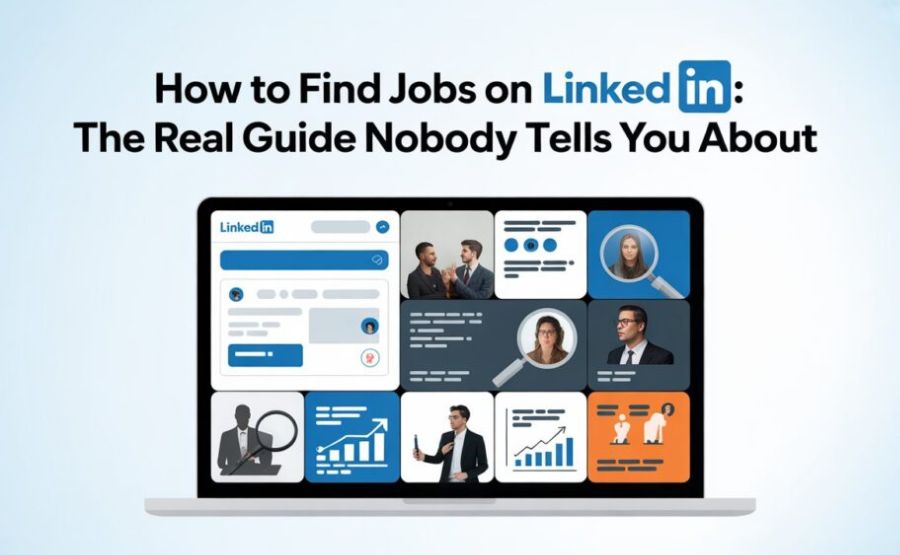
Networking on LinkedIn is not about asking strangers for favors. It is about building relationships before you need them.
Find people to connect with.
Go to the company page of a place you want to work. Click “People.” Browse the employees there. Look for people with titles like “Recruiter,” “Talent Acquisition,” “HR Manager,” or even the actual hiring manager for the department you want to join.
Do not just send a blank connection request. LinkedIn gives you 300 characters to write a note. Use them.
What to write in your message.
Here is the secret. Talk about them first. Mention something specific — a post they wrote, a project their company announced, a mutual connection, a shared school. Then introduce yourself in one sentence. Then make one simple ask.
Bad instance: “Hi, I am looking for a job and would love to connect.”
Good example: “Hi Sarah, I saw your recent post on scaling SaaS onboarding — I have been working on exactly that problem at my current company. I am exploring new opportunities and would love to connect and follow your insights.”
You completed your task, as seen in the second message. It is a compliment. It is specific. And it does not demand anything.
After you connect, do not immediately ask for a job.
That kills the relationship before it starts. Instead, engage with their posts. Leave a thoughtful comment. Share something useful. Give before you ask. When the time feels right — maybe a week or two later — you can send a follow-up message expressing genuine interest in their company and asking if they have five minutes to chat.
Step Seven: Post and Be Seen
You do not need thousands of followers for LinkedIn content to help your job search.
Even posting once or twice a week can significantly increase the number of times your profile appears in search results. LinkedIn’s algorithm rewards activity. A post from a small account that gets good engagement can reach thousands of people.
What should you post about? Things you know. Things you have learned. Problems you have solved at work. An article you read in your industry. A skill you recently picked up.
Keep it short. Be honest. Share something useful. That is the whole formula.
When recruiters look you up after seeing your application, they often scroll your recent activity. A profile with two recent thoughtful posts feels more real and more current than a profile that has been sitting untouched for two years.
Step Eight: The Follow-Up Nobody Does
Here is something that almost nobody does after applying on LinkedIn.
Find the recruiter or hiring manager. Send them a short, polite note saying you applied and you are genuinely excited about the role. Mention one specific thing about the company that interests you. Keep it to three sentences.
You are not being pushy. You are being memorable. Most applicants hit submit and disappear. A simple follow-up puts a face behind the application.
Wait about a week after applying before you send this. If you hear nothing after a week of that message, one final gentle follow-up is fine. Then let it go. Some people do not respond. That is normal. Do not take it personally.
LinkedIn Premium — Is It Worth It?
LinkedIn has a paid version called Premium, which costs about $30 per month.
It gives you InMail credits (the ability to message people you are not connected to), more search filters, and information about who viewed your profile.
Honest answer: it helps, but it is not required. The things that matter most — a great profile, active networking, smart search filters, and early applications — all work on the free version.
If you are deep in a job search and want to message people you are not connected to, a single month of Premium can be useful. But do not buy it thinking it will do the work for you. A mediocre profile with Premium is still a mediocre profile.
Final Words
Finding a job on LinkedIn is not a magic trick. It is a sequence.
First, make your profile worth finding. Second, turn on the right visibility signals. Third, search smartly using filters and saved alerts. Fourth, apply early and apply with some thought behind it. Fifth, build real connections before you need them.
The people who land jobs through LinkedIn are not the ones who apply to the most jobs. They are the ones who show up clearly, consistently, and like real human beings.
You have everything you need to start right now. Go update that headline. Set one job alert. Send one thoughtful connection message today.
One step at a time. That is all it takes.
FAQs
1. How do I start searching for jobs on LinkedIn?
Select the “Jobs” icon located at the top of your LinkedIn profile.Type a job title or skill into the search bar. Then use the filters — especially “Date Posted,” “Experience Level,” and “Remote/On-site” — to narrow down results to what actually fits you.
2. Do I need to pay for LinkedIn Premium to find a job?
No. The free version of LinkedIn includes everything most job seekers need — job search filters, saved searches, job alerts, and connection requests.InMail credits and more filters are provided by Premium, which can be useful but are not required. A strong profile and smart networking matter far more.
3. What is LinkedIn Easy Apply and should I use it?
Easy Apply lets you submit a job application directly on LinkedIn in under a minute. It is useful for applying quickly to roles that are a strong match. The risk is that it can tempt you to spray applications without thinking. Always customize your resume and any written answers, even when using Easy Apply.
4. What should I write in my LinkedIn headline?
Your headline should say what you do, who you help, and include the keywords a recruiter would search for. Instead of “Sales Manager,” try “B2B Sales Manager | SaaS | Helping Teams Hit Quota Through Consultative Selling.” Pack the most important words into the first 40 characters, because LinkedIn sometimes cuts the preview short.
5. How does the “Open to Work” feature work?
Go to your profile, click “Open to,” then “Finding a new job.” You can set it to be visible to everyone (green banner) or to recruiters only (hidden from regular users). If you are currently employed and do not want your boss to see it, choose “Recruiters only.”
6. How do I connect with a recruiter I don’t know?
Find them on LinkedIn by searching “[Company Name] recruiter” or “[Company Name] HR.” Send a connection request with a short, personalized note — 300 characters maximum. Mention something specific about them or their company, introduce yourself in one sentence, and make a simple ask like “I’d love to connect and follow your work.”
7. What is Boolean search on LinkedIn?
Boolean search lets you combine words to get smarter results. Use AND to require both words, OR to allow either, and NOT to exclude words. For example: “data analyst” AND “remote” NOT “senior” — this shows you remote data analyst jobs that are not senior-level.
8. How early should I apply after a job is posted?
As early as possible, ideally within 24 hours. Jobs that have been up for two days or more can already have hundreds of applicants. LinkedIn has a filter called “Under 10 Applicants” that helps you find the freshest postings with the least competition.
9. Should I message the hiring manager after I apply?
Yes, it can help. Find the recruiter or hiring manager on LinkedIn and send a brief, genuine note saying you applied and why you are interested. Keep it to three sentences. Do this about a week after applying. One polite follow-up after silence is fine. More than that becomes annoying.
10. Why is my LinkedIn profile not showing up in recruiter searches?
The most common reasons are: no keywords in your headline or About section, an incomplete profile, no skills listed, or an outdated location. Recruiters search by keywords, so if those words are not in your profile text, you simply will not appear. Update your headline, add relevant skills, and refresh your About section.
11. How many jobs should I apply to per day on LinkedIn?
Quality beats quantity every time. Applying to 3 to 5 well-matched jobs with a tailored resume will outperform sending 50 generic applications. Focus your energy on roles where you genuinely fit at least 70% of the requirements.
12. Can I use LinkedIn to find remote jobs specifically?
Yes. When you search for jobs, use the “Remote” filter under Work Type. You can also type “remote” directly into the search bar alongside your job title, like “remote content writer.” Setting up a saved search with the remote filter means new remote roles in your field arrive in your inbox automatically.
13. What should I post on LinkedIn to help my job search?
Share things you actually know — industry insights, lessons from your work, skills you are learning, or problems you have solved. You do not need to go viral. Even one or two thoughtful posts per week significantly increases the number of times your profile appears in searches.
14. Is networking on LinkedIn awkward?
Only if you start by asking for something. Begin by genuinely engaging with people’s content — leave a real comment, share something useful. When you do reach out, make it about them first. Most people respond warmly to personalized, respectful messages. The trick is to think of it as making a new professional friend, not hunting for a lead.
15. How do I know if my LinkedIn profile is optimized enough?
Go to your profile and click “View as public.” Read it like a stranger would. Does it clearly say what you do and what you are good at? Do the keywords in your headline match the jobs you want? Are your skills listed and endorsed? If someone spent seven seconds on your profile, would they understand who you are and what you offer? If the answer to any of those is no — fix that section first.
Explore more, learn more, and think deeper with Theory Magazine.