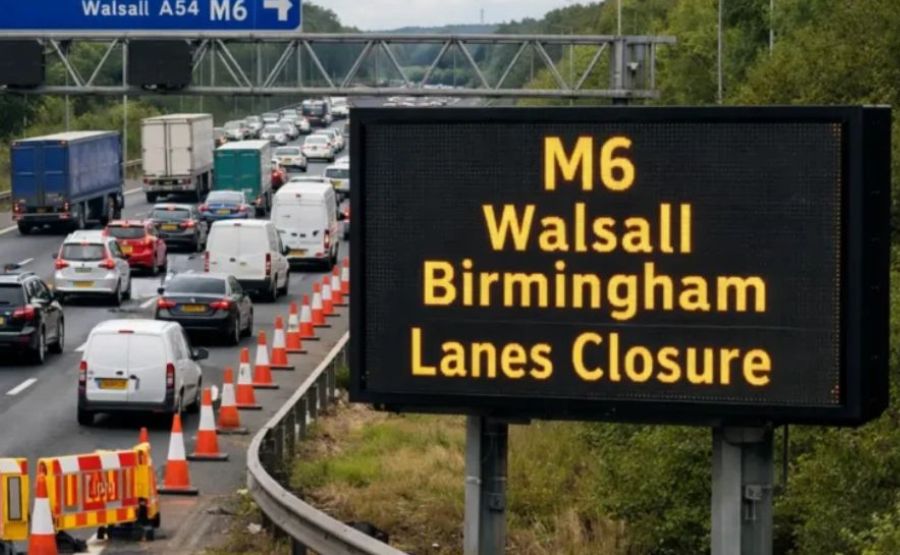
M6 Walsall Birmingham Lanes Closure: Everything Drivers Need to Know Right Now
Quick Facts at a Glance
| Detail | Information |
| Road | M6 Motorway |
| Key Stretch | Junction 6 (Birmingham) to Junction 10A (M54 link near Walsall) |
| Most Affected Junctions | J7 (Great Barr), J8 (Wednesbury/M5), J9 (Walsall), J10 (Walsall town) |
| Major Upgrade | Junction 10 improvement — started January 2020, completed March 2024 |
| Upgrade Cost | £78 million |
| Key Cause of Delays | Accidents, planned roadworks, bridge works, weather |
| Worst Recorded Delay | 90+ minutes (November 19, 2025 — 5-vehicle crash) |
| Responsible Body | National Highways West Midlands |
| Traffic Lights at J10 | Managed by Walsall Council |
| Alternative Routes | A34, A38, A454, M5, M6 Toll |
| Live Updates | National Highways (@HighwaysWMIDS on X), Google Maps, Waze |
Why This Road Matters So Much
Picture two of the busiest places in the English Midlands. One is Birmingham — the UK’s second-largest city. The other is Walsall — a busy industrial and commercial town just north of it.
Between them runs the M6. Every single day, thousands of people, lorries, vans, and delivery vehicles pour along that stretch. It is not just a road. It is the heartbeat of movement across the whole West Midlands.
When even one lane closes on this stretch, the knock-on effect spreads fast. Within minutes, queues build. Within half an hour, drivers eight miles back are sitting still wondering what happened. That is how sensitive this corridor is.
See also “The Ground Gave Way: The Full Story of the Riverbank Collapse Iford Playing Fields“
The Junctions You Need to Know
The M6 between Birmingham and Walsall has several key junctions. Each one is a busy meeting point of major roads, and each one has caused problems over the years.
Junction 6 is where the M6 meets the famous Spaghetti Junction interchange near Aston, Birmingham. Traffic coming from the city funnels onto the motorway here.
Junction 7 connects to the A34 near Great Barr. This is one of the main on and off points for people heading into north Birmingham and Walsall by local roads.
Junction 8 is the link between the M6 and the M5. When something goes wrong here, it does not just affect local drivers — it hits long-distance traffic heading across the country.
Junction 9 serves Wednesbury and is particularly tricky. The approach roads in this area are tight, and when this junction gets blocked, surrounding streets in Wednesbury and Walsall quickly fill up.
Junction 10 is Walsall’s main motorway junction. It is one of the busiest motorway junctions in the entire country. For years, it was also one of the most frustrating — and we will get to that story shortly.
Junction 10A is where the M6 meets the M54, the road that leads towards Telford and Wolverhampton. This link adds another wave of traffic into an already busy section.
The Big Story — The £78 Million Junction 10 Rebuild
If you drove through Walsall between 2020 and 2024, you will remember the misery. The traffic. The cones. The diversions that felt like they went around half the Black Country.
In January 2020, National Highways and Walsall Council started one of the biggest road projects in the region’s recent history. The goal was to completely rebuild and widen Junction 10 — the main M6 junction for Walsall.
The old junction was genuinely struggling. Bridges were narrow. Slip roads were short. Cars backed up onto the motorway. Local roads around Wolverhampton Road and the A454 were grinding to a halt every morning and evening.
The plan was ambitious. New wider bridges. Longer slip roads. Redesigned roundabout lanes. Better connections to the A454 and Black Country Route. The price tag? £78 million.
The estimated duration was two years. It took four.
Why Did It Take So Long?
Nobody planned for a global pandemic. When COVID-19 hit in early 2020, construction slowed dramatically.
Then came supply problems. Materials became harder to get. Prices went up. A subcontractor involved in the project actually went into administration — meaning the firm collapsed mid-work. That caused major delays while a replacement was found.
On top of all that, once workers dug deeper into the existing infrastructure, they found more problems than expected. Drainage systems needed fixing. Street light cabling had to be repaired. These were required extras; they weren’t optional.
National Highways put out multiple revised timelines. Each one pushed completion further back. Local residents and businesses around Walsall were patient for a long time. But frustration grew as the years ticked by.
The Finish Line — March 2024
Finally, in late March 2024, all temporary traffic management was removed from Junction 10. The project was officially complete.
A reporter from the Express & Star newspaper was dispatched to test drive the new intersection. Their verdict was mixed — less traffic than expected at 10am on a weekday was genuinely impressive. But one visitor from Wales described the new multi-lane roundabout as “a bit confusing” because of how many lanes there are now.
That is actually a fair comment. The junction is bigger and more capable than before. But bigger can mean more complicated for drivers who are not familiar with it.
National Highways confirmed they would keep monitoring the junction’s performance. Walsall Council continues to manage the traffic lights through the roundabout and adjusts their timings when needed.
Crash Incidents — The Human Cost of a Busy Road
Even with improvements finished, the M6 between Walsall and Birmingham keeps making the news. And not always for good reasons.
On November 19, 2025, a five-vehicle crash hit the northbound carriageway between Junction 8 and Junction 9 near Wednesbury. The accident happened at 6:24 in the morning — just as the rush hour was building.
Three cars, a lorry, and a van all collided. Two ambulances and a paramedic officer rushed to the scene. Two men were taken to Walsall Manor Hospital with injuries that were fortunately not considered life-threatening.
National Highways stopped all traffic on the motorway by 6:25am — just one minute after the crash was reported. By 6:49am, lane one reopened. But lanes two, three, and four stayed shut while vehicles were recovered and the carriageway was cleaned.
The result? Eight miles of queues. Delays stretching past ninety minutes. Thousands of drivers sitting in their cars wondering if they would ever get to work.
That is what one crash on this road can do.
Other Significant Closures in 2025
That November morning crash was not an isolated event. This stretch of motorway has seen a string of serious incidents.
Earlier in November 2025, two lanes were shut between Junction 10A and Junction 10 after a collision. Delays hit forty minutes and queues built rapidly before emergency services cleared the scene.
A particularly serious crash near Junction 10 involved a lorry and a motorcycle. The southbound carriageway was completely closed. All lanes remained shut until almost 11pm that night. Drivers heading south from Walsall had nowhere to go.
The M54 eastbound junction was also briefly closed during that same incident — showing how a single crash on the M6 can ripple outward and close connected roads too.
There was also a tragic fatality recorded on the stretch between Junctions 6 and 7, where a vehicle struck a barrier and a person died. Roads like this carry the weight of human stories every single day.
Planned Night Closures — When They Happen and Why
Not all lane closures are caused by accidents. Many are planned weeks in advance.
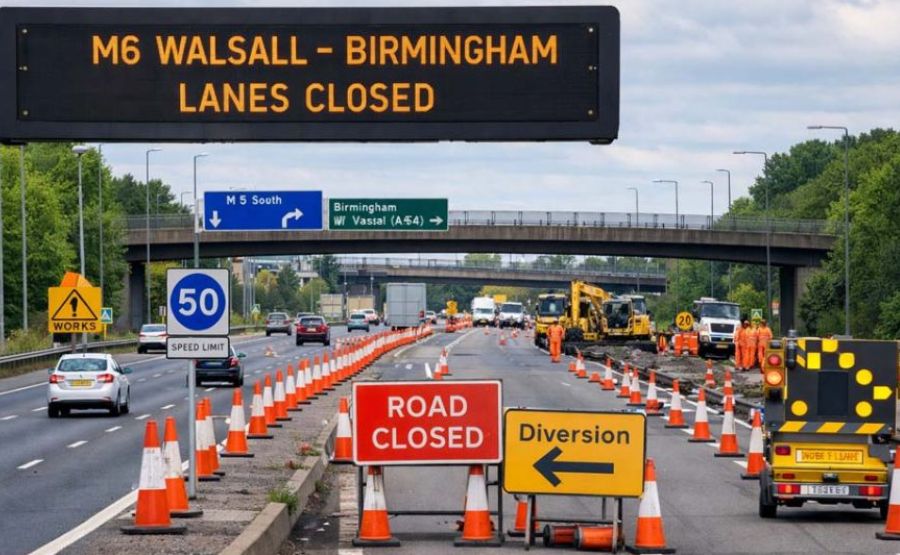
During the Junction 10 rebuild phase, National Highways used a pattern of overnight closures to carry out the most disruptive work when traffic was lightest. The southbound carriageway would close from around 9pm and reopen by 5am. Northbound closures followed similar patterns.
In late 2025, more overnight closures were scheduled on the southbound M6 between Junction 12 and Junction 10A. These ran from October 20 through to November 21 — a full month of nightly disruption. The reason was safety upgrades on the motorway structure itself.
Bridges on this stretch also require periodic maintenance work. National Highways has carried out bridge joint replacement programmes on sections between Junction 6 and Junction 7. These types of works need the road beneath to be clear, which means lane closures or full overnight shutdowns.
The pattern is the same every time. Work happens at night to protect drivers. Diversions are signed. And by morning, the cones come down and normal traffic resumes — until the next night.
What Happens to Traffic When Lanes Close
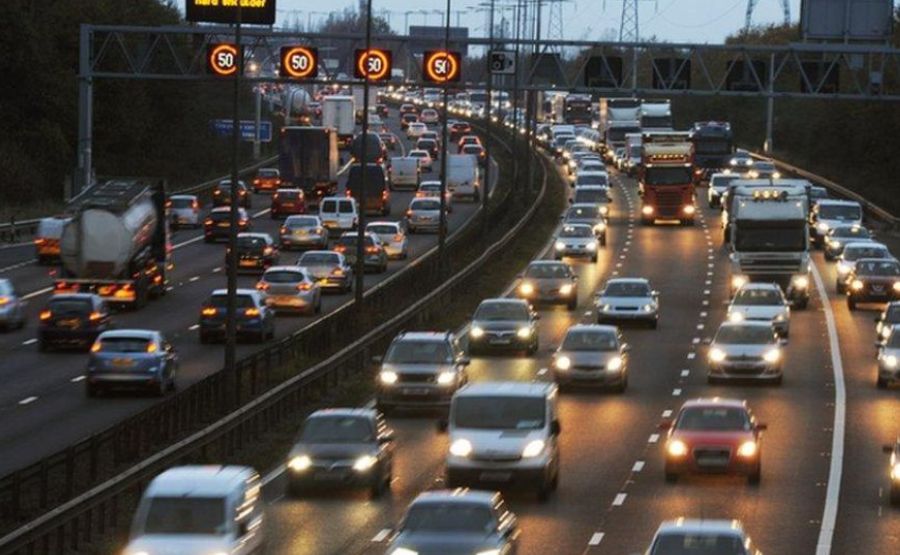
Most people have felt this. You are driving normally and then suddenly everything slows to almost nothing. You crawl forward for twenty minutes. Eventually you see cones. One lane. Everyone is squeezing together.
On a normal day, this stretch carries enormous volumes of vehicles. When it drops from four lanes to two, or two lanes to one, the maths is brutal. Cars that were doing 60mph suddenly do 10mph. The queue behind grows faster than the queue moves forward.
During morning rush hour — roughly 7am to 9am — this can stretch for miles in minutes. Evening rush hour, from around 4pm to 6:30pm, is equally bad. Add a crashed vehicle to either of those windows and you have a genuinely difficult day for tens of thousands of drivers.
Lorries suffer too. One important freight route is this area. When a lorry is delayed for ninety minutes, the goods it is carrying arrive late. Supermarkets, warehouses, factories, and businesses all feel that ripple effect.
Alternative Routes — What Actually Works
When the M6 is blocked, where do you go? Here are the realistic options.
The A34 runs from Junction 7 towards Walsall town centre and then connects to the A454. It is the most natural local diversion. But it fills up fast when everyone has the same idea.
The A38 runs south into Birmingham and can help drivers heading into the city avoid the worst of motorway gridlock.
The A454 (Black Country Route) connects Walsall to Wolverhampton and crosses over Junction 10. It becomes extremely busy when the motorway is disrupted.
The M5 is useful for drivers who need to get around Birmingham from the west. But when M6 and M5 are both under pressure at Junction 8, the M5 backs up too.
The M6 Toll is perhaps the most effective escape route for many drivers. It runs parallel to part of the M6 and generally stays much quieter because of the fee. It costs money. But on a day when you are already ninety minutes late, paying a few pounds to bypass the chaos feels very reasonable.
The honest truth is that no diversion route is perfect. When thousands of drivers all leave the M6 at the same time, every alternative road feels the pressure too. The side streets around Wednesbury, Walsall town centre, and West Bromwich all end up busier than they should be.
How to Stay Informed Before You Drive
The single best thing you can do before driving this stretch is check live traffic information.
- National Highways (@HighwaysWMIDS) on X (formerly Twitter) posts real-time updates on closures and incidents.
- Google Maps and Waze both show live traffic conditions and will automatically suggest alternative routes when incidents are detected.
- BBC WM and local radio broadcast traffic news during morning and evening commutes.
- The National Highways website lists all planned closures in advance, usually with dates, times, and diversion information.
- Walsall Council’s one.network map shows local roadworks that could affect your diversion route — useful if you are planning to go through town to avoid the motorway.
Checking these before you leave takes two minutes. It can save you ninety.
Smart Tips for Regular Commuters on This Route
If you drive this stretch every day, here are some things that genuinely help.
Leave earlier than you think you need to. The worst queues build between 7:30am and 8:30am. Getting on the road at 6:45am often means the difference between a smooth journey and a miserable one.
Save your alternative routes in your sat-nav in advance. Do not try to figure out the diversion while you are already stuck in traffic. Know your A34 route before you need it.
Keep your fuel tank topped up. Being stuck in a queue with low fuel adds stress you do not need.
If you use this road for deliveries or freight, let your customers know about potential delays. Managing expectations saves a lot of frustration on both sides.
And if you spot a queue forming ahead, move to the appropriate lane early and calmly. Late lane changes in motorway queues cause secondary crashes.
What the Future Looks Like for This Stretch
The Junction 10 rebuild is done. But the M6 between Walsall and Birmingham is not finished evolving.
National Highways continues to review the performance of Junction 10 and will adjust traffic light timing as needed. Further finishing and landscaping work was planned for areas around the junction following the main build’s completion.
The A34 Sprint project — a bus priority corridor linking Walsall with central Birmingham — is also progressing. It will affect travel patterns on local roads that many drivers use as M6 alternatives.
The bigger picture for motorway management in the UK is moving towards smart motorway technology — variable speed limits, lane control signs, and automated incident detection. Some of this is already in place on other sections of the M6.
What that means for drivers is better real-time information, faster response to incidents, and hopefully smoother flow — even when things go wrong.
Final Words
The M6 between Walsall and Birmingham is not just tarmac and white lines. It is the route millions of people depend on every single day to get to work, deliver goods, and visit family.
Lane closures here are not just an inconvenience — they ripple out across an entire region. They make workers late, delay deliveries, and raise stress levels for thousands of people at once.
The £78 million Junction 10 rebuild was a long, painful, expensive improvement. But it was needed. And now that it is done, the junction can handle more traffic more smoothly than it ever could before.
The accidents, the planned works, the overnight shutdowns — they are all part of managing one of the busiest roads in England. The key is knowing what to expect, checking before you travel, and staying patient when things do go wrong.
Because on the M6 between Walsall and Birmingham, something will always eventually go wrong again. That is not pessimism. That is just what happens on a road this busy.
The drivers who handle it best are the ones who are prepared.
FAQs
1. Which junctions are most affected by lane closures between Walsall and Birmingham?
Junctions 8, 9, 10, and 10A see the most frequent disruptions. Junction 10 at Walsall was the focus of a £78 million rebuild and still generates occasional incidents.
2. How long can delays last when lanes close on this stretch?
Minor incidents can cause 20 to 40-minute delays. Serious multi-vehicle crashes have caused delays exceeding 90 minutes, as seen in November 2025.
3. What caused the Junction 10 Walsall upgrade to take four years?
COVID-19, material shortages, a subcontractor going into administration, and additional underground repair work all pushed the completion date back repeatedly from the original 2022 target.
4. How much did the Junction 10 Walsall improvement cost?
The project cost £78 million, funded jointly by National Highways and Walsall Council as part of the region’s transport plan.
5. Who manages the traffic lights at Junction 10?
Walsall Council operates the traffic signal system at Junction 10, while National Highways maintains the motorway itself.
6. What is the best alternative if the M6 is closed near Walsall?
The A34 and A454 are the most commonly used local diversions. The M6 Toll is the most effective option for bypassing a large section of the motorway, though it charges a fee.
7. Are there night closures planned on the M6 near Walsall regularly?
Yes. National Highways uses overnight windows (typically 9pm to 5am or 6am) to carry out maintenance, bridge work, and safety upgrades with minimal impact on rush-hour traffic.
8. Does closing one lane really cause that much disruption?
Yes. The volume of vehicles on this stretch means even losing one of four lanes creates an immediate and significant bottleneck. During rush hour, this can back up for several miles within minutes.
9. How do I find out about planned closures in advance?
National Highways publishes planned closure schedules on their website. Their @HighwaysWMIDS account on X also provides advance notice and real-time updates.
10. Does the M6 Toll help during closures?
Yes, significantly. The Toll road runs alongside part of the main M6 and carries far less traffic. It is a genuinely useful option when the main motorway is blocked, though it costs money to use.
11. What should lorry drivers and freight companies do during closures?
Check live traffic updates before departure, plan alternative routes in advance, and communicate potential delays to customers early. The A34, A38, and M5 are all feasible alternatives depending on destination.
12. Are incidents near Junction 9 Wednesbury common?
Indeed. Junction 9 is frequently closed due to incidents and serves a busy neighborhood. The approach roads around Wednesbury are narrow, which means even minor traffic incidents can cause wider disruption.
13. Does the A34 Sprint bus project affect traffic near the M6?
It can. The Sprint project is creating a dedicated bus corridor on the A34 between Walsall and Birmingham. Changes to that road could affect how useful it is as an M6 diversion.
14. What happens to the eSIM — sorry, what happens when the M6 is fully closed rather than just lane restrictions?
When the full carriageway is closed, official diversion routes are signed using blue diversion symbols. These typically route traffic through Junction 9 or Junction 7 depending on direction, using A-roads like the A461, A4148, and A454 to rejoin the motorway at the next available junction.
Explore more, learn more, and think deeper with Theory Magazine.