Let me tell you a story that starts with a patent attorney, a personal blog, a heated Facebook argument, and a chart that eventually reached millions of people across the globe.
Most tools that change how people think about news are built by journalists or academics. This one was built by a lawyer who got tired of watching people shout at each other online and decided to draw a picture instead.
That picture became the Media Bias Chart. And once you see it, you start looking at your daily news in a completely different way.
Quick Facts
| Fact | Detail |
| Creator | Vanessa Otero |
| First published | December 2016 |
| Where it first went viral | Imgur (image-sharing platform) |
| Company behind it | Ad Fontes Media, Inc. |
| Company founded | 2018 |
| What “Ad Fontes” means | Latin for “to the source” |
| Company type | Public Benefit Corporation, Colorado |
| Vanessa’s background | Patent attorney; B.A. English from UCLA, J.D. from University of Denver |
| Number of analysts today | 40+ trained human analysts |
| Sources rated so far | Over 3,900 (articles, TV shows, podcasts, websites) |
| Chart updated | Static version twice a year; interactive version updated continuously |
| Available on | Website, interactive tool, iOS and Android app |
| Current version (as of early 2025) | Version 13.0 |
The Story Behind the Chart — It Started With a Facebook Fight
In 2016, something strange was happening online. People weren’t just disagreeing about politics anymore. They were disagreeing about the very facts they were reading.
One person would share a news story. Another would immediately fire back with a completely different story. Both would insist theirs was real news and the other was fake. Nobody was budging.
Vanessa Otero was watching all of this unfold on Facebook during the 2016 U.S. election season. She wasn’t a journalist. She was a patent attorney in Denver, Colorado — someone whose entire career centered on reading carefully, spotting inconsistencies, and breaking down complicated information in a logical way.
She decided to do what lawyers do. She made a map.
She wanted a way to show people visually that not all news sources are equal — and that “bias” and “unreliable” aren’t actually the same thing. So she drew a grid. A chart. A simple, color-coded picture.
She put it on her personal blog, a blog she called “All Generalizations Are False.” And then, in December 2016, someone posted it to Imgur, a site where people share images.
The chart exploded. Millions of people saw it. They argued about it, agreed with it, questioned it, and shared it everywhere. A personal project from a Denver lawyer had suddenly touched something millions of people were hungry for.
Two years later, Otero founded Ad Fontes Media — a company built entirely around keeping that chart alive and making it more rigorous, more reliable, and more useful.
See also “Glasgow Water Main Break Shettleston Road: Fully Explained“
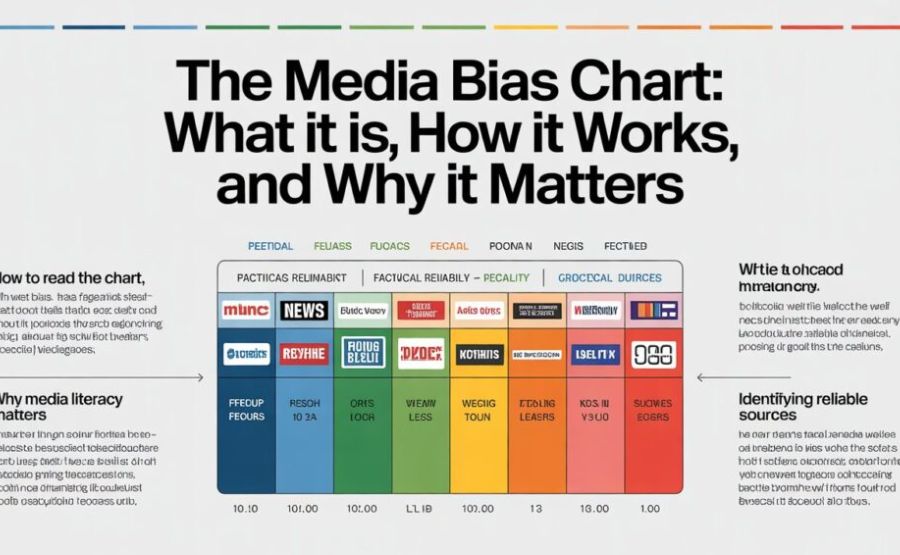
What the Chart Actually Shows
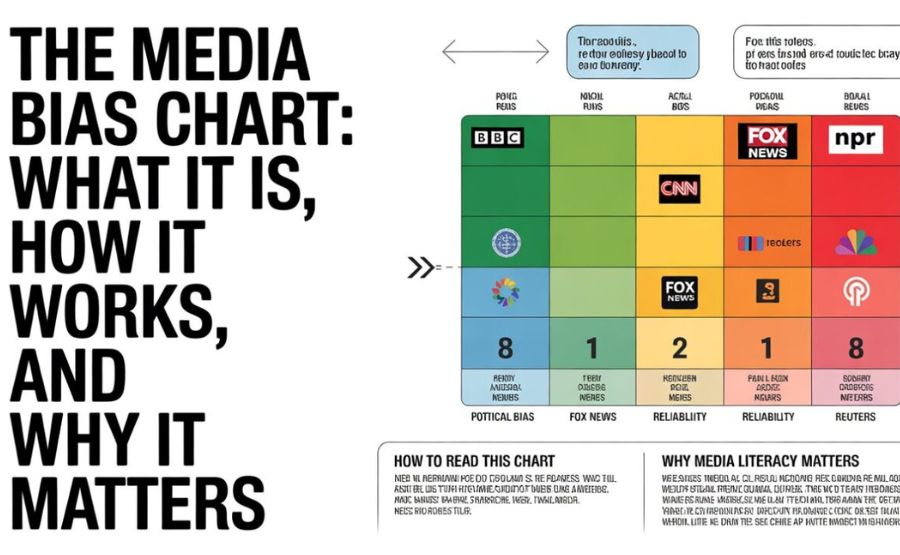
The chart looks like a grid. But it’s really telling you two separate things at once, which is why it’s so useful.
The left-right axis running across the bottom of the chart shows political lean. How far left or right does a news outlet tend to pull? All the way on the left you find hyper-partisan left-wing sources. All the way on the right you find hyper-partisan right-wing sources. Sources near the middle lean center or show only a slight tilt in either direction.
The up-down axis shows something different entirely. It measures reliability. How good is the actual journalism? Are the stories based on verified facts? Do headlines match what the articles actually say? Are sources cited properly?
At the very top of the chart sit sources producing original, fact-checked reporting. At the very bottom sit sources producing made-up content — fabricated stories or outright propaganda.
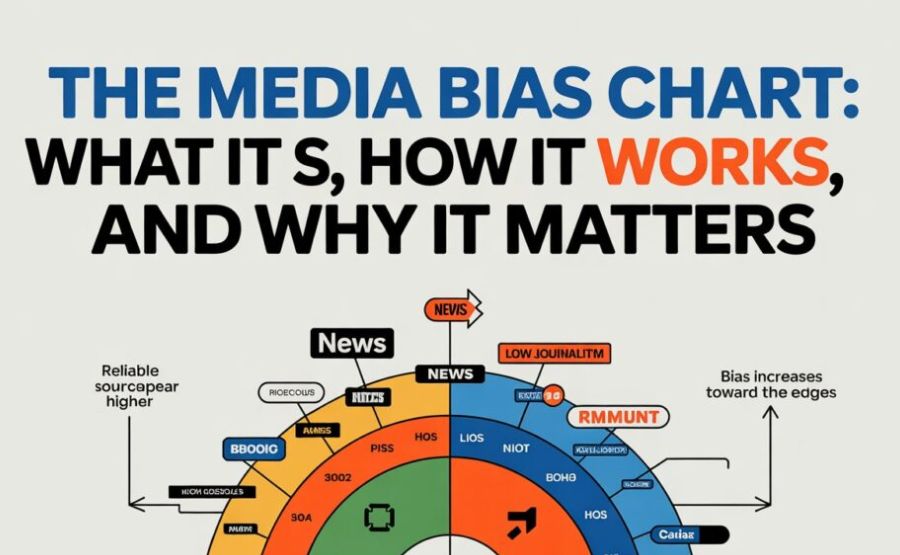
The shape of the whole thing looks a bit like a dome or an arch. The most reliable sources cluster up in the middle. As you travel toward either extreme on the political axis, the sources tend to slide lower on the reliability scale too. Not always — but often.
That pattern matters. It’s showing you something real about how political extremism and poor journalism tend to travel together.
The Color Zones — What Green, Yellow, Orange, and Red Mean
Ad Fontes uses a color coding system to help readers scan the chart quickly.
The green zone sits at the top center. Sources landing here are producing reliable, factual reporting with minimal political slant. This is the sweet spot. AP, Reuters, and the BBC tend to land in this zone. So do many local newspapers. Ad Fontes has noted that about 95% of local news sites they’ve rated fall into the green zone — a fact that surprises many people who assume local news is trustworthy by default.
The yellow zone covers sources that lean slightly left or right, or that mix reliable reporting with some opinion. These are still useful sources, but you want to read them knowing they have a tilt.
The orange zone is where things start getting concerning. Sources here mix fact with analysis and opinion in ways that can blur the line. Sensational headlines start appearing. Emotional language creeps into the reporting.
The red zone at the bottom edges of the chart contains the most extreme sources. Content here may contain misinformation, distorted facts, or heavily manipulated framing. These sources aren’t giving you journalism — they’re giving you a particular worldview dressed up as news.
How the Scores Are Actually Made — The Methodology
This part is what separates the Media Bias Chart from just one person’s opinion, and it’s worth understanding.
Every score on the chart comes from actual human beings reading actual articles and episodes.
Ad Fontes has a team of more than 40 trained analysts. Each one goes through roughly 30 hours of initial training before they ever rate a single article. They then continue with an additional 40 hours of training each year after that.
When an article gets rated, three analysts look at it — not one. And those three are deliberately chosen to represent different political views. One analyst leans left. One leans right. One sits in the center. They each rate the article independently, without talking to each other first. Then they compare their scores.
This setup is the core answer to a criticism Otero actually raised herself. In the very early days, she was the only one doing the ratings. She was honest enough to admit that one person’s perspective — no matter how careful — introduces blind spots. The shift to multi-analyst panels was a direct response to that problem.
Analysts score content across several specific factors. On the reliability side, they look at things like whether the information is accurate and verifiable, whether the headline honestly represents the article, and whether the piece is clearly news versus opinion or analysis. On the bias side, they evaluate the language used, how political positions are framed, and whether one perspective is given significantly more weight than others.
The scores for individual articles are then averaged to create the overall position for an outlet on the chart. The more articles rated for a single source, the more confident the placement becomes.
What “Ad Fontes” Means and Why It Matters
The company name isn’t random. “Ad Fontes” is Latin. It translates to “to the source.”
That phrase carries the whole philosophy. Instead of rating a news outlet based on its reputation, its political pedigree, or what other people say about it, Ad Fontes actually goes to the source material. They read the articles. They watch the episodes. They score what’s actually there, not what people assume is there.
It’s the difference between judging a restaurant based on its Yelp reputation versus actually sitting down and eating the food.
Where Famous Outlets Actually Land
People always want to know: where exactly do the big names fall?
AP (Associated Press) and Reuters consistently land near the top center of the chart. Both are wire services that focus almost entirely on factual reporting. Ad Fontes rates them as highly reliable and minimally biased.
BBC News lands in a similar zone — close to the top, leaning very slightly left by some measures but remaining in the high-reliability cluster.
NPR lands in the lean-left zone but scores high for reliability. Its news reporting and its opinion content are rated separately, and they don’t land in the same spot.
CNN’s website and CNN television are rated separately too, and their scores differ. The website generally lands in lean-left territory. Some of the TV programming drifts further.
Fox News similarly gets separate ratings for its website and its television content. The TV programming lands further to the right on the political axis, and the reliability scores for some of its shows are notably lower.
MSNBC sits on the opposite side — further left, with similar reliability concerns for its most opinionated programming.
Here’s something important to understand. A source being left-leaning doesn’t automatically make it unreliable. A source being right-leaning doesn’t automatically make it unreliable either. The two axes measure two completely separate things. A source can be politically consistent and still report facts accurately. The chart is designed to show both dimensions at once, not to collapse them into a single judgment.
The Other Bias Charts — AllSides, MBFC, and Beyond
Ad Fontes isn’t the only organization doing this work. A few others operate in the same space, each with a slightly different approach.
AllSides is probably the second most well-known. It’s been rating news outlets since 2012, longer than Ad Fontes has existed. Its method involves surveys of people from different political backgrounds, editorial reviews, and ongoing community feedback. AllSides rates political lean but explicitly does not rate accuracy. Their position is that judging factual accuracy would make them a kind of arbiter of truth — a role they’ve chosen not to take on.
Another approach is taken by Media Bias/Fact Check (MBFC). It rates outlets for factual reporting based primarily on how many times an outlet has been flagged by established fact-checkers. It also assigns political bias ratings. MBFC is run by a much smaller team and relies more heavily on editorial judgment.
Biasly is a newer entrant that uses a combination of AI-driven language analysis and human reviewer input. It’s building a more automated approach to bias detection.
Each tool has genuine strengths and genuine blind spots. Most media literacy experts suggest using more than one rather than treating any single chart as the final word.
The Honest Criticisms — What the Chart Can’t Do
The Media Bias Chart is genuinely useful. It is also genuinely imperfect, and the people who made it are open about that.
Here is the main thing a chart like this cannot capture: variation within a single outlet. A newspaper publishes hundreds of articles a month. Some of them are excellent. Some are weak. Some are reported well. Some slip into opinion-heavy framing. Averaging all of those into a single dot on a grid loses a lot of information.
The news desk of The New York Times and its opinion section produce very different kinds of content. The chart gives that paper one rating. That rating covers both, even though they behave quite differently in practice.
Critics from the political right have argued that the chart gives too much credit to mainstream outlets that, in their view, carry a liberal slant. Critics from the political left have argued the opposite — that the chart sometimes treats conservative outlets more generously than their actual content warrants. Both sides have pushed back publicly.
There is also the fundamental challenge that human beings are doing the rating. Even trained analysts with political diversity bring their own assumptions to what “reliable” and “biased” actually mean. Otero and her team have worked to minimize this through the three-analyst panel system, but it can’t be eliminated entirely.
And there’s the time problem. A single rating reflects what an outlet was doing when those articles were read. News organizations change. Editors change. Ownership changes. A rating from two years ago may not reflect what a network is doing today.
The FTC Investigation — A Very Recent and Important Development
In June 2025, something significant happened to Ad Fontes Media. The U.S. Federal Trade Commission sent them a civil investigative demand — a formal legal request for detailed information about the company’s operations, finances, methodology, and industry relationships.
Ad Fontes was not alone. The FTC’s investigation swept across several media rating organizations at the same time, part of a broader government examination of companies that evaluate news outlets for advertisers.
The concern driving the investigation was whether organizations like Ad Fontes were being used by advertisers to avoid spending money on certain news outlets — effectively influencing which outlets could survive financially.
As of early 2026, the investigation’s outcome was still unclear. What it does raise is a question worth sitting with: who evaluates the evaluators? A company that rates other companies for credibility should itself be subject to serious scrutiny. That’s a fair thing to want regardless of what you think of the FTC’s specific motives here.
How Real People Actually Use This Chart
The Media Bias Chart has found its way into some unexpected places.
Teachers use it in classrooms. Students analyzing a news story can look up the source and see where it falls before they even start reading. That changes the questions they ask. Instead of “is this true or false?” they start asking “where is this coming from, and what should I watch for?”
Advertisers and marketing teams use it for what they call brand safety decisions — choosing which outlets they want their ads to appear next to.
Journalists use it to understand how their own outlet is perceived by external evaluators.
And regular people — people who are just tired of not knowing who to trust — use it as a starting guide. Not a final answer. A starting point.
The smart way to use it is to look at where your most-read news sources fall. If every single one of them sits on the same side of the chart, you’re likely getting a narrower picture of the world than you realize. That’s the value the chart delivers most reliably — not a verdict on any single outlet, but a mirror held up to your own reading habits.
Final Words
A Denver lawyer drew a chart on her personal blog because she was frustrated with how people were talking past each other online. That chart, now in its thirteenth major version, has been seen by tens of millions of people.
It doesn’t solve the problem of media bias. Nothing does that completely. But it gives people a language for something that used to feel impossible to talk about clearly.
Bias is real. Reliability varies. Additionally, the two are not the same. That distinction alone — drawn visually on a chart anyone can read in under a minute — is more useful than most people expect when they first encounter it.
Look up where your news comes from. Check both axes. Then go read more than one source.
That’s the whole lesson, and it turns out it fits on a chart.
FAQs
1. What is the Media Bias Chart?
It’s a visual tool created by Vanessa Otero that maps news outlets on two dimensions: how politically biased they are (left to right) and how reliable their journalism is (top to bottom). The more reliable and less biased a source, the higher and more central it appears on the chart.
2. Who created the Media Bias Chart and why?
Vanessa Otero, a patent attorney from Denver, created the first version in December 2016 after becoming frustrated watching people argue about news sources during the U.S. election. She wanted a visual way to show that bias and reliability are two separate things.
3. What does “Ad Fontes” mean?
It’s Latin for “to the source.” The name reflects the company’s approach of rating news outlets by actually reading and analyzing their content, rather than just going on reputation or public perception.
4. How do the analysts decide where a news source falls on the chart?
Teams of three analysts — one leaning left, one leaning right, one in the center — independently read the same articles or watch the same episodes. They score content on specific criteria covering accuracy, headline quality, language, and political framing. Their individual scores are then compared and combined.
5. Is the Media Bias Chart itself biased?
That depends on who you ask. Critics from the right say it’s too generous to mainstream outlets they consider left-leaning. Critics from the left say it’s too easy on certain conservative outlets. Ad Fontes acknowledges no system is perfectly neutral, which is part of why they use politically diverse analyst teams.
6. Where does CNN fall on the Media Bias Chart?
CNN’s website and TV channel are rated separately. Both land in the lean-left portion of the chart, with the television programming generally scoring lower on reliability than the website for some of its more opinion-driven shows.
7. Where does Fox News fall on the chart?
Fox News gets separate ratings for its website and television content too. The television programming rates further to the right politically, and some shows score notably lower on reliability than the website’s straight news reporting.
8. What’s the difference between the Ad Fontes chart and the AllSides chart?
Ad Fontes rates both political bias AND reliability, uses trained analyst panels, and covers web, print, TV, and podcasts. AllSides rates political lean only, does not evaluate accuracy, and uses a mix of surveys, editorial review, and community input. Both are useful for different purposes.
9. Does the chart cover podcasts and TV shows, not just websites?
Yes. Ad Fontes has expanded significantly beyond websites. They now rate podcasts, radio shows, TV programs, and video content, with separate ratings from the same outlet’s website where the content differs.
10. How often is the chart updated?
The static printed version is updated twice a year, in January and August. The interactive online version and mobile app update more frequently based on ongoing daily analyst work.
11. Is it free to use the Media Bias Chart?
The static chart is available as a free download for personal, educational, and non-commercial use. Commercial use requires a license. The interactive online tool and the mobile app are available to access directly.
12. What happened with the FTC and Ad Fontes Media in 2025?
In June 2025, the Federal Trade Commission sent a civil investigative demand to Ad Fontes Media and several other media rating organizations, requesting detailed information about operations, finances, and methodology. The investigation was part of broader government scrutiny of how media rating firms influence advertiser decisions. The outcome remained unclear into 2026.
13. Can I look up a specific news source on the chart?
Yes. The interactive version of the Media Bias Chart lets you search for specific outlets and see their individual scores. The app lets you filter by source type and see real-time data updated by the analyst team.
14. Is a source being left-leaning the same as being unreliable?
No, and this is one of the most important things the chart communicates. Political lean and journalistic reliability are two separate measurements. A source can lean left or right and still report facts accurately. The chart shows both dimensions independently so readers don’t confuse one for the other.
15. Should I only read sources from the green zone at the top center of the chart?
The green zone is a great place to anchor your news reading. But understanding lean-left or lean-right sources is also valuable — as long as you know what you’re reading and why. The goal isn’t to eliminate all sources except centrist ones. The goal is to be aware of what each source is doing so you can read it critically.
Explore more, learn more, and think deeper with Theory Magazine.