Quick Reference Facts
| Detail | Value |
| Total possible 3-letter .com combinations | 17,576 |
| Year all three-letter .coms were registered | ~1997 |
| First 3-letter domain ever registered | BBN.com (April 1985) |
| Industry nickname | LLL.com |
| Price range (low-tier .com) | $10,000–$30,000 |
| Price range (mid-tier .com) | $50,000–$250,000 |
| Price range (premium .com) | $500,000–$2M+ |
| Average .com resale price (2025) | $23,264 |
| Premium letters (Western market) | A, B, C, D, E, F, G, H, I, L, M, N, O, P, R, S, T |
| Lower quality letters | Q, X, Y, Z |
| Best extension for value | .com |
| Where to buy/sell | Sedo, GoDaddy Auctions, Afternic, Flippa |
The Day the Internet Ran Out of Three-Letter Domains
Picture this. April 24, 1985.
A company called BBN Technologies quietly registered BBN.com. No fanfare. No auction. No bidding war. Just a simple registration that cost nothing, handled by a government-funded office like it was admin paperwork.
Nobody in that office had any idea what they were sitting on.
Fast forward about twelve years. The internet had exploded into something nobody predicted. Businesses were scrambling for web addresses. Investors were grabbing everything they could. And then, around 1997, something remarkable happened.
The last three-letter .com was registered.
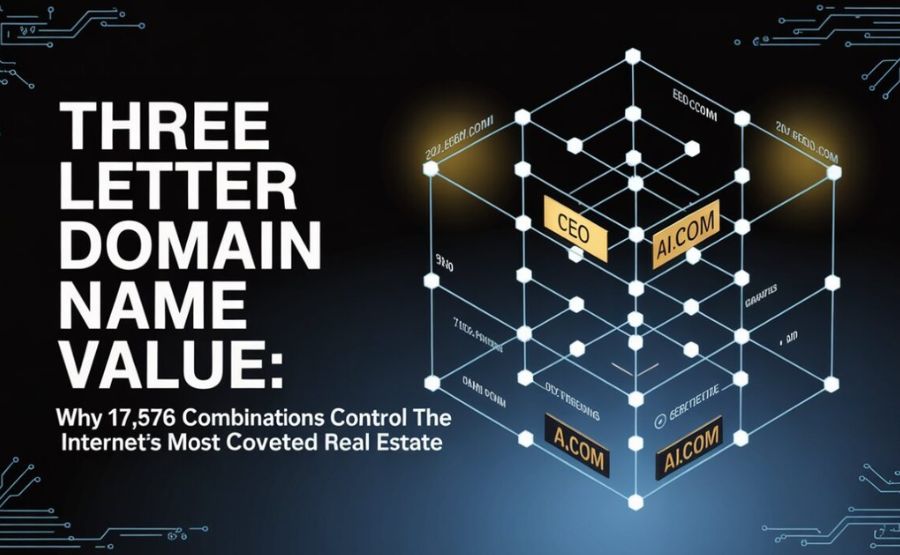
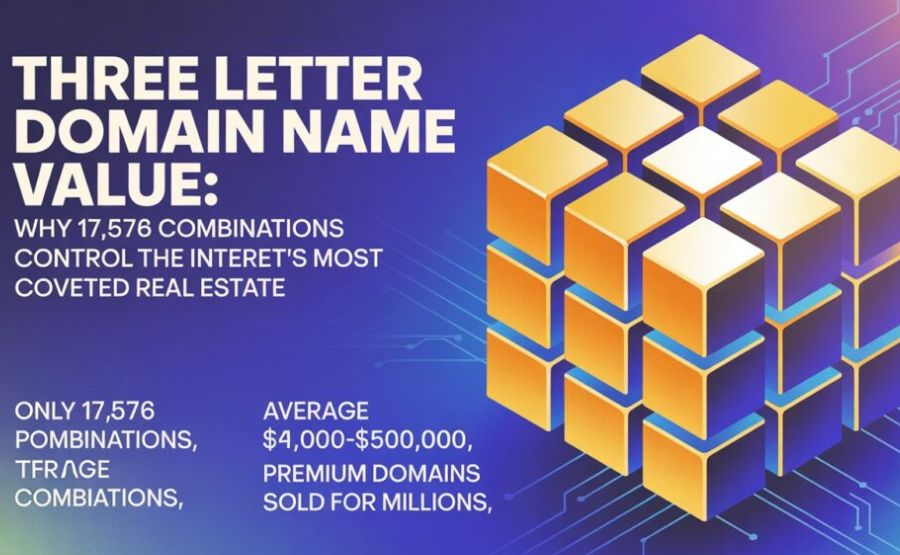
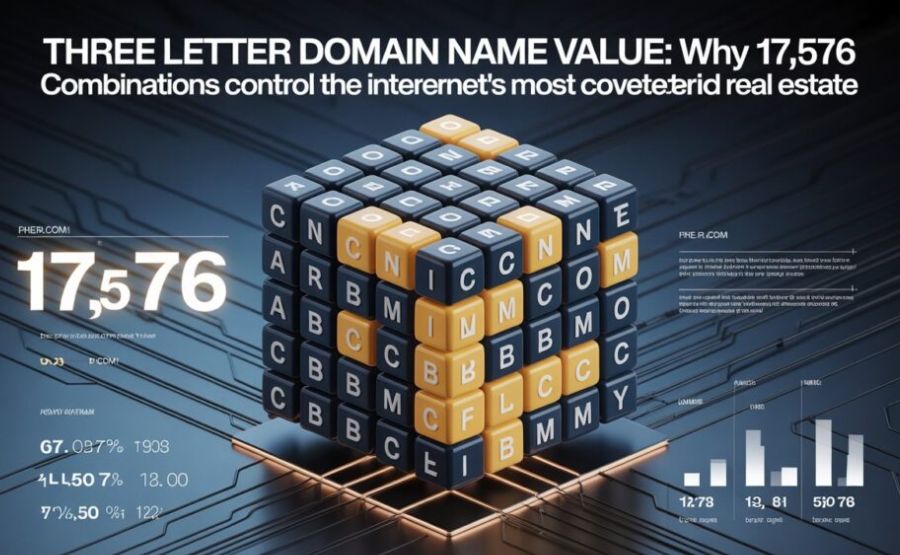
All 17,576 of them — gone. Every combination from AAA.com to ZZZ.com. Claimed. Taken. Done. No new ones can ever exist. The alphabet only has 26 letters, and 26 × 26 × 26 equals exactly 17,576. That math doesn’t change. That number will never grow.
When supply is permanently frozen and the whole world is still growing, prices only go one direction.
See also “How to See Who Shared Your Instagram Post: The Complete 2026 Guide“
What Is a Three-Letter Domain Name Worth?
Here’s the honest answer first. There is no single number.
A three-letter .com domain can sell for $10,000. It can also sell for $2 million. The three-character structure is the same, but the prices are drastically different. And the gap between those two numbers comes down to a handful of very specific things.
Think of it like houses on a street. They’re all houses. But one faces the park, one backs onto a motorway, and one is falling down. Same street, completely different prices.
At the floor of the market, you’ll find combinations with tricky letters — lots of Qs, Xs, and Zs, no recognizable meaning, hard to say out loud. These trade in the $10,000 to $30,000 range.
In the middle of the market, things get interesting. Better letter combinations, combinations that could serve as a company’s initials, or names with a clean rhythmic feel. These land between $50,000 and $250,000.
At the top of the market, the names feel inevitable. You hear them and think: of course that’s a company name. Clear initials. Easy to say. Impossible to forget. Premium all-letter combinations here have cleared $500,000 and some deals have reached deep into the millions.
And many of the biggest sales? They never get reported publicly. The buyer and seller sign an NDA and the number stays secret forever.
Why Does .com Matter So Much?
You might be thinking — there are three-letter domains in other extensions too. What about .net? Or .org? What about the newer ones?
Great question. Here’s the honest answer.
.com is the king. It has been for 30 years and nothing has seriously threatened that crown. When someone types an address without thinking, they add .com automatically. It’s muscle memory. It’s trust baked into a generation of internet users.
A three-letter .net domain is a genuinely valuable asset. You can expect $10,000 to over $100,000 for a good one. But that same combination as a .com? Often worth three to ten times more.
.org is respected and has a loyal following, especially for nonprofits and associations. Three-letter acronyms are common in the nonprofit world, which creates real buyer demand for LLL.org names. Sales regularly land in the $5,000 to $50,000 range.
The newer extensions like .io and .ai are worth watching. The AI boom sent .ai registrations soaring — up 300% in 2024 alone. Short .ai names now attract serious money from tech startups. But they still trade at a discount to .com in most cases.
The blunt truth: if you own a three-letter .com, you own a Ferrari. A three-letter .net is a very nice BMW. A .ai is a fast electric car that’s exciting but newer. You choose based on what the market will actually pay.
The Letter Quality Secret Most People Don’t Know
Not all letters are equal. This is when most novices are taken aback.
In the Western domain market, letters have tiers.
A, B, C, D, E, F, G, H, I, L, M, N, O, P, R, S, and T are premium letters. These appear in common words, common business names, common acronyms. A domain made of all premium letters is immediately more liquid and more valuable.
Middle-tier letters include J, K, U, V, W. Useful in some combinations, weaker in others.
Lower-tier letters include Q, X, Y, Z. Not useless — but harder to sell, and they’ll drag the price down unless something else makes the name special.
Pick the right three letters and the price jumps dramatically. The very best letter combinations can command five to six times what the weakest combinations fetch, even with the same extension.
The Chinese Market Changes Everything
Here’s where it gets genuinely fascinating.
China has its own rules about which letters are desirable. And those rules are almost backwards from the Western list.
Chinese investors tend to avoid vowels entirely. They also tend to avoid the letter V. Instead, they prize consonants like B, C, D, F, G, H, J, K, L, M, N, P, Q, R, S, T, W, X, Y, Z.
These preferred names even have a nickname in the industry — CHIPs (Chinese Premium domains).
Why the difference? The Chinese language uses characters rather than letters. Short letter combinations work as brandable codes rather than words. Vowels don’t carry the same phonetic weight. So a combination like QXZ.com — nearly worthless in the Western market — could attract interest from a Chinese buyer who sees it differently.
This creates an interesting effect. Sometimes you can own a domain that most Western buyers would overlook, and a buyer in Shanghai thinks it’s exactly what their brand needs.
The Chinese domain market exploded around 2015, sending prices for quality three-letter .coms soaring. It was a frenzy. After that peak, things settled to a more rational level. But Chinese buyers remain a major force in this market today, and smart sellers always consider that audience.
What Really Makes a Three-Letter Domain Worth More?
Five things separate the $20,000 names from the $500,000 names.
1. Acronym power. Does the combination match the initials of a real industry, a real category, or a well-known company type? ABC.com is priceless because ABC is one of the most famous networks in the world. NBA.com, UPS.com, AWS.com — these are owned by exactly the companies you’d expect. The closer your three letters are to matching a real-world brand’s initials, the higher the ceiling.
2. Pronounceability. Say the domain out loud. Does it roll off the tongue? CVC patterns (consonant-vowel-consonant) like the word “cat” — tend to be the most mouth-friendly. A domain that sounds natural gets used more. It gets typed more. It spreads faster. That matters to buyers.
3. Letter quality. As covered above, the individual letter tier matters enormously. Three premium letters beats three low-tier letters every time, all else being equal.
4. Clean history. A domain that was once used for spam, illegal content, or scam websites carries baggage. That baggage can hurt search rankings and scare away legitimate buyers. Always check the history of a domain before paying serious money for it.
5. Extension. We’ve covered this, but it bears repeating. The same three letters on .com vs. .net vs. .org are completely different assets with completely different ceilings.
Real Companies That Bet Big on Three-Letter Domains
This isn’t theoretical. Real companies have paid real money for these assets — and then built on them.
ABC — The American Broadcasting Company owns ABC.com. It serves millions of viewers and tells you who they are the moment you see the address.
UPS — The delivery giant sits on UPS.com. Three letters that mean one thing globally: your package is on the way.
AWS — Amazon Web Services uses AWS.com. In the tech world, those three letters are as recognizable as any logo.
NBA.com — The National Basketball Association. Short, clean, impossible to misread.
FOX — The media company behind Fox.com needs no explanation.
And then there are the rebrand stories. Box was originally on Box.net. They paid to upgrade to Box.com when the company hit a certain level of ambition. ConvertKit rebranded to “Kit” and acquiring Kit.com was central to that move. Those three letters marked the beginning of a new era for a business with $45 million in yearly revenue.
These companies didn’t buy premium three-letter domains to save money. They bought them because the domain became the brand.
The Market in Numbers: What’s Really Happening Right Now
Let me give you some real market context.
Between 2022 and 2026, researchers tracked publicly reported domain sales from the industry’s top list. Out of five years of data, only 31 three-letter .com sales appeared in the top 100 publicly reported transactions. That’s how rarely these assets actually trade.
Owners who hold a quality LLL.com rarely sell. There’s no pressure to. The asset doesn’t need maintenance. It doesn’t depreciate. It doesn’t require staff. It just sits there appreciating while the global demand for premium digital identity grows every year.
The average .com resale price across all types hit $23,264 in 2025 — a jump of 63.6% year over year. The overall domain aftermarket is heating up.
And in 2025, a single domain — AI.com — sold for $70 million, setting a new all-time record for any domain sale. That sale reshaped how the entire industry thinks about short, high-relevance combinations.
How to Buy a Three-Letter Domain Today
You can’t register one fresh. That door closed in 1997. Every option today involves buying from someone who already owns it.
Here’s where to look:
GoDaddy Auctions — One of the largest secondary markets for domains. Many three-letter names pass through here, especially expiring ones.
Sedo — A global marketplace popular with both buyers and sellers of premium domains. Good for fixed-price listings and negotiations.
Afternic — Part of the GoDaddy network and widely used by domain investors. Strong reach to buyers.
Flippa — More of a general marketplace but handles premium domains too.
Direct outreach — Sometimes the best approach is going straight to the owner. Look up who owns the domain, send a professional inquiry, and start a conversation.
A few rules before you spend a single dollar:
Check the trademark. Three letters can match a famous company’s trademark. If DEF Corp has trademarked DEF for 30 years and you buy DEF.com hoping to sell it to them, you could face legal risk. Do your homework first.
Check the history. Use the Wayback Machine (archive.org) to see what the site was used for. A domain with a shady past can poison your search rankings before you even launch.
Set your ceiling before the auction starts. Auction rooms — even digital ones — create emotional pressure. Decide your max before you bid. Then stop there. Full stop.
Research comparable sales. Sites like NameBio track publicly reported domain sales. Look at what similar three-letter combinations have sold for recently. That gives you an anchor for negotiation.
How to Sell a Three-Letter Domain for Maximum Value
If you own a three-letter .com, congratulations. You’re sitting on a genuinely rare asset.
Here’s how to approach the sale strategically.
First, figure out who would actually want it. A three-letter combination that matches a common industry acronym has natural end-user buyers — companies in that industry who want their initials as their web address. Those buyers pay more than investors do. Find the story and lead with it.
List on multiple platforms. Afternic and Sedo both have wide networks. Being on both increases visibility without much extra effort.
Consider a broker for high-value names. A good broker knows who’s actively looking for premium three-letter assets. They can reach buyers you’d never find yourself. Just be aware that brokers charge a commission, usually between 10% and 20%, so account for that in your pricing.
Don’t underprice because you’re impatient. A quality three-letter .com that sits unsold for six months is not failing. It may simply be awaiting the ideal buyer. Patience is the most undervalued skill in this market.
Finally — don’t overstate. The name’s value speaks for itself. Show the letters, name the asking price, and let serious buyers do the math. Those that understand it, understand it.
Is a Three-Letter Domain a Good Investment?
Honestly? It depends on what you’re buying.
The asset class as a whole has appreciated over decades. Supply is permanently fixed. Global demand for digital identity keeps growing. That combination tends to push prices upward over time.
But not every three-letter domain is a good investment. A combination of low-tier letters with no acronym value and no obvious buyer pool can sit on a marketplace for years without a serious offer. Paying $25,000 for a weak combination and expecting it to double in a year is wishful thinking.
The strongest investments in this category are names with:
- All premium letters
- A recognizable acronym potential
- Clean history
- .com extension
- A believable buyer story
If those boxes are ticked, a three-letter domain can appreciate steadily and attract real corporate buyers when the right company is ready to upgrade their brand.
If those boxes aren’t ticked — well, you might be paying for prestige that doesn’t exist yet.
Final Words
Three-letter domain names are the internet’s version of beachfront property. The supply ran out before most people were old enough to understand the internet. There will never be more.
That scarcity is the foundation. But it’s not the whole story.
The right three letters, in the right extension, with a clean history and a natural buyer pool — that combination can command prices that make people blink. Not because of magic. Because the math works: too many businesses in the world, not enough prime digital addresses, and companies willing to pay serious money to say who they are in three clean characters.
Whether you’re looking to buy one, sell one, or just understand why your competitor has a three-letter web address that makes their brand look so effortlessly established — now you know the full picture.
Three letters. One extension. A fixed supply that closed decades ago. That’s the whole story.
FAQs
1. How much is a three-letter .com domain worth?
It varies widely. Low-tier letter combinations start around $10,000 to $30,000. Mid-tier combinations land between $50,000 and $250,000. Premium combinations with strong acronym potential can reach $500,000 to several million dollars.
2. Can I still register a three-letter .com domain fresh?
No. Every single one of the 17,576 possible combinations was registered by around 1997. The only way to get one today is to buy it from whoever currently owns it on the secondary market.
3. What makes one three-letter domain worth more than another?
The main factors are letter quality (premium vs. low-tier letters), whether the combination forms a recognizable acronym, how easy it is to pronounce, the domain’s history, and the extension (.com being the most valuable).
4. Which letters make a three-letter domain more valuable?
In the Western market, premium letters are A, B, C, D, E, F, G, H, I, L, M, N, O, P, R, S, T. Lower-value letters include Q, X, Y, and Z. All-premium combinations command the highest prices.
5. Is a three-letter .net worth less than a .com?
Yes, significantly. The same combination on .net typically trades at 60–80% below the .com equivalent. Dot-com has decades of built-in user trust that other extensions haven’t matched.
6. What is LLL.com?
It’s an industry shorthand for a three-letter .com domain. L stands for “letter.” Domain investors and brokers use this notation to quickly describe the format.
7. What are Chinese Premium domains (CHIPs)?
CHIPs are three-letter combinations that avoid vowels (A, E, I, O, U) and the letter V. Chinese investors prize these combinations because vowels are less valued in their letter-based branding logic.
8. Where is the best place to buy or sell a three-letter domain?
The main platforms are Sedo, GoDaddy Auctions, Afternic, and Flippa. For high-value names, working with a domain broker who has corporate connections can yield better results.
9. How do I check what a three-letter domain sold for in the past?
NameBio.com tracks publicly reported domain sales and is the most widely used resource for checking comparable sales. Keep in mind many large deals are never publicly reported.
10. Are three-letter .ai domains valuable?
Yes, increasingly so. The AI technology boom pushed .ai registrations up 300% in 2024. Short .ai combinations are now attracting serious buyers in the tech space, though they generally still trade below equivalent .com names.
11. Should I check for trademark conflicts before buying a three-letter domain?
Absolutely. Some three-letter combinations match the registered trademarks of major corporations. Buying with the intent to profit from that association can create serious legal exposure. Always search trademark databases before purchasing.
12. How long does it take to sell a three-letter domain?
It varies enormously. A premium combination with a clear buyer pool could sell within weeks. A weaker combination might take months or years to find the right buyer. Patience is essential in this market.
13. Do three-letter domains increase in value over time?
Historically, yes — because supply is permanently fixed while the number of businesses seeking premium digital identity keeps growing. But not every combination appreciates equally. Letter quality, extension, and acronym relevance all determine whether a specific name gains value over time.
Explore more, learn more, and think deeper with Theory Magazine.