
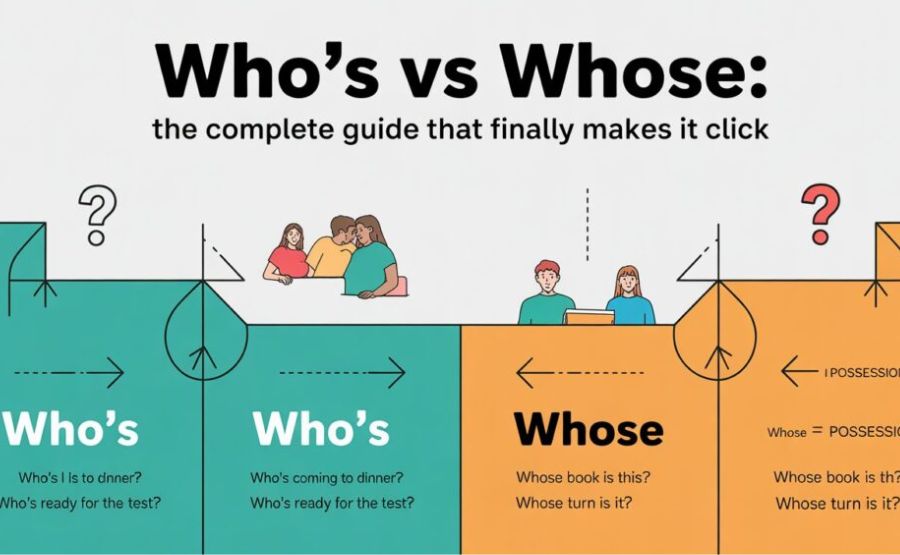
Every day, millions of people write “who’s” when they mean “whose” — and they have absolutely no idea they’ve done it.
This mistake slips into emails, essays, social media posts, and even professional documents. And the frustrating thing is, it’s one of the easiest mistakes in English to fix once you understand what’s actually happening behind the two words.
Let me walk you through the whole thing. By the end of this, you won’t guess anymore. You’ll just know.
Quick Reference
| Feature | Who’s | Whose |
| What it is | A contraction | A possessive pronoun / determiner |
| Full form | “Who is” or “who has” | No full form — it stands alone |
| Shows ownership? | No | Yes |
| Has an apostrophe? | Yes ( ‘ ) | No |
| Used in questions? | Yes | Yes |
| Used in relative clauses? | Sometimes | Yes, very commonly |
| Can it be used for objects? | No | Yes (accepted by most style guides) |
| Formal writing tip | Write “who is” / “who has” in full | Fine as-is in all contexts |
| Memory trick | Replace with “who is” — if it fits, use who’s | Replace with “his/her” — if it fits, use whose |
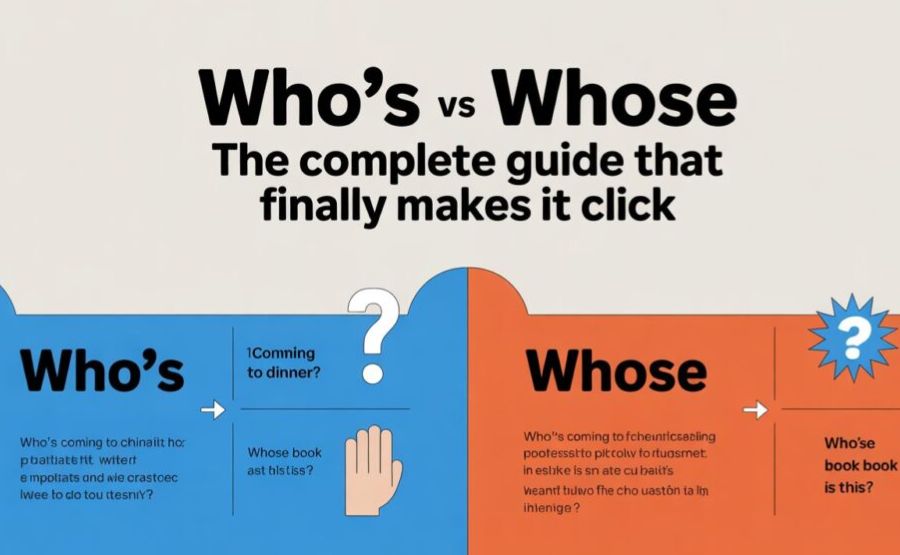
| Example | “Who’s coming tonight?” | “Whose bag is this?” |
Why This Mistake Happens So Often
Here’s the honest reason this trips people up.
Both words come from the word “who.” They sound identical when you say them out loud. And here’s the thing that really fools people — in English, we usually form possession by adding ‘s to a word.
The dog’s collar. Sarah’s jacket. My brother’s car. Adding apostrophe-s shows that something belongs to someone. That pattern is everywhere in English.
So when someone sees “whose” without an apostrophe, their brain goes “wait, shouldn’t that be who’s?” And when they see “who’s” with an apostrophe, their brain goes “that must be possessive.”
But here’s the twist. For once, the apostrophe has nothing to do with ownership. That apostrophe in “who’s” is showing a missing letter, not a belonging relationship.
That single mix-up is responsible for almost every error people make with these two words.
See also “Twin Bed Measurements: Everything You Need to Know Before You Buy“
What “Who’s” Actually Means
“Who’s” is a contraction. That word “contraction” just means two words squished into one, with an apostrophe standing in for the missing letters.
“Who’s” is short for either “who is” or “who has.”
That’s all it ever is. Nothing more. Nothing less.
The apostrophe is sitting there where the letters “i” and “a” used to be, holding their place.
Examples with “who is”:
- Who’s coming to dinner? → Who is coming to dinner?
- Who’s responsible for this? → Who is responsible for this?
- Do you know who’s in charge? → Do you know who is in charge?
Examples with “who has”:
- Who’s been sitting in my chair? → Who has been sitting in my chair?
- Who’s already eaten? → Who has already eaten?
- I wonder who’s taken the last piece. → I wonder who has taken the last piece.
The test is simple. Before you write “who’s,” try swapping it out for “who is” or “who has.” Read the sentence out loud. Does it still make sense? Then “who’s” is correct. If the sentence suddenly sounds broken, you need “whose” instead.
What “Whose” Actually Means
“Whose” is a possessive word. It shows that something belongs to, comes from, or is associated with someone.
There is no apostrophe. None at all. And that’s on purpose — in English, possessive pronouns like “his,” “hers,” “its,” “theirs,” and “whose” never use apostrophes. That’s just the rule.
Think of it this way. You’d never write “hi’s” or “her’s” or “their’s” — those would all look wrong to you immediately. “Whose” works exactly the same way. It’s already possessive all on its own. The apostrophe would be wrong.
“Whose” shows up in two main situations.
First, in questions:
- Whose phone keeps ringing?
- Whose idea was this?
- Whose car is blocking the driveway?
Second, in relative clauses — those are sentence parts that describe or give more information about a noun:
- The woman whose daughter won the award looked so proud.
- He was the one whose advice actually helped.
- The teacher whose class I loved most just retired.
In both situations, “whose” is doing the same job. It connects ownership or relationship to someone or something mentioned in the sentence.
The Memory Tricks That Actually Work
Grammar books give you rules. But tricks help you remember those rules when you’re in the middle of typing fast and your brain goes blank.
Trick #1 — The Swap Test
This is the most reliable one. Before you write “who’s,” silently replace it with “who is” or “who has.” Does the sentence still work?
- “Who’s driving tonight?” → “Who is driving tonight?” ✓ Use who’s.
- “Who’s backpack is that?” → “Who is backpack is that?” ✗ Sounds wrong. Use whose.
Trick #2 — The His/Her Test
Try replacing the word with “his” or “her” and see if the sentence makes sense.
- “Whose coat is that?” → “His coat is that.” Well, sort of. The ownership meaning is there. Use whose.
- “Who’s coming?” → “His coming?” That doesn’t work at all. Use who’s.
If “his” or “her” could roughly slot in, you’re in possessive territory — use “whose.”
Trick #3 — Spot the Missing Letter
Remember that the apostrophe in “who’s” always stands for a missing letter. If there are no missing letters in what you mean — if you’re simply talking about ownership — then there’s nothing to contract. No contraction needed means no apostrophe. That means “whose.”
Common Wrong Examples — And the Fix
Seeing the error in context cements the rule faster than any explanation. Here are real-world mistakes with their corrections.
Wrong: Who’s shoes are these?
Right: Whose shoes are these?
(You can’t say “Who is shoes are these” — that’s nonsense. This is about ownership.)
Wrong: I don’t know whose going to show up.
Right: I don’t know who’s going to show up.
(Expand it: “who is going to show up” — that works. Contraction needed.)
Wrong: The student who’s essay won was thrilled.
Right: The student whose essay won was thrilled.
(Try “who is essay” — broken. This is possession. Use whose.)
Wrong: Who’s responsibility is it to lock up?
Right: Whose responsibility is it to lock up?
(Ownership of responsibility — that’s a possessive job. Whose.)
Wrong: Can you tell me whose been using my laptop?
Right: Can you tell me who’s been using my laptop?
(Expand: “who has been using my laptop.” Contraction. Who’s.)
Can You Use “Whose” for Objects — Not Just People?
Here’s the grammar debate that most guides skip over, but it’s genuinely worth knowing.
Technically, “who” refers to people. So “whose” — being the possessive form of “who” — should technically only refer to people too.
But here’s the problem. English doesn’t have a possessive version of “which.” If you want to say a building’s windows are tall, or a painting’s colors are rich, or a river’s banks are steep — how do you fit that into a relative clause?
You’d have two options:
- “The building whose windows are floor-to-ceiling” (uses whose for a thing)
- “The building the windows of which are floor-to-ceiling” (technically correct but painfully awkward)
Most writers, understandably, pick the first option.
And Merriam-Webster — one of the most authoritative dictionaries in the English language — has officially backed this up. They point out that writers like Shakespeare, Milton, Jane Austen, and F. Scott Fitzgerald all used “whose” for inanimate objects. The rule against it is outdated, they say, and “whose” for objects is now widely accepted.
So go ahead. “The book whose ending surprised me.” “The mountain whose peak was hidden by clouds.” These are correct in modern English.
The one exception: when “whose” starts a question, it can only refer to a person. “Whose keys are these?” only makes sense if you’re asking about a person who owns keys. You wouldn’t open a question with “whose” and mean an object.
Using “Who’s” in Formal vs Informal Writing
Here’s a quick practical point that comes up a lot for students and professionals.
Contractions in general — “don’t,” “can’t,” “who’s,” “they’re” — are considered informal. They belong in conversations, casual emails, texts, social media, and dialogue in fiction.
In formal writing — academic papers, legal documents, cover letters, official reports — it’s generally better to write out “who is” or “who has” in full rather than contracting them.
So in a school essay, instead of writing “The candidate who’s running on education reform gained popularity,” you’d write “The candidate who is running on education reform gained popularity.”
Same meaning. Slightly more formal weight.
“Whose” doesn’t have this issue at all. It’s perfectly appropriate in all writing, formal or casual. There’s no “formal equivalent” because it’s already the standard, accepted possessive form.
Whose vs Who’s in Relative Clauses
This is the area that trips up even people who know the basic rule.
A relative clause is a phrase that adds information about a noun in your sentence. Here are two examples side by side to show how differently “who’s” and “whose” behave in this context.
With “whose” (possessive in a relative clause):
- “The manager whose team delivered the results got promoted.”
- “She’s the author whose work I’ve admired for years.”
- “They found the child whose parents had been searching all night.”
In every one of those sentences, “whose” is linking a person to something they own or are connected to. You could replace “whose” with “his/her/their” and a linking word, and the meaning holds.
With “who’s” (contraction in a relative clause):
- “I know someone who’s always late.”
- “She’s the teacher who’s helped me most.”
- “He’s looking for a friend who’s willing to listen.”
In these, “who’s” means “who is.” The word isn’t showing ownership — it’s describing what the person does or is.
The distinction is clear once you test it. Ownership? Whose. Identity or action? Who’s.
The “It’s vs Its” Connection
If this “who’s vs whose” rule still feels slippery, there’s a parallel in English that works exactly the same way and might make it click.
Think about “it’s” vs “its.”
- “It’s” means “it is” or “it has.” Apostrophe = contraction.
- “Its” shows possession — “The cat licked its paw.” No apostrophe = possessive.
The pattern is identical:
- Apostrophe = contraction, missing letters
- No apostrophe = possessive, ownership
“Who’s” and “whose” follow this exact same logic.
Once you’ve learned “it’s vs its,” you’ve already learned “who’s vs whose.” The principle is the same.
Quick Practice — Test Yourself
Try choosing the right word for each sentence. Answers below.
- _____ going to take notes at the meeting?
- The artist _____ painting sold for $2 million was shocking.
- I can’t remember _____ phone this is.
- _____ been eating my sandwich?
- Do you know _____ in charge of the project?
- The company _____ offices are downtown and just expanded.
Answers:
- Who’s (Who is going to take notes)
- Whose (possessive — the artist’s painting)
- Whose (possessive — ownership of the phone)
- Who’s (Who has been eating)
- Who’s (who is in charge)
- Whose (possessive — the company’s offices)
Final Words
“Who’s vs whose” is one of those grammar rules that sounds more complicated than it actually is.
Once you understand the two players — a contraction on one side, a possessive on the other — the whole thing clicks into place. “Who’s” always hides “who is” or “who has” inside it. “Whose” always shows that something belongs to or is connected to someone.
The apostrophe is the clue. It’s there in “who’s” because a letter went missing. It’s absent from “whose” because possessive pronouns in English never need one.
Use the swap test every time you’re unsure. Slip in “who is” or “who has.” If the sentence breaks, reach for “whose.” If it holds, write “who’s.”
Do that a few dozen times, and eventually you won’t even need the test. The right one will just feel natural, the way learning anything does after enough practice.
FAQs
1. What is the main difference between who’s and whose?
“Who’s” is a contraction meaning “who is” or “who has.” “Whose” is a possessive word showing that something belongs to or is connected with someone. One contracts two words; the other shows ownership.
2. Does “who’s” always have an apostrophe?
Yes, always. The apostrophe in “who’s” marks the missing letters from “who is” or “who has.” If there’s no apostrophe, you’re looking at “whose” — the possessive form.
3. Why doesn’t “whose” have an apostrophe?
Because possessive pronouns in English never use apostrophes. Words like “his,” “hers,” “its,” “theirs,” and “whose” all show ownership without an apostrophe. That’s the consistent rule for this entire category of words.
4. What’s the easiest test to tell them apart?
Try replacing the word with “who is” or “who has.” Read the sentence aloud. If it still sounds right, use “who’s.” If the sentence breaks apart, use “whose.”
5. Can “whose” refer to things and not just people?
Yes. Modern English — and major authorities like Merriam-Webster — accept “whose” for objects and things when “of which” would be too awkward. “The building whose roof collapsed” is grammatically fine today.
6. Is “who’s” appropriate in formal writing?
Not ideally. In formal or academic writing, it’s better to write out “who is” or “who has” in full. Contractions carry an informal tone. “Whose,” on the other hand, is perfectly appropriate in all writing styles.
7. Can “whose” start a question?
Yes. “Whose jacket is this?” “Whose turn is it?” In questions, “whose” asks about ownership. Note that when “whose” opens a question, it can only refer to a person, not an object.
8. Can “who’s” start a question?
Yes. “Who’s coming with us?” “Who’s already finished?” In these cases, “who’s” is asking “who is” or “who has” — it’s about identity or action, not ownership.
9. Are “who’s” and “whose” homophones?
Yes, completely. They sound identical when spoken. The difference only shows up in writing — which is exactly why the mistake happens so often in typed or written text.
10. What is “whose” called in grammar?
“Whose” functions as a possessive pronoun or a possessive determiner (also called a possessive adjective). When it replaces a noun on its own (“Whose is this?”), it’s a pronoun. When it comes before a noun (“Whose bag is this?”), it’s a determiner.
11. Can I use “whose” for animals?
Yes. “The dog whose leash broke came running back.” Just as “who” can refer to animals (especially pets treated like people), “whose” can too.
12. Is “whos” (no apostrophe, no possessive meaning) ever correct?
Only in one very specific context — the fictional “Whos” from Dr. Seuss’s How the Grinch Stole Christmas are called “Whos” because it’s a proper noun (a group name), not because of any grammar rule. In standard English writing, “whos” without an apostrophe is never correct.
13. What’s the similar rule with “it’s” vs “its”?
Identical pattern. “It’s” = contraction of “it is” or “it has.” “Its” = possessive, no apostrophe. Once you know one pair, you essentially know both.
14. How do I use “whose” in a relative clause?
Use “whose” in a relative clause when you’re linking a person (or object) to something they own or are associated with. Example: “The woman whose presentation ran over time apologised.” “Whose” connects “the woman” to “her presentation.”
15. What happens if I keep mixing these up in professional writing?
It signals a grammar gap that can affect how readers perceive your writing — whether in job applications, business emails, academic papers, or journalism. It’s a small error that catches more attention than it deserves, simply because it’s so common. Fixing it is quick and the payoff is real.
Explore more, learn more, and think deeper with Theory Magazine.