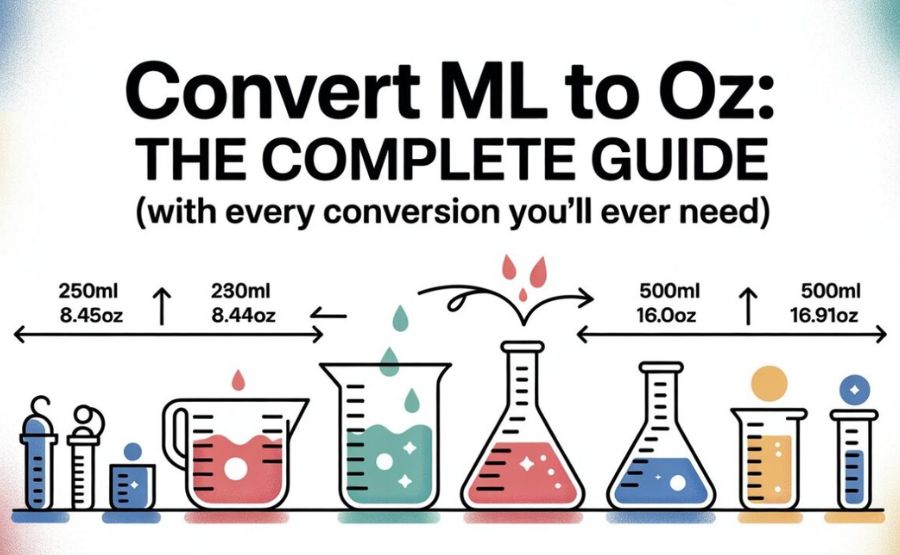
You’re standing in your kitchen, following a recipe from an American website, and it says “add 8 fl oz of milk.” But your measuring cup only shows millilitres. Sound familiar?
This happens to millions of people every single day. Cooks, nurses, students, travelers — anyone crossing the invisible line between the metric world and the imperial world hits this exact wall. Let me make it disappear for you permanently.
Quick Reference
| What You Have (ml) | US fl oz | UK Imperial fl oz |
| 1 ml | 0.034 fl oz | 0.035 fl oz |
| 5 ml (1 teaspoon) | 0.169 fl oz | 0.176 fl oz |
| 10 ml | 0.338 fl oz | 0.352 fl oz |
| 25 ml | 0.845 fl oz | 0.880 fl oz |
| 30 ml | 1.014 fl oz | 1.056 fl oz |
| 50 ml | 1.691 fl oz | 1.760 fl oz |
| 100 ml | 3.381 fl oz | 3.520 fl oz |
| 150 ml | 5.072 fl oz | 5.280 fl oz |
| 200 ml | 6.763 fl oz | 7.040 fl oz |
| 250 ml | 8.454 fl oz | 8.800 fl oz |
| 355 ml (soda can) | 12.00 fl oz | 12.503 fl oz |
| 500 ml | 16.907 fl oz | 17.598 fl oz |
| 750 ml | 25.361 fl oz | 26.397 fl oz |
| 1000 ml (1 litre) | 33.814 fl oz | 35.195 fl oz |
First — What Are We Actually Converting?
Before any math, let’s talk about what these two units actually are. Because understanding them makes the conversion feel logical instead of random.
A millilitre is a metric unit of volume. “Milli” means one thousandth. So one millilitre is one thousandth of a litre. Think of it as a tiny cube exactly one centimetre on each side. That cube holds exactly 1 ml of liquid.
A fluid ounce is a completely different system. It’s an old measurement that came from a simple idea: how much water weighs one ounce? Pour out that amount of water, and you have one fluid ounce. That’s where the name comes from.
Here’s the important thing: fluid ounces and weight ounces are not the same thing. A fluid ounce measures volume (space taken up by a liquid). A regular ounce measures weight. Mixing these two up is one of the most common errors in cooking. A fluid ounce of honey and a fluid ounce of water take up the same space, but they weigh very different amounts.
See also “How to Check Website Position on Google: And What to Do With That Information“
The Big Problem Nobody Warns You About — Two Different Fluid Ounces
Here’s where people get confused and nobody really explains it clearly.
There are two versions of the fluid ounce in the world.
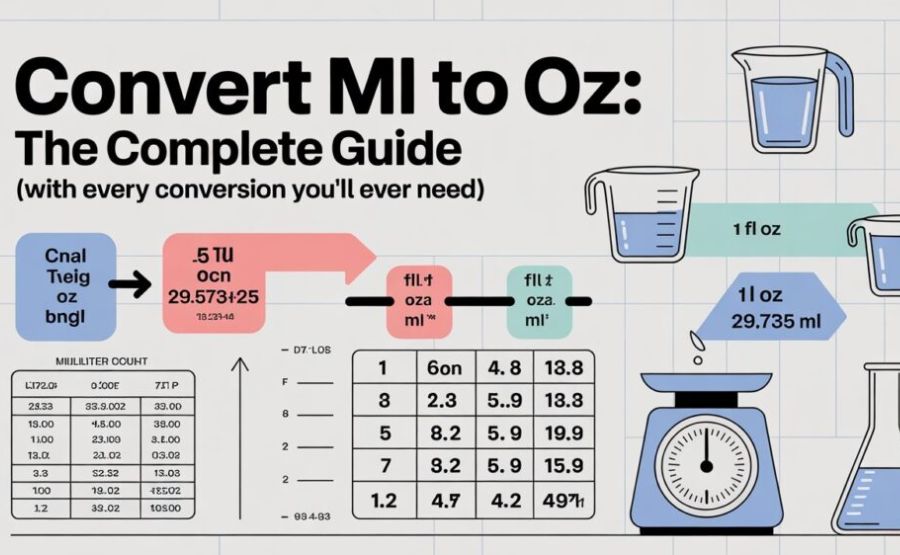
One is the US fluid ounce, used in America. One US fluid ounce equals exactly 29.5735 millilitres.
The other is the UK Imperial fluid ounce, used in Britain, Australia, Canada (for older measurements), and some other countries. One UK fluid ounce equals exactly 28.4131 millilitres.
That doesn’t sound like a huge difference. But when you’re converting 500 ml, that gap creates a difference of nearly half a fluid ounce. In a medical context or a precise baking recipe, that matters.
The simple rule: if you’re converting for an American recipe or product — use 29.5735. If the recipe or package is British — use 28.4131.
Most online converters default to the US version. Always check which one you need before trusting the result.
The Exact Conversion Formula — Both Versions
Let me give you the formulas clearly, without clutter.
To convert ml to US fluid ounces:
Fluid ounces = millilitres ÷ 29.5735
Or the same thing written differently:
Fluid ounces = millilitres × 0.033814
To convert ml to UK Imperial fluid ounces:
Fluid ounces = millilitres ÷ 28.4131
Or:
Fluid ounces = millilitres × 0.035195
Both formulas give you the same answer. Divide by the big number or multiply by the small one — your choice. Some people find multiplying easier. Others prefer dividing. Pick whichever feels natural to you.
The Mental Shortcut That Makes This Fast
You don’t always need a calculator. Here’s a quick trick that works well enough for everyday use.
Every 30 ml is roughly 1 fl oz.
That’s not perfectly accurate — the precise number is 29.5735 — but for quick kitchen conversions, it gets you close enough fast.
So if you have 300 ml, that’s about 10 fl oz. 600 ml is about 20 fl oz. 150 ml is about 5 fl oz.
You can do these calculations while your hands are covered in flour without stopping to find your phone. That’s the whole point of a mental shortcut.
For anything precise — medication doses, scientific measurements, commercial recipes — always use the exact formula or a proper calculator. The shortcut is for when you just need a quick estimate.
Real-World Conversions You’ll Actually Need
Let me run through the conversions that come up most often in real life.
5 ml → 0.17 US fl oz
That’s one standard teaspoon. Medicine bottles in metric countries use 5 ml as the standard dose measurement. American recipes sometimes call for 0.17 fl oz of vanilla extract. They mean the same thing.
15 ml → 0.51 US fl oz
That’s one tablespoon. So if an American recipe says “1 tablespoon,” that’s exactly 15 ml. Useful to know when your measuring spoons are labelled in one system and your ingredients in the other.
30 ml → 1.01 US fl oz
People round this to exactly 1 fl oz all the time in cooking, and it’s close enough. A standard shot of espresso is usually 30 ml. A single shot of spirits is also commonly 30 ml or 1 fl oz, depending on the country.
100 ml → 3.38 US fl oz
This is a very common bottle size for travel toiletries. Airport rules allow containers of up to 100 ml — which is about 3.4 fl oz. This explains the “3.4 oz” limit you see on US airport security guidelines.
240 ml → 8.11 US fl oz
That’s approximately one cup. American cooking uses cups constantly. One cup equals 8 fl oz, which equals about 237–240 ml depending on precise rounding. Most people say “one cup is 240 ml” for everyday cooking.
355 ml → 12 US fl oz
That’s a standard can of soda — exactly the same volume whether it says 355 ml or 12 fl oz on the side. A useful anchor point to remember.
500 ml → 16.9 US fl oz
That’s the standard plastic water bottle most people carry. It’s also sold in the US as “16.9 oz” — you’ve seen that on water bottle labels without maybe realising it.
750 ml → 25.4 US fl oz
A standard wine bottle. One bottle of wine contains about 25 fl oz, or about five 5-oz glasses.
1000 ml → 33.8 US fl oz
One full litre. If you drink a litre of water, you’ve had about 34 fl oz, or just over four cups.
Converting in the Other Direction — oz Back to ml
Maybe you’re working the other way. An American recipe calls for fl oz and you want ml. Just flip the formula.
ml = fl oz × 29.5735 (US)
ml = fl oz × 28.4131 (UK)
A few quick examples:
- 1 fl oz = 29.57 ml
- 4 fl oz = 118.29 ml
- 8 fl oz = 236.59 ml (approximately one cup)
- 12 fl oz = 354.88 ml (a soda can)
- 16 fl oz = 473.18 ml (just under half a litre)
- 32 fl oz = 946.35 ml (close to one litre, but not quite)
Why These Two Systems Exist (Short History)
Here’s the quick story, because it helps explain why this confusion exists in the first place.
The metric system, including millilitres, was developed during the French Revolution in the late 1700s. The whole idea was to create one logical, standardized system based on powers of ten. France wanted to move away from the chaotic collection of local measurements that varied from town to town.
The metric system spread across Europe and eventually most of the world. Today, practically every country uses it for science, medicine, and everyday life.
The fluid ounce comes from a much older tradition. It was originally based on wine measurements in medieval England. The basic idea was simple — the amount of a liquid that weighs one ounce of that liquid. But because different liquids weigh different amounts, this created inconsistencies that led to multiple versions.
The UK eventually settled on one definition through the Imperial system, established officially in 1824. The US had already broken away from Britain by then, and stuck with their own older measurement tradition instead. That’s why US and UK fluid ounces ended up being slightly different numbers.
The United States is the largest economy in the world to still use the imperial system for everyday commerce. That’s why the ml-to-oz conversion matters so much — America produces and exports enormous amounts of products, recipes, and content that use fluid ounces, while the rest of the world works in millilitres.
Where This Conversion Shows Up in Real Life
Let me paint a few pictures to make this feel practical.
In the kitchen: A recipe from a popular American cooking blog calls for 6 fl oz of cream. Your measuring jug shows millilitres. You multiply 6 by 29.5735 and pour out 177 ml. Done.
In medicine: A liquid painkiller says the adult dose is 10 ml. Someone asks you “how much is that in ounces?” You divide 10 by 29.5735 and tell them it’s about 0.34 fl oz. Close to a third of a fluid ounce.
At the airport: You’re packing liquids for carry-on. The US TSA rule allows containers up to 3.4 fl oz. That’s 100 ml. Your shampoo bottle is labelled 150 ml. It doesn’t fit the rule.
At a bar: A cocktail recipe calls for 2 fl oz of gin. That’s about 59 ml. Your bar measure shows ml but not fl oz. Now you know exactly where to stop pouring.
In skincare and beauty: A perfume bottle says 1.7 fl oz. A friend asks how many millilitres that is. Multiply 1.7 by 29.5735. It’s about 50 ml — the classic perfume travel size.
In baby care: An infant’s medicine dose is 2.5 ml. Parents sometimes ask “how many ounces is that?” It’s about 0.085 fl oz — tiny, which is exactly why medication for small children is always measured in ml for precision.
Nutrition Labels — The Special 30 ml Rule
Here’s something specific worth knowing if you read food and drink labels carefully.
In the United States, nutrition facts labels round the fluid ounce to exactly 30 ml instead of the technically precise 29.5735 ml. This rounding was officially established by the FDA for ease of labelling.
So when you see a US nutrition label that says “serving size: 1 fl oz (30 ml),” that 30 ml is deliberately rounded. It’s not an error. It’s a standardised simplification used across all American food and beverage packaging.
For general cooking and label-reading purposes, using 30 ml as your mental equivalent for 1 fl oz is fine. For pharmaceutical or scientific work, always use the precise 29.5735 figure.
Dry Ounces vs Fluid Ounces — The Mistake That Trips Everyone Up
This one causes genuine confusion, and it deserves its own explanation.
When someone says “ounces” without the word “fluid” in front, they could mean weight. A dry ounce is a unit of mass — it equals 28.35 grams.
A fluid ounce is a unit of volume. It equals 29.5735 ml (US).
These are close in number but measure completely different things. You can convert millilitres to fluid ounces. You can convert millilitres to grams only if you also know the density of the specific liquid.
For water specifically, 1 ml of water weighs approximately 1 gram. So 30 ml of water weighs about 30 grams, which is about 1.06 dry ounces. But 30 ml of honey weighs significantly more because honey is denser than water.
The lesson: always confirm whether someone means fluid ounces (volume) or just ounces (weight) before doing your conversion. They’re different units with different formulas.
Final Words
Converting ml to oz is one of those conversions that feels complicated the first time and simple every time after that.
The core of it is this: divide your ml number by 29.5735 to get US fluid ounces. Or multiply by 0.033814. Same result either way. For a quick mental estimate, just remember that 30 ml is approximately 1 fl oz.
Know which type of fluid ounce your recipe or product is using — US or UK. Know the difference between a fluid ounce and a dry ounce. And for anything medical or precise, skip the shortcuts and use the exact numbers.
Once these ideas live in your head, you’ll move between systems effortlessly. The kitchen becomes less frustrating. The pharmacy makes more sense. The airport security line becomes straightforward (wait — I’m not supposed to say that word). The airport line is no longer a mystery.
Two systems, one simple conversion factor, and now you have it permanently.
FAQs
1. What is 1 ml in fl oz?
One millilitre equals 0.033814 US fluid ounces. For the UK Imperial system, one millilitre equals 0.035195 fluid ounces. In everyday use, many people simply remember that 30 ml is approximately 1 fl oz.
2. How do I convert ml to oz without a calculator?
Use the 30 ml = 1 fl oz shortcut for everyday cooking estimates. Divide your ml number by 30 and you’ll be close enough for most kitchen purposes. For precise needs, use a calculator and divide by 29.5735 (US) or 28.4131 (UK).
3. Is a US fluid ounce the same as a UK fluid ounce?
No. A US fluid ounce is 29.5735 ml. A UK Imperial fluid ounce is 28.4131 ml. They are slightly different. For most kitchen uses the difference is small, but for large quantities it adds up.
4. How many ml is 8 fl oz?
Eight US fluid ounces equals approximately 236.59 ml — which is one standard American cup. This is why “one cup” and “eight fluid ounces” are used interchangeably in US recipes.
5. What is 100 ml in fl oz?
100 ml equals approximately 3.38 US fluid ounces. This is why the airport liquid rule is described as “3.4 oz” in the US — it’s the same 100 ml limit, just converted.
6. How many fl oz is 250 ml?
250 ml equals approximately 8.45 US fluid ounces. In UK ounces, it’s about 8.80 fl oz.
7. What is the difference between a fluid ounce and a dry ounce?
A fluid ounce measures volume — how much space a liquid takes up. A dry ounce measures weight — how heavy something is. One US fluid ounce equals 29.5735 ml. One dry ounce equals 28.35 grams. They are different units measuring different things.
8. How many ml is 16 fl oz?
16 US fluid ounces equals approximately 473.18 ml — just under half a litre. This is the size of many takeaway coffee cups and bottled drinks in the US.
9. What is 500 ml in fl oz?
500 ml equals approximately 16.91 US fluid ounces, or about 17.60 UK fluid ounces. This is the size of a standard water bottle.
10. Why does the US nutrition label say 1 fl oz = 30 ml when the exact answer is 29.57 ml?
The FDA rounds it to 30 ml for nutrition labelling purposes — it’s an official simplification to make labels cleaner and more consistent. The precise conversion is 29.5735 ml per US fluid ounce, but food labels use the rounded 30 ml version.
11. How many fl oz is 750 ml?
750 ml equals approximately 25.36 US fluid ounces. A standard wine bottle is 750 ml, which is why you often see it described as roughly 25 ounces.
12. What is 1 litre in fl oz?
One litre (1000 ml) equals approximately 33.81 US fluid ounces, or about 35.20 UK fluid ounces.
13. How many ml is 2 fl oz?
Two US fluid ounces equals approximately 59.15 ml. Two UK Imperial fluid ounces equals approximately 56.83 ml.
14. Can I convert ml to oz on my phone?
Yes — the built-in calculator apps on both iPhone and Android include unit conversion features. Just type your ml value and select “volume” conversions. Google also converts instantly if you type something like “500 ml to oz” directly into the search bar.
15. What is 30 ml in oz?
30 ml equals approximately 1.014 US fluid ounces — which is why 30 ml is commonly treated as “about 1 fl oz” in everyday use. For nutrition labels, the FDA officially uses exactly 30 ml as the equivalent of 1 fl oz.
Explore more, learn more, and think deeper with Theory Magazine.