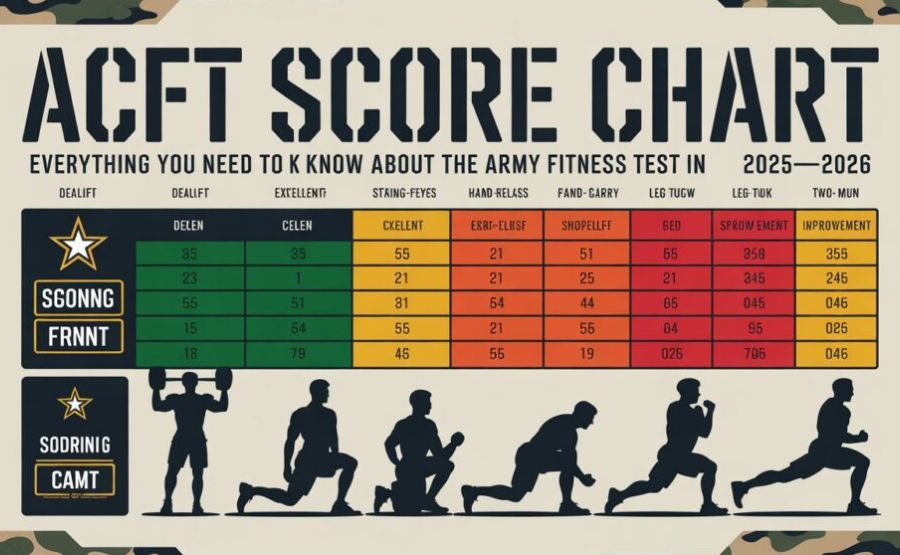
Here’s something that catches a lot of people off guard: the test everyone’s been training for — the ACFT — officially stopped being the Army’s fitness test on June 1, 2025.
It’s been replaced by something called the Army Fitness Test, or AFT. But the ACFT’s structure, scoring principles, and six-event model are still deeply relevant — because the AFT kept five of those six events and uses a nearly identical scoring system. So if you’re studying the ACFT score chart, you’re 90% of the way to understanding the AFT too.
Let me walk you through all of it. The old test. The new test. Every event. Every number. And exactly what a score means for a soldier’s career.
Quick Facts
| Feature | Details |
| Full name | Army Combat Fitness Test |
| Official period | October 2022 – May 31, 2025 |
| Replaced by | AFT (Army Fitness Test), starting on June 1, 2025 |
| Number of events | 6 |
| Max possible score | 600 points (100 per event) |
| Minimum pass per event | 60 points |
| Heavy MOS minimum | 70 points per event |
| Significant MOS minimum | 65 points per event |
| Moderate MOS minimum | 60 points per event |
| Age/gender scoring | Yes — adjusts by age group and sex |
| Time limit for full test | 90 minutes |
| Scoring body | U.S. Army |
| Replaced | APFT (Army Physical Fitness Test, used since 1983) |
Why the Army Changed the Outdated Fitness Exam
Before the ACFT, soldiers took something called the APFT — the Army Physical Fitness Test. That test had been running since 1983. Forty years of the same three events: push-ups, sit-ups, and a two-mile run.
The problem? Modern warfare doesn’t look like 1983. Soldiers carry heavy loads over rough terrain. They lift, drag, sprint, throw, and hold positions for extended periods under stress. A push-up-and-run test doesn’t tell you much about whether someone can do that.
Another issue was injury rates. Data showed that certain soldier tasks — particularly carrying casualties and maneuvering with equipment — were causing musculoskeletal injuries at alarming rates. The Army wanted a test that prepared people for those demands, not just measured baseline cardiovascular fitness.
The ACFT was the answer. Six events. Each one mapped to a real battlefield task. And scoring that treated the test as one unified challenge rather than three separate exercises.
See also “Who’s vs Whose: The Complete Guide to Getting It Right Every Time“
The Six ACFT Events — What They Are and Why
Every event was designed with a purpose. Let me walk through each one.
1. Three-Repetition Maximum Deadlift (MDL)
This tests your raw lower-body and core strength. You lift a hex (hexagonal) bar as heavy as you can, three times in a row. The minimum to score any points is 80 pounds. A perfect 100-point score on the male scale for ages 17–21 requires lifting 340 pounds.
This event connects directly to lifting and loading tasks on a battlefield — loading ammunition, moving heavy equipment, picking up an injured fellow soldier.
2. Standing Power Throw (SPT)
You pick up a 10-pound medicine ball and throw it backward over your head, measured by how far it travels. This event tests explosive power and total-body coordination. It’s the event that got cut when the AFT replaced the ACFT in June 2025, mainly due to concerns about injury risk and inconsistent grading in the field.
3. Hand-Release Push-Up (HRP)
This isn’t a standard push-up. You go all the way down to the ground, briefly release your hands off the floor to break contact, then push back up. That reset ensures every rep is full range of motion. No cheating with half-reps. In two minutes, you try your hardest.
4. Sprint-Drag-Carry (SDC)
This is five 50-meter back-and-forth lanes that test completely different physical qualities back to back. You sprint one length. Drag a 90-pound sled one length. Carry two 40-pound kettlebells one length. Do lateral shuffles one length. Sprint again. This event is timed and covers 250 meters total. It mirrors the variety of demands soldiers face in short, intense bursts.
5. Plank (PLK)
Replace sit-ups with a plank. That was one of the ACFT’s deliberate changes. Sit-ups were associated with lower back injuries. The plank — holding a rigid position on forearms and toes — tests core endurance without that risk. You hold the position as long as possible, up to a maximum of 4 minutes and 20 seconds, which earns a perfect 100 points.
6. Two-Mile Run (2MR)
The classic finisher. Run two miles as fast as you can. This has been in Army fitness tests for decades because it works — aerobic endurance is genuinely important. The difference from the old APFT is that this event follows five demanding events, not the first thing you do while fresh.
How the ACFT Scoring System Works
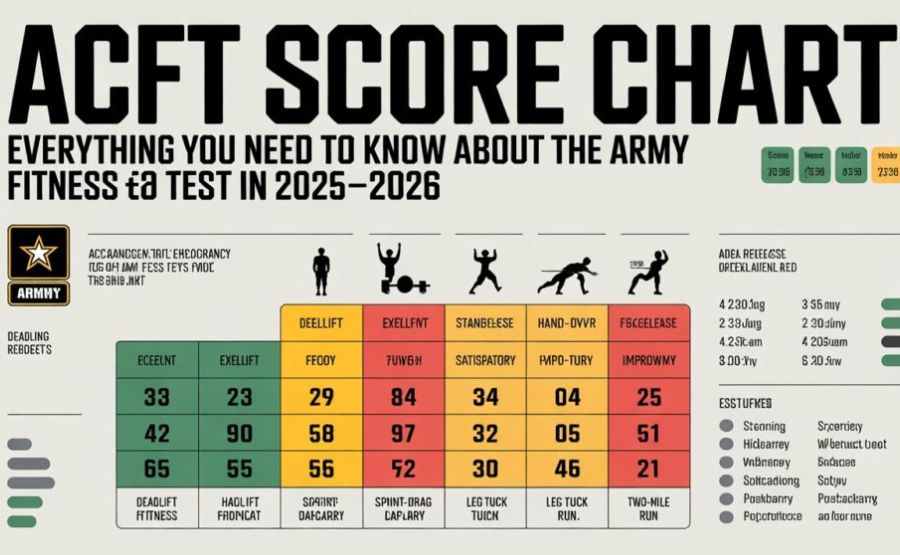
Each event is scored on a scale from 0 to 100 points. The maximum possible total score is 600.
But you don’t start at zero and earn your way up. There’s a minimum threshold per event. If you score below 60 on any single event, you fail the entire test — even if every other event was excellent.
That matters. A soldier who runs a phenomenal two-mile but collapses during the deadlift fails. The test is designed this way deliberately. The Army doesn’t want someone who’s outstanding in one dimension but dangerously weak in another.
The Three MOS Categories — Heavy, Significant, Moderate
MOS stands for Military Occupational Specialty. Essentially, it’s your job in the Army. And the ACFT adjusted its minimum standards based on how physically demanding your job is.
The most physically taxing positions are Heavy (Black).. Infantry, Special Forces, combat engineers. These soldiers needed a minimum of 70 points per event. Failing to reach 70 on even one event while in a Heavy MOS meant failing the test.
Significant (Gray) — Roles with high but slightly less extreme physical demands. Minimum of 65 points per event.
Moderate (Gold) — Jobs with moderate physical demand. Minimum of 60 points per event. This is also the Army-wide minimum — no one passes with less than 60 on any event, regardless of their MOS.
This was a key change from the old APFT. Before, everyone took the same test to the same minimum standard regardless of their job. The ACFT acknowledged that the same minimums shouldn’t be applied to someone removing a building and someone operating a supply truck.
Age and Gender in ACFT Scoring
The ACFT was a significant departure from the APFT in another way. It reintroduced age-based scoring, and it maintained separate male and female standards.
This was controversial. Some argued the test should be completely gender-neutral since combat doesn’t adjust for gender. Others pointed out that physiological differences are real and a purely neutral standard would push women out of some roles unfairly.
The ACFT’s answer was separate tables by age group and gender. Older soldiers needed fewer deadlift pounds or fewer push-up reps to earn the same points as younger soldiers. The physical standards scaled with what’s reasonably achievable at different points in a career.
Here’s a sense of how the age groups were structured (brackets varied slightly by event):
- Ages 17–21
- Ages 22–26
- Ages 27–31
- Ages 32–36
- Ages 37–41
- Ages 42–46
- Ages 47–51
- Ages 52–56
- Ages 57+
A 50-year-old Staff Sergeant and a 19-year-old Private weren’t competing on the same scale. Each had standards appropriate to their age group, while both still had to hit that minimum of 60 points per event.
Sample Score Standards — What Numbers Actually Mean
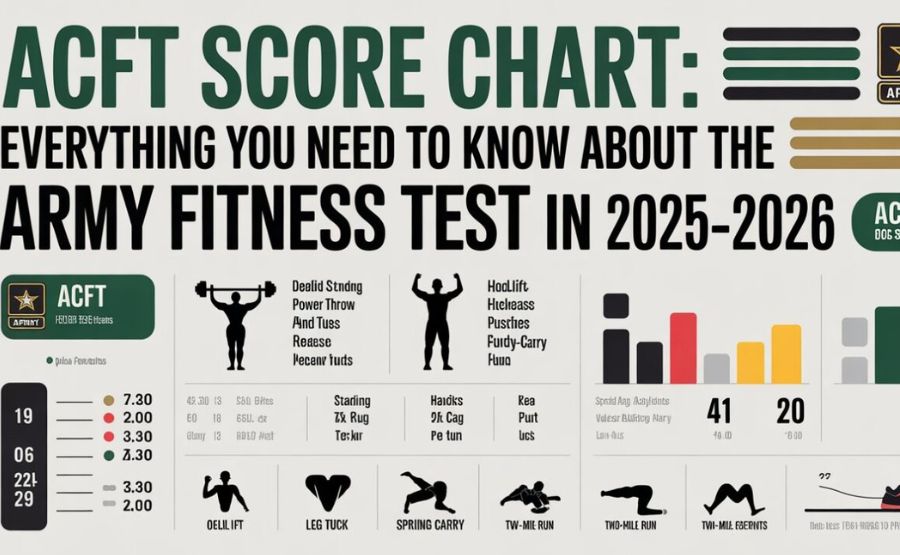
Let me give you a real-world sense of what scores look like for the major events. These are approximate figures based on official ACFT tables for adult males in the 22–26 age bracket:
Maximum Deadlift (100 points): 340 lbs
Maximum Deadlift (minimum/60 points): 180 lbs
Hand-Release Push-Up (100 points): 60 reps in 2 minutes
Hand-Release Push-Up (60 points): 20 reps
Sprint-Drag-Carry (100 points): 1 minute 33 seconds
Sprint-Drag-Carry (60 points): 2 minutes 10 seconds
Plank (100 points): 4 minutes 20 seconds
Plank (60 points): 1 minute 30 seconds
Two-Mile Run (100 points): 13 minutes 30 seconds
Two-Mile Run (minimum/60 points): 18 minutes 00 seconds
Female standards in the same age bracket required fewer pounds on the deadlift, fewer push-up reps, and slightly different run times while still earning equivalent points. The system was built so that a 60-point performance represents genuine minimum readiness across the board, regardless of who’s taking the test.
The ACFT and Promotion Points
This is where the score chart stops being just a fitness number and starts being a career number.
ACFT scores fed directly into the Army’s semi-centralized promotion system. The maximum points a soldier could earn from the ACFT for promotion consideration was 120. Higher scores translated into more promotion points, which stacked against points from education, duty performance, military awards, and other factors.
A soldier scoring near 600 on the ACFT earned significantly more promotion points than someone scraping by at 360. Over a career, those differences compound.
Under the newer AFT (which took over in June 2025), a revised promotion points table was implemented. Old ACFT scores recorded before May 31, 2025 remained valid for promotion purposes through September 30, 2025, giving soldiers time to transition.
Alternate Events for Soldiers on Profile
Not every soldier can perform every standard event. Injuries, chronic conditions, and medical profiles create real exceptions. The ACFT included alternate aerobic events for soldiers who couldn’t run the two-mile.
Those alternates included:
- A 2.5-mile walk (for those unable to run)
- A 12-kilometer stationary bike ride
- A 5-kilometer row on a rowing machine
- A swim event (though this was rarely administered due to facility requirements)
These were not offered to anyone who simply preferred a different event. A soldier needed a documented medical profile to access alternates. Temporary profiles allowed temporary substitution. A permanent profile created a more lasting accommodation built into the soldier’s record.
The alternate scoring wasn’t identical to the run scoring — it used a different conversion, and in some cases resulted in a Go/No-Go outcome rather than a point-based score.
When the ACFT Became Official — A Brief History
The road to the ACFT was longer and bumpier than most people realize.
The Army started developing the test around 2018 and ran pilot testing over the following two years. The original rollout faced significant controversy — concerns about injury risk, fairness for women, and the difficulty of standardizing some events across different bases and conditions.
The Standing Power Throw, in particular, drew criticism. Grading it consistently required calibrated equipment and trained evaluators, and results varied in ways that didn’t always reflect actual fitness differences.
After multiple adjustments, the Army unveiled what it called the “final version” on March 23, 2022. It became the official test of record for Active Duty in October 2022 and for Reserve and National Guard by early 2024. Then on June 1, 2025 — after analyzing data from nearly one million ACFT iterations and consulting with the RAND Corporation — the Army made another shift. The ACFT became the AFT. Five events instead of six. Same spirit, refined execution.
ACFT vs AFT — The Key Differences
Since so many people are searching for ACFT information while actually needing AFT clarity, here’s a direct side-by-side comparison:
| Feature | ACFT (Oct 2022 – May 2025) | AFT (June 2025 onward) |
| Number of events | 6 | 5 |
| Max score | 600 | 500 |
| Removed event | — | Standing Power Throw |
| Combat MOS minimum | 70 pts per event | 60 pts per event + 350 total |
| Non-combat minimum | 60 pts per event | 60 pts per event + 300 total |
| Gender scoring | Age+gender normed | Age normed; combat MOS sex-neutral |
| Effective date | April 2022 | June 1, 2025 |
The biggest philosophical shift is that the AFT introduced a total score minimum in addition to the per-event minimum. Passing the ACFT required 60 per event — nothing else. The AFT requires 60 per event AND a total of at least 300 (or 350 for combat roles). That change means you can’t coast on strong events and barely pass weak ones. You need genuine across-the-board performance.
What a “Good” ACFT Score Actually Looked Like
Numbers mean different things in different contexts. Here’s a practical guide to what ACFT scores meant in practice:
- 360 total (60 per event) — Minimum passing for most soldiers. You’re compliant, but you’re not standing out.
- 420–480 total — Solid performance. Competitive for non-combat roles. This is a respectable score.
- 480–540 total — Strong soldier. Well above average. Good for promotion considerations.
- 540–580 total — High performer. The kind of score that gets noticed.
- 580–600 total — Elite. Very few soldiers hit this range. A near-perfect performance across all six events.
For combat MOS soldiers (Heavy category), the effective minimum was 420 — 70 per event — making that the real baseline for infantry, Rangers, and similar roles.
Final Words
The ACFT score chart represents more than a fitness measurement. It represents a serious moment in Army history — the decision to finally align physical testing with what soldiers actually do in the field.
Forty years of push-ups, sit-ups, and two-mile runs gave way to deadlifts, medicine ball throws, and obstacle-style carries. The idea was simple: if the test looks like the job, soldiers who pass the test will actually be ready for the job.
The transition to the AFT in June 2025 refined that idea further. Fewer events, cleaner standards, a total-score requirement that prevents lopsided fitness. The ACFT’s DNA lives on in the AFT.
Whether you’re a soldier prepping for your next test, a civilian curious about military standards, or someone digging through old PT scores trying to understand career implications, the core principles are the same. Sixty points minimum per event. Real strength, real endurance, real agility. And a score that either opens doors or closes them.
Train accordingly.
FAQs
1. What is the ACFT?
The Army Combat Fitness Test was the official U.S. Army physical fitness test from October 2022 to May 31, 2025. It consisted of six events worth 100 points each, for a total maximum score of 600.
2. What replaced the ACFT?
On June 1, 2025, the ACFT was replaced with the Army Fitness Test (AFT). The AFT has five events (the Standing Power Throw was removed) and a maximum score of 500. The structure and five remaining events are essentially the same.
3. What is the minimum passing score on the ACFT?
Each event requires a minimum score of 60 points for each soldier. The minimum per-event score also varies by MOS category: 70 for Heavy, 65 for Significant, and 60 for Moderate.
4. What is a perfect ACFT score?
600 points — 100 points on each of the six events. Very few soldiers achieve this. It requires elite-level performance in every category.
5. What are the six ACFT events?
Three-Repetition Maximum Deadlift (MDL), Standing Power Throw (SPT), Hand-Release Push-Up (HRP), Sprint-Drag-Carry (SDC), Plank (PLK), and Two-Mile Run (2MR). The Standing Power Throw was removed in the AFT update.
6. Does the ACFT score chart differ by age and gender?
Yes. Scoring tables were adjusted by age group (roughly in 5-year brackets) and gender. Older soldiers and female soldiers had different raw performance thresholds to earn the same point totals.
7. How does the ACFT affect promotion points?
ACFT scores fed into the Army’s semi-centralized promotion system, with a maximum of 120 promotion points available based on fitness score. Higher ACFT scores earned more promotion points, directly affecting career advancement speed.
8. What happens if you fail one ACFT event?
You fail the entire test — even if you scored 100 on every other event. You must still complete the remaining events, but the overall result is a fail. Soldiers who fail may face counseling, additional training requirements, and career implications.
9. How long does the ACFT take?
The test must be completed within 90 minutes from start to finish, including the preparation drill. Events are performed in a set order with brief rest periods between them.
10. What are alternate aerobic events on the ACFT?
Soldiers with medical profiles who cannot run the two-mile can substitute with a 2.5-mile walk, a 12-kilometer stationary bike, a 5-kilometer row, or a swim event. These require documented medical profiles — they aren’t available by choice.
11. Are old ACFT scores still valid?
ACFT scores recorded before May 31, 2025 remained valid for promotion considerations through September 30, 2025. After that date, only AFT scores under the new system count.
12. What is the Heavy, Significant, Moderate MOS classification?
These are three physical demand categories that classified every Army job. Heavy (Black) jobs — like infantry — required 70 minimum per event. Significant (Gray) required 65 per event. Moderate (Gold) required 60 per event.
13. What’s a good ACFT score to aim for?
For most soldiers, anything above 450 is competitive. Combat MOS soldiers should target 500+. If you’re aiming for schools, special assignments, or strong promotion consideration, 480 and above puts you in a strong position.
14. How is the ACFT different from the old APFT?
The APFT had three events — push-ups, sit-ups, and a two-mile run. The ACFT expanded to six events covering strength, power, endurance, speed, and agility. The ACFT also scored based on MOS physical demand, while the APFT used the same standard for every soldier.
15. Does the AFT score chart work the same as the ACFT?
Very similarly. The AFT employs the same minimum score of 60 points per event and the same scoring range of 0 to 100. The main differences are: five events instead of six, a maximum of 500 points instead of 600, and new total score minimums (300 for most soldiers, 350 for combat MOS). If you understand the ACFT score chart, the AFT is a quick adjustment.
Explore more, learn more, and think deeper with Theory Magazine.