Quick Facts
| Detail | Value |
| Weight (US gallon, whole milk) | 8.6 pounds / 3.9 kg |
| Weight (US gallon, skim milk) | ~8.63 pounds / 3.91 kg |
| Weight (US gallon, 2% milk) | ~8.62 pounds / 3.91 kg |
| Weight (UK imperial gallon, milk) | ~10.3 pounds / 4.67 kg |
| US gallon size | 3.785 liters / 128 fl oz |
| UK imperial gallon size | 4.546 liters / 160 fl oz |
| Milk density | 1.026–1.034 g/cm³ |
| Water weight (US gallon) | 8.34 pounds / 3.78 kg |
| Half-gallon of milk | ~4.3 pounds / 1.95 kg |
| Milk water content | ~87.7% |
The Simple Answer First
You’re in the grocery store. You grab that big plastic jug of milk. You think, “This doesn’t seem that heavy.”
But it is.
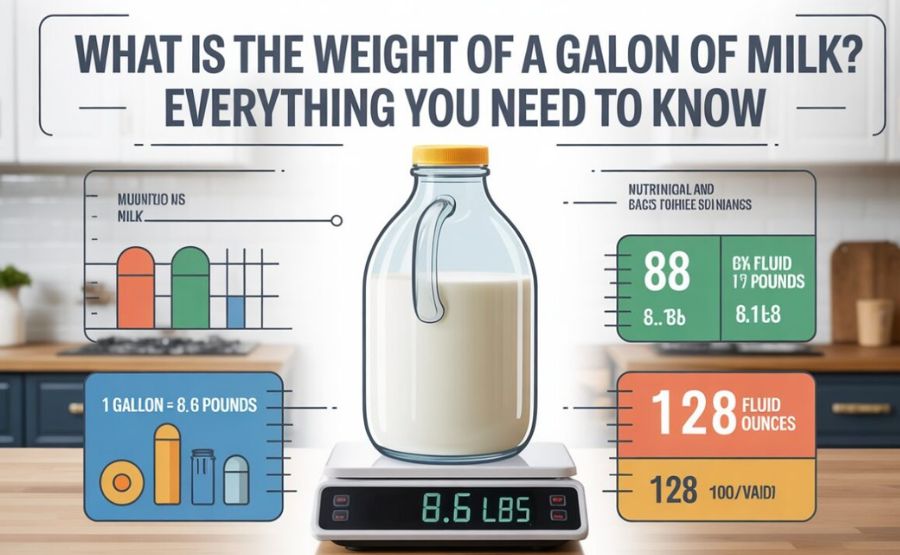
A standard US gallon of whole cow’s milk weighs about 8.6 pounds — that’s around 3.9 kilograms. You’re basically carrying the same weight as a medium-sized house cat every time you pick one up.
Now here’s where it gets interesting. That number shifts depending on where you live, what kind of milk you buy, and even how cold it is. Let’s walk through all of it, one piece at a time.
See also “Convert ml into oz: The Complete, No-Confusion Guide“
Does a Gallon of Milk Weigh the Same Everywhere?
Short answer — no. Not even close.
If you’re in the United States, a gallon holds 128 fluid ounces, which is about 3.785 liters. That gives you 8.6 pounds of milk when you fill it up.
Now hop across the ocean to the United Kingdom. Their “gallon” is a different beast entirely. A UK imperial gallon holds 160 fluid ounces — about 4.546 liters. That extra volume means a British gallon of milk weighs closer to 10.3 pounds (4.67 kg).
That’s nearly two pounds heavier — not because the milk is different, but because the container is bigger.
Most of the rest of the world just uses liters and skips the whole gallon conversation. Honestly, that might be simpler.
Why Is Milk Heavier Than Water?
Here’s something that surprises a lot of people.
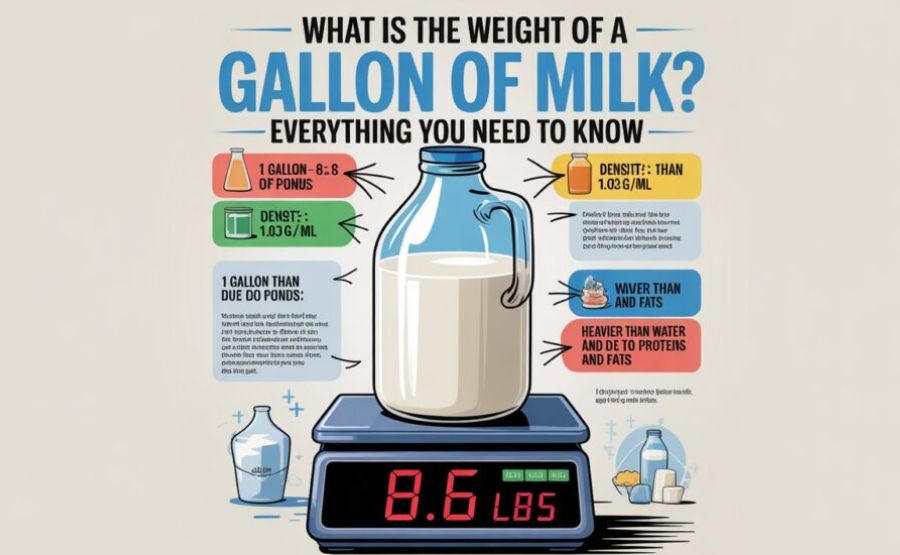
A gallon of plain water weighs about 8.34 pounds. A gallon of milk weighs 8.6 pounds. Milk is heavier — even though both are liquids you pour from a jug.
Why? Think of it this way.
Milk is not just white water. It’s a whole mixture — about 87.7% water, yes, but the rest is fat, protein, sugar (lactose), minerals, and vitamins. Scientists have identified over 250 different chemical compounds in milk. All of those extra ingredients are packed into the same space, making milk denser than plain water.
Density is just a fancy word for “how much stuff is squeezed into a space.” More stuff = more weight.
That’s why milk wins the scale comparison every time.
Whole Milk vs. Skim Milk — Which One Weighs More?
This is the part where people get confused. And honestly, it’s a bit counterintuitive.
You might think whole milk is heavier because it has more fat. More fat = more weight, right?
Actually, no. Here’s the twist.
Fat is lighter than water. When cream sits in a glass of milk, it floats to the top — that fat being less dense than the watery part beneath it. So when you take fat away from milk (like in skim milk), you’re replacing that lighter stuff with more of the heavier stuff — water, protein, minerals.
The result? Skim milk ends up slightly denser, and thus slightly heavier per gallon.
The numbers are close:
- Whole milk (3.25% fat): ~8.6 lbs per gallon
- 2% reduced fat milk: ~8.62 lbs per gallon
- 1% low-fat milk: ~8.63 lbs per gallon
- Skim/fat-free milk: ~8.63 lbs per gallon
The difference is only about 0.03 pounds. You’d never feel it in your hand. But it’s real, and it’s measurable in a lab.
Does Temperature Change How Much Milk Weighs?
Yes — but only a tiny bit.
Cold milk is slightly denser than warm milk. When any liquid gets cold, its molecules slow down and pack together tighter. Tighter packing = more density = slightly more weight in the same space.
So technically, the cold milk you pull from the fridge weighs a hair more than the same milk left on the counter. But the difference is so tiny you’d need precise equipment to even notice it.
For shopping, cooking, or hauling groceries — temperature doesn’t matter. Just know that dairy farms and scientists measure milk density at a standard temperature so all their numbers line up cleanly.
How Do You Calculate Milk’s Weight Yourself?
Want to figure it out from scratch? Here’s the simple method.
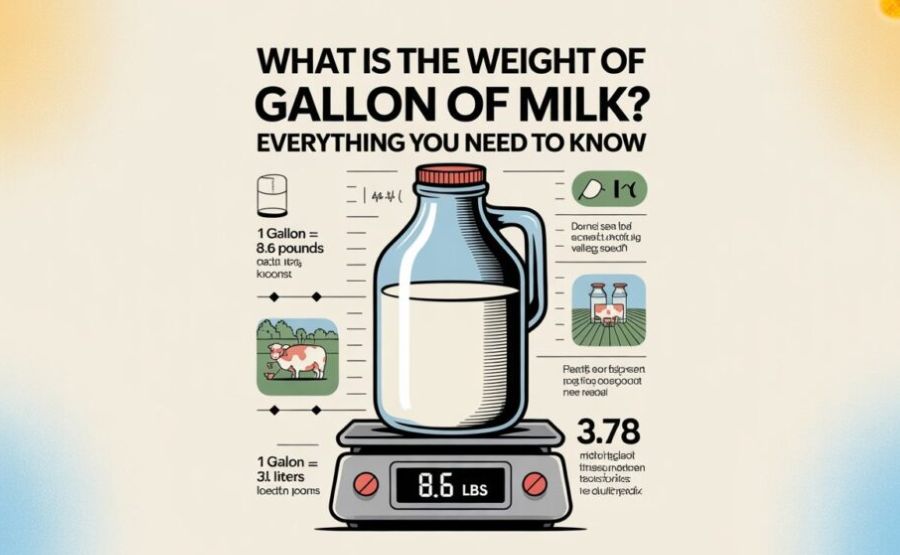
Milk’s density sits between 1.026 and 1.034 grams per cubic centimeter. Scientists usually use an average of 1.03 g/cm³ for calculations.
One US gallon equals 3,785.41 cubic centimeters.
Multiply those two numbers together: 3,785.41 × 1.03 = about 3,898 grams.
Then convert grams to pounds (divide by 453.59) and you land right around 8.6 pounds. Math confirmed.
If you want the quick cheat sheet for smaller amounts:
- 1 quart of milk ≈ 2.15 lbs
- 1 pint of milk ≈ just over 1 lb
- 1 cup of milk ≈ 0.54 lbs
- Half-gallon ≈ 4.3 lbs
Old-timers used to say “a pint’s a pound the world around.” That phrase was made for water. Milk breaks the rule by just a little — a pint of milk is slightly over one pound because it’s denser.
What About Plant-Based Milks?
The milk aisle looks very different now than it did 20 years ago.
Almond milk, oat milk, soy milk, coconut milk, rice milk, pea milk — they’re everywhere. And their weights? They differ from cow’s milk because their ingredients are different.
Almond milk is mostly water with a small amount of almonds. It’s much lower in fat and calories than cow’s milk, so a gallon of it tends to be lighter.
Oat milk is thicker and creamier. It has more carbohydrates than most alternatives. Its density sits closer to cow’s milk than almond milk does.
Soy milk is nutritionally the closest to cow’s milk of all the plant-based options. It matches cow’s milk in protein content, so its weight per gallon is also closer to dairy.
Coconut milk (the carton kind, not the canned curry kind) has a fat content similar to cow’s milk, making it one of the heavier plant-based options by the gallon.
None of these will land at exactly 8.6 pounds per gallon. But they’ll all be in the same general ballpark — within a pound or so — because they’re still mostly water with add-ins.
The Difference Between Cow’s Milk, Buffalo Milk, and Goat’s Milk
Not all dairy comes from cows.
Buffalo milk is rich and thick. It contains more fat and more protein per liter than regular cow’s milk. Because protein is denser than fat, and buffalo milk packs in more of both, it actually has a higher specific gravity than cow’s milk. A gallon of buffalo milk weighs a bit more.
Goat’s milk contains the most fat of common dairy milks according to nutrition research, but it also has a different fat structure — smaller globules that blend more easily into the liquid. Its weight per gallon is comparable to cow’s milk.
Skim versions of any milk — whether cow, goat, or buffalo — tend to weigh slightly more than their full-fat counterparts for the same reason we already covered: less fat means denser liquid.
Practical Moments When This Actually Matters
“Okay, cool science,” you might be thinking. “But when does this ever matter to me?”
More often than you’d expect.
In the kitchen: Most recipes list milk in cups or ounces — and that’s fine. But if you’re ever measuring milk by weight on a food scale (like professional bakers do), knowing that one cup of milk weighs about 8.6 oz rather than 8 oz helps keep your proportions accurate.
Carrying groceries: Two gallons of milk in a bag is roughly 17 pounds. Now you know why your arm feels like it’s about to fall off. Use two bags.
Dairy farming: Farms don’t measure production in gallons — they measure in pounds. A single dairy cow can produce 50 to 60 pounds of milk per day. That’s 5 to 7 gallons daily, from one animal. Over a week, that same cow produces 350 to 420 pounds of milk.
Cheese math: It takes around 10 pounds of milk to make just 1 pound of cheese. So a single gallon of milk — at 8.6 pounds — makes less than one pound of cheese. That’s why good cheese costs what it does.
Shipping and logistics: Milk companies move millions of gallons. A tiny error in weight estimation multiplied millions of times becomes a massive problem. Dairy scientists measure density constantly.
A Fun Comparison — Milk vs. Other Common Liquids
Just to put things in perspective, here’s how a gallon of milk stacks up against other things you pour:
- Water: 8.34 lbs — lighter than milk
- Whole milk: 8.6 lbs — our star
- Orange juice: ~8.6 lbs — almost identical to milk
- Honey: ~12 lbs — much heavier
- Gasoline: ~6.1 lbs — lighter than milk
- Vegetable oil: ~7.7 lbs — lighter than milk
So milk is denser than many everyday liquids, but not the heaviest by a long shot.
Why Skim Milk Weighing More Is Hard to Believe
Let’s sit with this one more second because it genuinely confuses people.
When you remove fat from milk, you’d expect to make it lighter. Fat has mass. Taking things out should reduce the total, right?
Here’s what actually happens. Fat takes up space. When you remove fat, the space it occupied doesn’t go away — it fills with more of the watery, protein-rich liquid. That replacement liquid is heavier per unit of space than fat was.
Think of it like replacing cotton stuffing in a pillow with sand. You removed the cotton, but the sand that fills the same space weighs more. The pillow (gallon) didn’t get smaller — but it got heavier.
That’s skim milk in a nutshell.
Final Words
So, what is the weight of a gallon of milk?
In the US, it’s 8.6 pounds of whole milk — and a fraction heavier if it’s skim. In the UK, that same “gallon” label means a bigger container that weighs about 10.3 pounds. The difference comes from one simple fact: the word “gallon” means different things in different countries.
Milk is heavier than water because it carries more inside it — fat, protein, minerals, sugar, and hundreds of other compounds your body actually uses. That extra weight is why milk nourishes us the way it does.
Next time you hoist that jug out of the fridge, you’ll know exactly what you’re holding. Not just milk. But 8.6 pounds of nutrition, chemistry, and a little bit of science in a plastic handle.
FAQs
1. How much does a gallon of whole milk weigh?
A US gallon of whole milk weighs approximately 8.6 pounds (3.9 kilograms).
2. Does a gallon of milk weigh more than a gallon of water?
Yes. Water weighs 8.34 lbs per gallon, while milk weighs 8.6 lbs. The extra fat, protein, and minerals in milk make it slightly heavier.
3. Does skim milk weigh more or less than whole milk?
Skim milk actually weighs a tiny bit more — about 8.63 lbs vs. 8.6 lbs — because fat is lighter than water, and removing fat makes the remaining liquid denser.
4. Why does a UK gallon of milk weigh more than a US gallon?
Because a UK imperial gallon (4.546 liters) is larger than a US gallon (3.785 liters). More liquid = more weight.
5. How much does a half-gallon of milk weigh?
About 4.3 pounds (1.95 kg) — exactly half of a full gallon.
6. How much does 2% milk weigh compared to whole milk?
2% milk weighs about 8.62 lbs per gallon. The difference from whole milk (8.6 lbs) is barely noticeable.
7. Does temperature affect the weight of milk?
Slightly. Cold milk is denser and marginally heavier. But the difference is so small it doesn’t matter for everyday cooking or shopping.
8. How many pounds is a quart of milk?
About 2.15 pounds.
9. Does plant-based milk weigh the same as cow’s milk?
Not exactly. Almond milk tends to be lighter. Soy milk and oat milk are closer to cow’s milk in weight. The specific weight depends on each product’s ingredients and water content.
10. How much does a gallon of milk weigh in kilograms?
About 3.9 kilograms for a US gallon of whole milk.
11. Why does it take so much milk to make cheese?
Because it takes roughly 10 pounds of milk to yield 1 pound of cheese. Most of the milk weight is water and whey, which separate out during cheesemaking.
12. Is a pint of milk really a pound?
Almost. The old saying “a pint’s a pound the world around” works well for water. Milk is slightly heavier, so a pint of milk is just over one pound.
Explore more, learn more, and think deeper with Theory Magazine.