Quick Facts
| Fact | Value |
| Weight per gallon of liquid propane | 4.2 lbs (1.9 kg) |
| Weight per pound in gallons | 0.236 gallons |
| Standard temperature for measurement | 60°F (15.5°C) |
| Propane density | ~0.493 g/cm³ |
| Empty 20 lb tank (tare weight) | ~17 lbs |
| Full 20 lb tank (total weight) | ~37 lbs |
| BTUs per gallon of propane | ~91,500 BTU |
| BTUs per cubic foot | ~2,516 BTU |
| Propane vs. water weight per gallon | 4.2 lbs vs. 8.34 lbs |
| Chemical formula | C₃H₈ |
| Safe fill level of any tank | 80% of capacity |
The Number Everyone Searches For
Let me just give it to you right away.
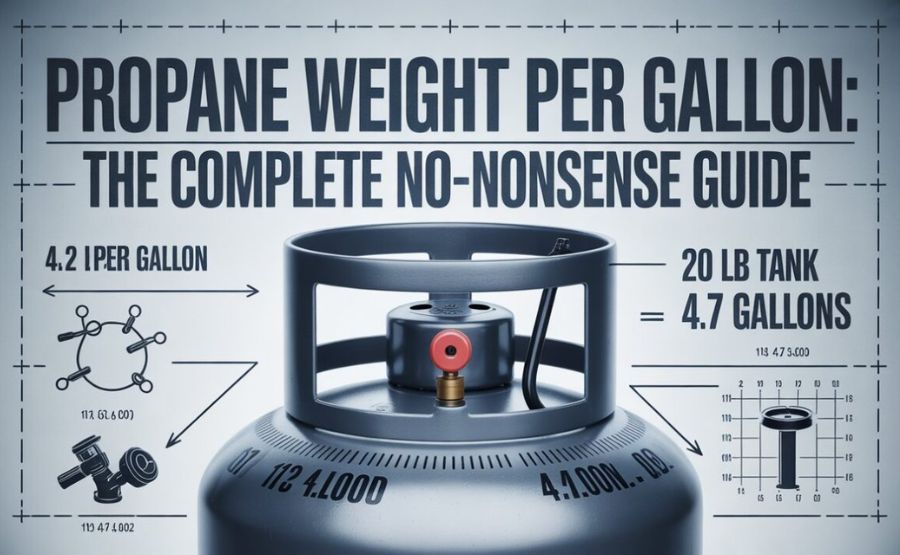
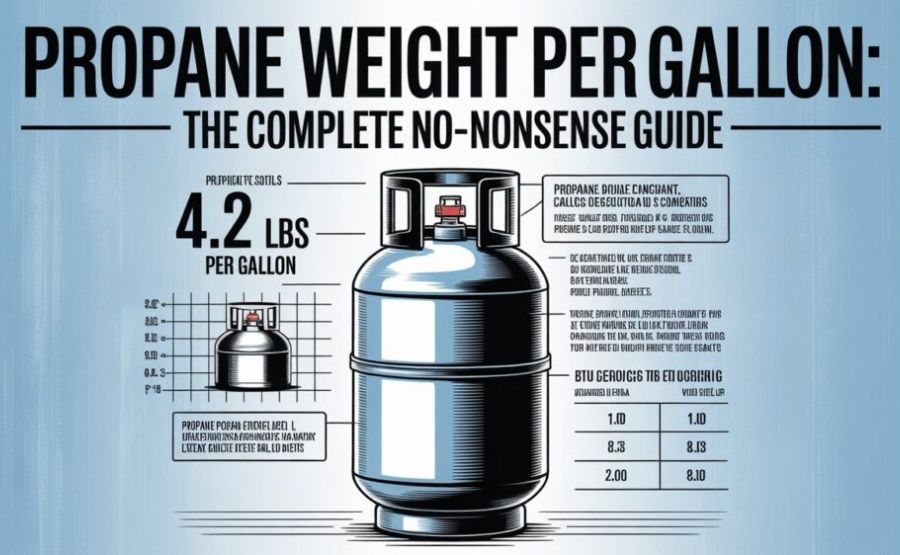
One liquid gallon of propane weighs 4.2 pounds — or about 1.9 kilograms if you think in metric. That number, 4.2, is the one you’ll use for almost every propane calculation you’ll ever do.
Some sources say 4.23. Some say 4.24. A few say 4.25. The tiny differences come from rounding and measurement temperature. For everyday life — grilling, heating, camping, cooking — just use 4.2 and you’ll never go wrong.
Now let’s talk about why propane weighs what it weighs, what changes that number, and how to actually use it.
See also “What Is the Weight of a Gallon of Milk? Everything You Need to Know“
Wait — Why Is Propane Measured in Gallons AND Pounds?
This trips people up constantly. And honestly, it’s a fair complaint.
When you fill up a car, you buy gas in gallons. When you grab a propane tank for your grill, the label says “20 lb.” When your house has a big propane tank, the gauge reads in percentages and gallons.
Why can’t propane just pick one unit and stick with it?
Here’s the short answer. Propane lives as a liquid inside the tank but escapes as a gas when you use it. Volume (gallons) makes sense for delivery and billing. Weight (pounds) is used for portable tanks because it’s easier to weigh a tank than to fit a pump with a flow meter.
Both are correct. Both are useful. The magic number — 4.2 — converts between them.
Gallons × 4.2 = Pounds of propane
Pounds ÷ 4.2 = Gallons of propane
That’s your cheat sheet.
How Temperature Changes the Weight
Here’s something that even experienced grillers don’t always know.
Propane weighs 4.2 pounds per gallon at 60°F. That’s the industry standard temperature — the number printed in textbooks and used by fuel companies for billing.
But propane is sensitive to temperature. When it gets cold, propane liquid gets denser. The same gallon takes up a little less space. When it gets warm, propane expands and that same gallon takes up more room.
On a hot summer afternoon, a full tank holds slightly fewer pounds per gallon than the same tank on a cold winter morning.
For billing purposes, this difference matters. For backyard grilling purposes, you’ll never notice. The difference between hot and cold propane by weight is just a few fractions of a pound per gallon.
The Mystery of Why Propane Is Lighter Than Water
Pick up a gallon of milk. It weighs about 8.6 pounds. Pick up a gallon of water. About 8.34 pounds. Now imagine a gallon of propane — just 4.2 pounds.
That’s barely half the weight of water.
How does that work?
Propane’s molecules are just structured differently. Propane (C₃H₈) is made of carbon and hydrogen atoms arranged in a way that leaves lots of empty space between them. The molecules don’t pack together as tightly as water molecules do.
Less tight packing = lower density = lighter per gallon.
It’s the same reason gasoline (about 6 lbs per gallon) is lighter than water too. Hydrocarbons — the family propane belongs to — are generally less dense than water.
Understanding Tank Weights — The Tare Weight Secret
This is the piece of knowledge that most people are missing. And it’s genuinely useful.
Every propane tank has two weights to know:
1. The tare weight (TW) — how much the empty metal tank itself weighs. This number is stamped right onto the metal collar at the top of the tank. Look for the letters “TW.”
2. The propane weight — how many pounds of actual fuel are inside.
Add them together and you get the total weight.
Here’s the simple formula: Total weight = TW + (gallons × 4.2)
Say your grill tank has a tare weight of 17 pounds and holds 4.7 gallons of propane. That’s 17 + (4.7 × 4.2) = 17 + 19.74 = about 37 pounds when full.
When you pick up your tank and it feels light, set it on a bathroom scale. Say the scale reads 29 pounds and the TW is 17. Subtract: you’ve got 12 pounds of propane left. Divide 12 by 4.2 and that’s about 2.8 gallons remaining.
Now you know exactly where you stand.
Propane Tank Sizes and Their Real Weights
Propane tanks come in a wild range of sizes. Here’s a quick tour from smallest to biggest:
Small portable (1 lb): Those tiny camping canisters for a backpacking stove. They weigh about 1.5 lbs empty and under 2.5 lbs full.
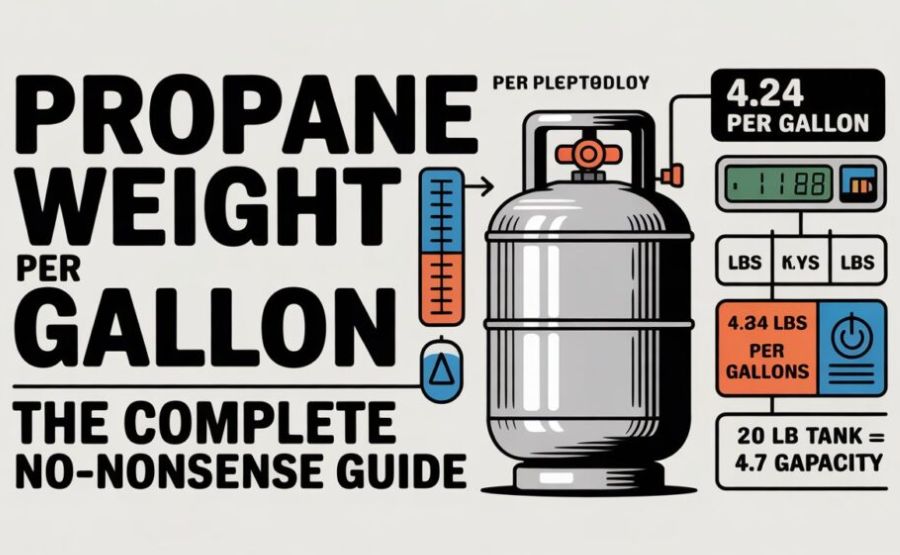
20 lb tank (grill size): This is the standard backyard BBQ tank. Empty weight is around 17 lbs. Full, you’re looking at roughly 37 lbs. It holds about 4.7 gallons of propane — not 20 gallons. Remember, the “20 lb” name refers to pounds of propane, not gallons.
30 lb tank: Popular with RV owners. Empty around 25 lbs, full around 55 lbs. Holds about 7.1 gallons.
100 lb tank: Common for small appliances or backup heating. Empty around 70 lbs, full around 170 lbs.
100 gallon tank: Used for small homes or single appliances. Empty around 215 lbs, full around 555 lbs.
250 gallon tank: A medium residential tank. Empty about 485 lbs, full about 1,335 lbs.
500 gallon tank: Whole-home heating territory. Empty around 950 lbs, full about 2,650 lbs.
1,000 gallon tank: Large homes or commercial use. Empty around 1,760 lbs, full about 5,160 lbs.
Every single one of those calculations starts from the same number — 4.2 pounds per gallon.
The 80% Rule — Why Your “Full” Tank Isn’t Truly Full
Here’s something that frustrates people at first but makes total sense once you understand it.
Propane tanks are never filled completely to 100%.
The industry standard is 80% capacity. A tank labeled “500 gallons” will only ever hold about 400 gallons of propane. A “100 gallon” tank gets filled to 80 gallons.
This isn’t a rip-off. It’s physics.
Propane needs breathing room. Heat makes it expand, and a tank packed solid with liquid and then sitting in summer sun is a disaster waiting to happen. That 20% of empty space allows the liquid to expand safely without the pressure inside the tank climbing to dangerous levels.
So when your gauge shows 80%, that’s actually a full fill. When it drops to 20%, it’s time to call for a delivery. Don’t wait for zero — appliances can behave oddly or pull in air as the tank empties.
How to Tell How Much Propane You Have Left
There are four main ways, and each one is useful in different situations.
Method 1: Use a scale. Weigh the tank. Subtract the tare weight (stamped on the collar). The leftover number is the pounds of propane remaining. Divide by 4.2 to get gallons. This is the most accurate method for portable tanks.
Method 2: The warm water trick. Pour warm (not boiling) water down the side of the tank slowly. Then run your hand along the side. The metal feels warm where there’s no propane. Where propane is present, the metal goes noticeably cool — the liquid inside absorbs the heat. The transition point marks your fuel level. Not lab-accurate, but surprisingly reliable in a pinch.
Method 3: Read the gauge. Big residential tanks have built-in gauges under a little lid on top. The dial looks like a speedometer. The numbers are percentages, not gallons. Multiply the percentage by the tank’s full capacity to get your remaining gallons. Then multiply by 4.2 to get pounds if you want.
Method 4: Smart sensors. Newer wireless propane monitors clip onto your tank or sit inside the valve. They connect to a phone app and show you fuel level in real time. Some even track your usage patterns and send a low-fuel alert before you run out.
Propane’s Energy — Why It Packs Such a Punch
Four pounds sounds light. And it is light. But what propane lacks in weight it makes up for in energy.
One gallon of propane holds roughly 91,500 BTUs of heat energy. One cubic foot of propane gas contains about 2,516 BTUs.
Compare that to natural gas — about 1,030 BTUs per cubic foot. Propane delivers more than twice the energy in the same volume of gas.
That’s why propane appliances are prized in off-grid homes. You burn less fuel to get the same heat. A propane furnace running for an hour does what a natural gas furnace takes two hours to accomplish, in terms of the same cubic footage of fuel burned.
Technically, both fuels burn at similar flame temperatures — around 3,560°F. The difference is how much energy they release per unit. Propane is the more concentrated punch.
Propane vs. Other Fuels — A Weight Comparison
Just to put propane’s 4.2 lbs per gallon in perspective:
- Water — 8.34 lbs/gallon
- Whole milk — 8.6 lbs/gallon
- Gasoline — ~6.1 lbs/gallon
- Diesel — ~7.1 lbs/gallon
- Propane (liquid) — 4.2 lbs/gallon
- Natural gas (liquid) — ~3.5 lbs/gallon
Propane is lighter than most common fuels. But per pound, it holds tremendous energy. That’s a genuinely useful combination for portable energy storage.
Propane and the Environment — The Surprising Truth
Many people assume propane is just another dirty fossil fuel. The real picture is more interesting.
Propane is listed as a clean alternative fuel under the US Clean Air Act. The EPA recognizes it as lower-emission than gasoline, diesel, and coal.
If propane spills or leaks, it doesn’t puddle on the ground and soak into the soil. It immediately turns back into vapor and drifts away. It won’t contaminate groundwater. It won’t kill a lake. It won’t poison the earth your garden grows in.
When burned, propane releases around 50% fewer greenhouse gases than coal and 30–40% fewer than gasoline. Propane furnaces can reach efficiency ratings of 95% or higher, meaning very little of the fuel is wasted.
Does propane produce CO₂ when it burns? Yes — it is a fossil fuel. But compared to heating oil, coal, or gasoline, it is one of the cleaner choices available right now.
And unlike natural gas (which is mostly methane and leaks badly during pipeline transport), propane doesn’t release methane into the atmosphere during everyday use.
Exchange Tanks vs. Refill Stations — A Hidden Difference
Here’s something most people don’t know — and it costs them money.
When you swap your empty tank at a grocery store or hardware store, you’re getting an exchange tank. These tanks are often filled to only 15–18 pounds of propane, even though they’re labeled as 20 lb tanks.
That’s up to 25% less fuel than the label suggests.
When you take your tank to a refill station, you pay for exactly what goes in. A good refill station will fill to a true 20 pounds. That’s more propane for the same cost, or often less.
The lesson? If you want to stretch your dollar and your gas, refilling beats exchanging almost every time.
Practical Uses That Depend on Knowing the Weight
Understanding propane weight isn’t just a trivia fact. It has real everyday uses.
Camping and hiking: Knowing how much your fuel canister weighs empty helps you calculate how much propane you have left without a gauge. Weight it, subtract the empty weight, and divide by 4.2.
Cooking and baking: Professional kitchens and catering operations track propane usage by weight. Knowing 4.2 lbs per gallon lets them predict how many events a tank will last.
RV travel: RV owners live by their propane weight. Running out mid-trip is miserable. Weighing the tank before leaving is a simple habit that saves a lot of frustration.
Home heating planning: When a 250-gallon tank hits 20% on the gauge, that’s 50 gallons left — about 210 pounds of propane. Knowing that tells you roughly how many days of heating you have before a delivery becomes urgent.
Moving a tank safely: Propane tanks over a certain weight require specific handling equipment. Knowing how heavy a full 100-gallon tank is (about 555 lbs) means you know when to call for help rather than try to drag it yourself.
Final Words
Propane is a remarkable fuel hiding inside a plain metal tank.
One gallon weighs just 4.2 pounds — lighter than water, lighter than gas, lighter than almost anything you pour from a container. But those 4.2 pounds hold enough energy to cook dozens of meals, heat a room for hours, or power a grill through an entire summer of backyard cookouts.
The weight per gallon — 4.2 — is a number worth memorizing. It tells you how full your tank is, how much fuel you’re buying, how long it’ll last, and how heavy that tank is going to feel when you carry it back from the truck.
Next time you pick up a propane tank, you’ll know exactly what’s inside. Not just gas. But chemistry, energy, and a little bit of science you can carry in one hand.
FAQs
1. How much does a gallon of propane weigh?
One liquid gallon of propane weighs 4.2 pounds (about 1.9 kg), measured at the standard reference temperature of 60°F.
2. How many gallons are in a 20 lb propane tank?
A 20 lb propane tank holds about 4.7 gallons of propane when filled to the 80% safe capacity level.
3. How heavy is a full 20 lb propane tank total?
About 37 pounds — roughly 17 pounds for the empty tank plus around 20 pounds of propane fuel.
4. Why is a propane tank never filled 100%?
Propane expands when warm. Tanks are filled to only 80% capacity so the liquid has safe room to expand as temperatures rise, preventing dangerous pressure buildup.
5. Does temperature affect how much a gallon of propane weighs?
Yes. Cold propane is slightly denser, so it weighs marginally more per gallon. Warm propane expands and weighs a bit less. The standard measurement is taken at 60°F.
6. What does the tare weight (TW) stamped on my propane tank mean?
It’s the weight of the empty tank with no propane in it. Subtract it from the current total weight to find out how many pounds of propane remain.
7. How do I calculate how much propane is left in my tank?
Weigh the tank, subtract the tare weight stamped on the collar, and that’s your remaining propane in pounds. Divide by 4.2 to convert to gallons.
8. Is propane lighter than gasoline?
Yes. Propane weighs about 4.2 lbs per gallon while gasoline weighs around 6.1 lbs per gallon. Propane is considerably lighter.
9. How does propane compare to natural gas in energy?
Propane delivers about 2,516 BTUs per cubic foot. Natural gas delivers about 1,030 BTUs per cubic foot. Propane packs more than twice the energy for the same volume of gas.
10. Is propane safe for the environment if it spills?
Yes — propane immediately evaporates into vapor if it leaks or spills. It doesn’t contaminate soil or groundwater, and it’s classified as a clean alternative fuel under the US Clean Air Act.
11. Why do exchange tanks sometimes feel lighter than a full tank?
Exchange tanks at stores are often filled to only 15–18 lbs instead of the full 20 lbs. Getting your tank refilled at a propane station typically gives you a true 20-pound fill.
12. How many BTUs are in a gallon of propane?
Approximately 91,500 BTUs per gallon — enough to run a typical 30,000 BTU/hour home heater for about three hours.
13. How much does a 500-gallon propane tank weigh when full?
About 2,650 pounds — which includes the empty tank weight of around 950 pounds plus roughly 1,700 pounds of propane (400 gallons at 80% capacity × 4.2 lbs).
Explore more, learn more, and think deeper with Theory Magazine.