
Here’s a moment everyone has experienced at least once.
You’re looking at a recipe from a British cooking blog. The oven temperature says 180°C. Your oven dial is Fahrenheit. You stare at the numbers. You guessed it. Your cake comes out wrong.
Or maybe you’re chatting with a friend in the US. They say “it’s 98 degrees outside today!” You panic slightly — until you realize they mean Fahrenheit, not Celsius. The sidewalk would melt on a day with 98°C.
Temperature scales are everywhere in daily life. And when two different systems collide — Celsius and Fahrenheit — things get confusing fast.
This guide fixes that. For good.
Quick Reference Facts
| Detail | Information |
| Celsius Symbol | °C |
| Fahrenheit Symbol | °F |
| Celsius Inventor | Anders Celsius, Swedish astronomer |
| Fahrenheit Inventor | Daniel Gabriel Fahrenheit, German physicist |
| Fahrenheit Scale Created | 1724 |
| Celsius Scale Created | 1742 |
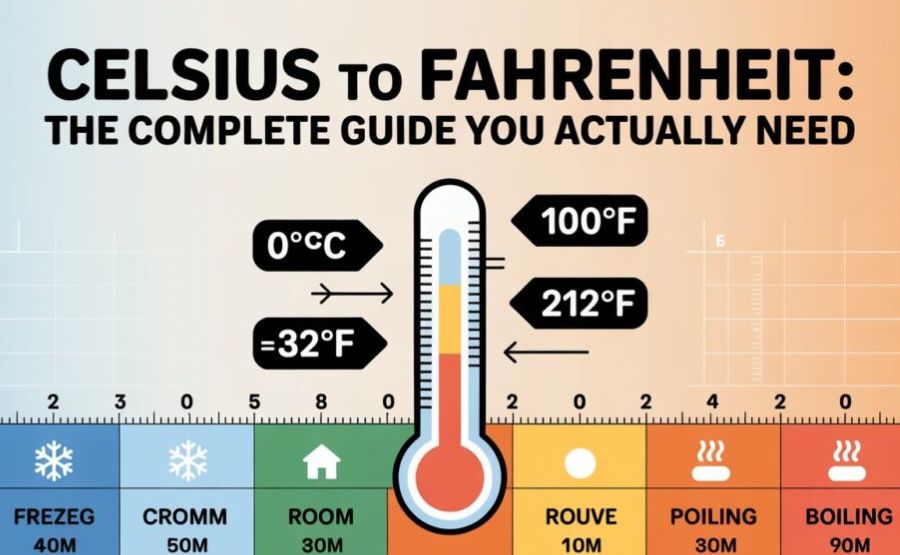
| Water Freezing Point (C) | 0°C |
| Water Freezing Point (F) | 32°F |
| Water Boiling Point (C) | 100°C |
| Water Boiling Point (F) | 212°F |
| Body Temperature (C) | 37°C |
| Body Temperature (F) | 98.6°F |
| Exact Formula C → F | °F = (°C × 9/5) + 32 |
| Quick Estimate Formula | Double the °C number, then add 30 |
| Where Celsius is Used | Almost the entire world |
| Where Fahrenheit is Used | USA, its territories, some Caribbean nations |
| Special Point | −40° is identical on both scales |
Two Scientists, Two Very Different Ideas
Before we get into math, let’s talk about the two people who started all this.
Their names were Daniel Gabriel Fahrenheit and Anders Celsius. They lived in the same era, roughly 300 years ago. They both cared deeply about measuring temperature accurately. But they went about it in completely different ways.
Daniel Fahrenheit came first. He was a Polish-born physicist who spent most of his life in the Netherlands. In 1714, he built the first reliable mercury thermometer — a genuine scientific achievement at the time. Previous thermometers used alcohol and were wildly inconsistent.
Ten years later, in 1724, he published his temperature scale.
Here’s the strange part. His zero point — the lowest fixed point on his scale — was the freezing temperature of a mixture of ice, water, and salt. He chose that because it was the coldest stable temperature he could reliably reproduce in his laboratory.
His second reference point was human body temperature, which he estimated at 96°F. (Later, the scale got refined, which pushed body temperature up to 98.6°F.)
Water ended up freezing at 32°F and boiling at 212°F. Not the most intuitive numbers. But his thermometers were so much better than anything else available that his scale caught on quickly across England and the Dutch Republic.
See also “How to Clear Cache of Website: The Complete, No-Jargon Guide“
Anders Celsius: The Man Who Flipped His Own Scale
Anders Celsius came along about 18 years after Fahrenheit. He was a Swedish astronomer at Uppsala University, and in 1742 he designed a new temperature scale that used water as its anchor.
His original design had a beautiful logic: 100 was the freezing point of water. Zero was the boiling point.
Yes, you read that right. It was upside-down from what we use today.
After Celsius died in 1744, the Swedish botanist Carl Linnaeus decided to flip the scale. Cold things should have low numbers. Hot things should have high numbers. So he reversed it.
The scale we now call Celsius — with 0 as freezing and 100 as boiling — was actually Linnaeus’s adjustment of Celsius’s original idea.
For a while, the scale was called “Centigrade,” which means “hundred steps.” It was officially renamed Celsius in 1948 to honor the man who inspired it.
The Formula: Explained Like You’re Ten Years Old
Okay. This is the part most people dread. But I promise it’s easier than it looks.
The formula to convert Celsius to Fahrenheit is:
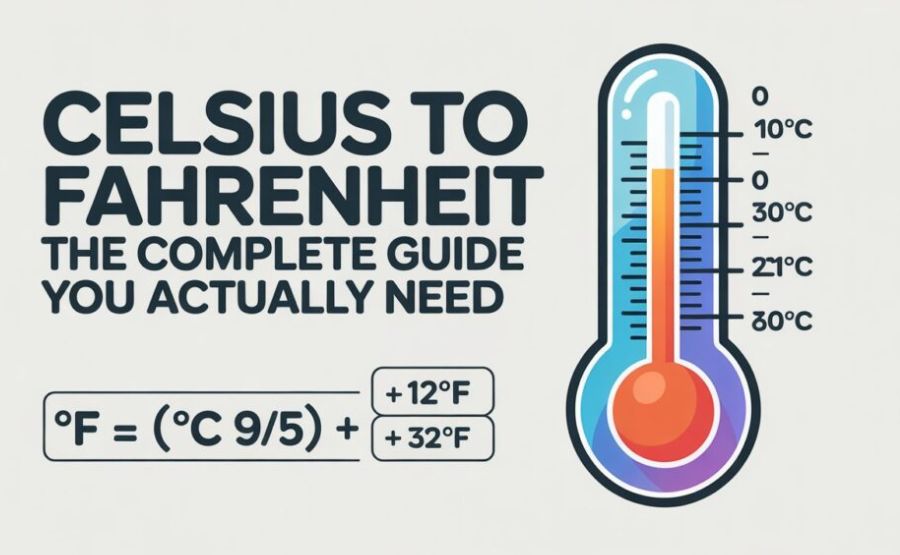
°F = (°C × 9/5) + 32
Let’s break that down into plain steps.
Step 1: Take your Celsius temperature.
Step 2: Multiply it by 9, then divide by 5. (Or just multiply by 1.8 — same result.)
Step 3: Add 32 to whatever number you got.
That’s the whole thing.
Example: Let’s convert 25°C.
- 25 × 1.8 = 45
- 45 + 32 = 77
So 25°C = 77°F. That’s a warm, sunny day.
Example: Let’s convert 0°C.
- 0 × 1.8 = 0
- 0 + 32 = 32
So 0°C = 32°F. That’s the freezing point of water. Makes perfect sense.
The Quick Trick When You Don’t Have a Calculator
The exact formula is great when you have paper or a phone handy.
But what if someone tells you it’s 22°C outside and you need a rough idea in Fahrenheit — right now, in your head?
Here’s the shortcut: Double the number, then add 30.
22 × 2 = 44. 44 + 30 = 74°F.
The exact answer is 71.6°F. So your estimate is pretty close — within a few degrees. Good enough for weather conversations, not precise enough for medical or cooking purposes.
Use the real formula when accuracy matters. Use the shortcut when you just want a ballpark answer fast.
Going the Other Way: Fahrenheit to Celsius
Sometimes you need to go backwards — from Fahrenheit to Celsius.
The formula flips:
°C = (°F − 32) × 5/9
Step 1: Subtract 32 from your Fahrenheit number.
Step 2: Multiply by 5. Then divide by 9. (Or multiply by 0.556 — same thing.)
Example: Convert 98.6°F to Celsius.
- 98.6 − 32 = 66.6
- 66.6 × 5/9 = 37
So 98.6°F = 37°C. That’s normal human body temperature.
Example: Convert 212°F.
- 212 − 32 = 180
- 180 × 5/9 = 100
So 212°F = 100°C. The boiling point of water. Perfect.
Common Temperatures You’ll Actually Need
Nobody wants to memorize formulas for temperatures they never use. So here are the conversions that actually come up in real life.
Weather:
- 0°C = 32°F (freezing — grab your coat)
- 10°C = 50°F (cold — still grab your coat)
- 20°C = 68°F (comfortable, mild)
- 25°C = 77°F (warm and pleasant)
- 30°C = 86°F (hot)
- 37°C = 98.6°F (body temperature)
- 40°C = 104°F (dangerously hot for outdoor activity)
Body Temperature (Medical):
- Normal: 37°C / 98.6°F
- Low fever: 38°C / 100.4°F
- High fever: 39°C / 102.2°F
- Very high fever: 40°C / 104°F
Cooking and Baking:
- 150°C = 300°F (slow/low cooking)
- 160°C = 325°F (gentle baking)
- 180°C = 356°F (most common baking temp — cakes, cookies)
- 190°C = 375°F (bread, roasting)
- 200°C = 392°F (hot roasting)
- 220°C = 430°F (high heat, pizza, crispy items)
The most important baking temperature to memorize: 180°C equals about 356°F. Most recipes from the UK, Europe, and Australia call for 180°C. American recipes often say 350°F. Both are in roughly the same range — close enough for most baked goods.
The Strange Place Where Both Scales Agree
Here’s one of the most fascinating facts in all of temperature history.
There is exactly one temperature where Celsius and Fahrenheit show the same number.
That number is −40.
At −40 degrees, it doesn’t matter which scale you’re using. Both say −40. They meet at this single, bone-chilling point and then go their separate ways again.
This isn’t a coincidence or a trick. You can actually prove it mathematically. If you set the two formulas equal to each other and solve the equation, −40 is the only possible answer.
This temperature is extraordinarily cold. Well below anything humans normally experience outdoors. But scientists working in the Arctic or Antarctic can hit temperatures close to this range. And for them, the Celsius/Fahrenheit question briefly becomes irrelevant.
Why Does the US Still Use Fahrenheit?
This is one of those questions that leads to a surprisingly long history lesson.
Fahrenheit spread across the world because of the British Empire. Britain adopted it. Wherever British influence reached — including the American colonies — Fahrenheit went too.
When most of the world later shifted to Celsius as part of adopting the metric system, the United States didn’t follow. Britain itself switched to Celsius by the 1960s and 1970s. The US never made the change for everyday public use.
Why not? It’s a mix of factors. Infrastructure and habit are deeply embedded. Weather broadcasts, building codes, recipes, thermostats, medical records — all of it was built around Fahrenheit. Changing it would require decades of simultaneous effort across every industry and public institution.
There’s also a practical argument that Fahrenheit supporters make. The Fahrenheit scale covers the typical range of outdoor human temperatures — roughly 0°F to 100°F — in a way that maps neatly onto human experience. 0°F is really cold. 100°F is really hot. The scale sort of “fits” weather in a way Celsius doesn’t as neatly.
Scientists in the US, including those at the National Weather Service, actually work in Celsius internally. The Fahrenheit numbers that appear in public forecasts are converted afterward, specifically because the public expects them.
So the US uses Fahrenheit not because scientists prefer it, but because the public grew up with it.
Celsius and Cooking: The Real-World Problem
Here’s where this conversion becomes genuinely important — and where getting it wrong has real consequences.
Imagine you find a gorgeous chocolate cake recipe from a UK food blogger. She says to bake it at 180°C for 30 minutes. You live in the US. Your oven speaks Fahrenheit.
You think: “180 sounds like a normal oven temperature.” You set your oven to 180°F.
Your cake stays raw for the first 20 minutes. Then you crank the heat in confusion. By the time it cooks through, it’s dry and the texture is wrong.
What happened? 180°C is 356°F. You set your oven about 180 degrees too cold.
That’s the cost of a conversion mistake in the kitchen.
There’s another wrinkle too. Convection ovens — the fan-assisted type common in many modern kitchens — run hotter than standard ovens. If your recipe was written for a standard oven, you should reduce the temperature by about 25°F (or 15°C) when using a convection setting. Failing to adjust for this is one of the most common baking mistakes.
Temperature and Medicine: When Accuracy Is Non-Negotiable
In a weather conversation, being 3 degrees off doesn’t matter much.
In a medical situation, it matters enormously.
Normal human body temperature is 37°C / 98.6°F. A fever starts at 38°C / 100.4°F. At 40°C / 104°F, a fever is serious. Above 41°C / 105.8°F, it requires immediate medical attention.
If you’re living in a Celsius country and you read a US medical source that says “fever starts at 100.4°F,” you need to know that translates to 38°C. If you confuse that with 100°C — the boiling point of water — you’ve misread the situation completely.
When using medical information across different scales, convert carefully and double-check.
Gas Marks: The Third System Nobody Warned You About
If you thought two temperature systems were confusing enough, wait until you encounter Gas Marks.
Older British and Irish oven recipes sometimes list cooking temperatures as “Gas Mark 4” or “Gas Mark 6.” These are settings from older gas ovens that don’t correspond directly to degrees.
Here’s a simple conversion:
- Gas Mark 1 ≈ 140°C / 275°F (very low)
- Gas Mark 2 ≈ 150°C / 300°F (low)
- Gas Mark 4 ≈ 180°C / 350°F (moderate — most common)
- Gas Mark 6 ≈ 200°C / 400°F (moderately hot)
- Gas Mark 8 ≈ 230°C / 450°F (hot)
If you’re following a vintage British recipe and see a Gas Mark, now you know what to do.
Final Words
Temperature conversion isn’t just a math problem. It connects to history, culture, cooking, health, and how different parts of the world understand the same physical reality.
Daniel Fahrenheit and Anders Celsius both worked hard to solve a genuine human problem: how do we measure heat and cold in a way everyone can understand and repeat reliably?
They gave us two answers. The world chose one. The US chose the other. And now we all need to know both.
The good news? Once you understand the formula — and remember a handful of key temperatures — converting between the two becomes second nature.
Next time someone tells you it’s 23°C outside, you’ll know instantly: comfortable, warm, probably jacket-free. And when that British recipe says 180°C, you’ll set your oven to 356°F without hesitation.
That’s the whole point.
FAQs
1. What is the formula to convert Celsius to Fahrenheit?
The exact formula is: °F = (°C × 9/5) + 32. Multiply your Celsius number by 1.8 and then add 32. That gives you the Fahrenheit equivalent.
2. What is the quick mental math trick for Celsius to Fahrenheit?
Double the Celsius number and add 30. For example, 20°C doubles to 40, plus 30 equals 70°F. The exact answer is 68°F — this trick gives you a close estimate, not a precise result.
3. What is 100°C in Fahrenheit?
100°C = 212°F. This is the boiling point of water at sea level. Every time water bubbles in a pot, it’s at this temperature.
4. What is 0°C in Fahrenheit?
0°C = 32°F. This is the freezing point of water. When you see ice forming on a puddle, the temperature has hit this point.
5. What is 37°C in Fahrenheit?
37°C = 98.6°F. This is the average normal human body temperature. Doctors and nurses in Celsius countries measure for fever by looking for numbers above 38°C (100.4°F).
6. At what temperature are Celsius and Fahrenheit the same?
They are identical at −40 degrees. At −40°C and −40°F, both scales show the same number. Above this point, Fahrenheit is always higher than Celsius. Below it, Fahrenheit is lower.
7. Who invented the Celsius scale?
Anders Celsius, a Swedish astronomer, created it in 1742. His original scale was reversed from today’s version — he had 0 as boiling and 100 as freezing. After his death, the botanist Carl Linnaeus flipped it to the version we use now.
8. Who invented the Fahrenheit scale?
Daniel Gabriel Fahrenheit, a German physicist born in what is now Poland, created it in 1724. He also invented the mercury thermometer in 1714. His scale set 32°F as the freezing point and 212°F as the boiling point of water.
9. Why does the United States use Fahrenheit instead of Celsius?
The US inherited Fahrenheit from British colonial influence. When most of the world switched to Celsius as part of adopting the metric system, the US did not follow. Decades of infrastructure, public habits, weather systems, and industry standards built around Fahrenheit made switching enormously difficult.
10. What is 180°C in Fahrenheit for baking?
180°C equals approximately 356°F, which most people round to 350°F when following American recipes. This is the most common oven temperature for cakes, cookies, and general baking.
11. What is 350°F in Celsius?
350°F is approximately 177°C — close to 180°C. American recipes at 350°F and UK recipes at 180°C are targeting almost the same heat level.
12. How do I convert Fahrenheit back to Celsius?
Use this formula: °C = (°F − 32) × 5/9. Subtract 32 from the Fahrenheit number, then multiply the result by 0.556 (or multiply by 5 and divide by 9). That gives you the Celsius temperature.
13. Is Celsius part of the metric system?
Yes. Celsius is the temperature unit in the metric (SI) system. Scientists worldwide use Celsius for most measurements, and Kelvin for extreme scientific work (Kelvin starts at absolute zero, the coldest temperature theoretically possible).
14. Why does a fever start at 38°C but the number sounds bigger in Fahrenheit (100.4°F)?
Because the two scales have different starting points and different step sizes. One Celsius degree equals 1.8 Fahrenheit degrees. That means small changes in Celsius show as bigger jumps in Fahrenheit numbers, which is why Fahrenheit seems to show more “drama” in medical readings.
15. Should I reduce oven temperature for a fan/convection oven?
Yes. Convection ovens circulate hot air more efficiently than standard ovens. Reduce the temperature by 25°F (about 15°C) from what the recipe states. So a recipe calling for 180°C in a standard oven becomes about 165°C in a convection oven. Cooking time may also be slightly shorter.
Explore more, learn more, and think deeper with Theory Magazine.