If you’ve ever stared at your paper wondering “do I put the author’s name HERE or at the END of the sentence?” — this guide was written for exactly that moment.
In-text citing sounds scarier than it is. Once you understand the basic idea behind it, the rest just clicks into place. Let me walk you through it like a friend who’s done this a hundred times.
Quick Reference
| Style | Used In | What Goes in Parentheses | Page Number Needed? |
| APA | Psychology, Social Sciences | Author + Year | Only for direct quotes |
| MLA | English, Literature, Humanities | Author + Page Number | Yes, always |
| Chicago (Notes) | History, Arts | Footnote number | In the footnote |
| Chicago (Author-Date) | Some sciences | Author + Year | For direct quotes |
| IEEE | Engineering, Technology | Bracketed number [1] | Not typically |
| Harvard | Many fields in UK/Australia | Author + Year | For direct quotes |
Why Do In-Text Citations Even Exist?
Think of it like giving credit at school. If your friend told you something clever and you repeated it to the class, you’d say “Emma told me this.” That’s essentially all an in-text citation does.
It tells your reader “I didn’t come up with this — I got it from somewhere. Here’s the clue to find that source.”
Every time you quote, paraphrase, or summarise someone else’s idea, you need one of these little citations right there in the text. Not at the end of the paper only — right there, in the moment.
The goal is simple: your reader should be able to find any source you mention. The in-text citation is their signpost.
See also “Celsius to Fahrenheit: The Complete, Human Guide to Temperature Conversion“
The Big Three Styles — And Which One You’re Probably Using
There are dozens of citation styles out there. But three of them cover the vast majority of students and researchers.
APA is used in psychology, sociology, education, and most social sciences. It cares deeply about publication dates because recent research matters a lot in those fields.
MLA is the one English and literature classes love. It cares about page numbers because your professor wants to see the exact line you’re quoting.
Chicago splits into two versions. Notes-Bibliography uses footnotes, common in history. Author-Date works similarly to APA, used in some sciences and social sciences.
Ask your teacher or professor which one they want before you write a single word of your paper. Don’t assume. Getting the style wrong is a common and entirely avoidable mistake.
APA In-Text Citations — The Author-Date Style
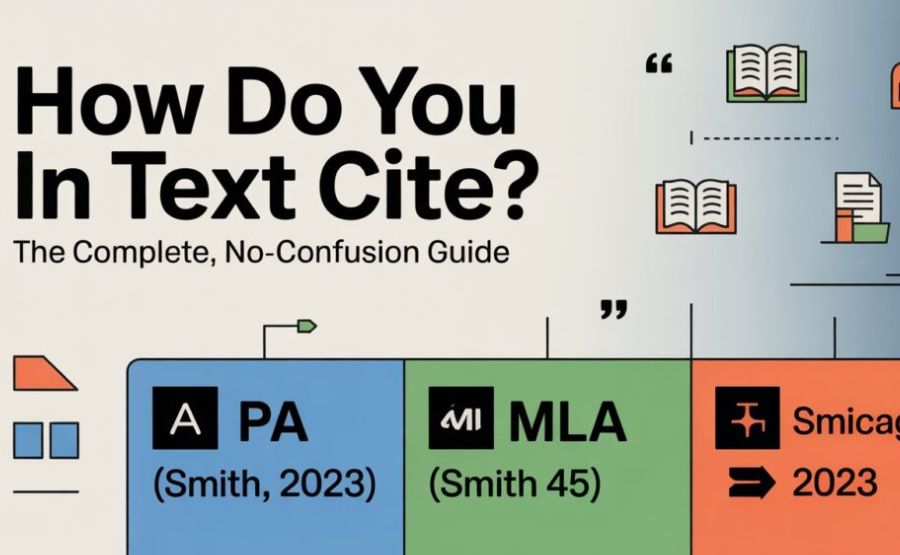
APA in-text citations look like this: (Smith, 2022)
That’s it. Author’s last name, comma, year. Done.
If you’re quoting something word-for-word, you also add a page number: (Smith, 2022, p. 45)
If you’re just paraphrasing — putting someone’s idea into your own words — you skip the page number and just use the author and year.
Let me show you what that looks like in a real sentence.
With the citation in brackets at the end:
Research shows that students who sleep more than eight hours perform significantly better on memory tests (Smith, 2022).
With the author’s name woven into the sentence:
Smith (2022) found that students who sleep more than eight hours perform significantly better on memory tests.
Both are correct. The second one just flows more naturally when the author’s name is important to your point.
APA With Multiple Authors — The Et Al. Rule
Here’s where a lot of people get tripped up.
If a source has one or two authors, list both names every time you cite it:
(Johnson & Lee, 2021)
If a source has three or more authors, list only the first author, then write “et al.” — which is Latin for “and others”:
(Martinez et al., 2020)
Et al. is always written in lowercase, and there’s a period after “al” because it’s an abbreviation.
APA When There’s No Author
Sometimes a website or article doesn’t list a person’s name anywhere. Don’t panic.
Use the first few words of the title instead. Put article titles in quotation marks. Put book or website names in italics.
For example: (“Climate Change Effects,” 2023) or (National Health Report, 2023)
APA When There’s No Date
Use n.d. — which stands for “no date.”
Example: (Smith, n.d.)
It looks a little odd, but it’s the correct way to handle it. You’re being honest with the reader that you don’t know when this was published.
APA for Websites With No Page Numbers
Websites almost never have page numbers. APA knows this and has a fix.
If you’re quoting a specific line, use a paragraph number instead: (Chen, 2022, para. 3)
If the article has clear headings, you can name the section: (Chen, 2022, Results section, para. 2)
If there’s no easy way to locate the exact spot, at minimum give the author and year. That’s still better than nothing.
MLA In-Text Citations — The Author-Page Style
MLA works differently from APA. Instead of the year, MLA wants the page number.
A basic MLA citation looks like this: (Smith 45)
No comma between the name and the number. That trips people up if they switch between styles.
Example in a sentence:
The novel explores loneliness as “a fundamental human condition that no technology can fix” (Smith 45).
With the author’s name in the sentence itself:
Smith argues that loneliness is “a fundamental human condition that no technology can fix” (45).
When you use the author’s name in the sentence, you only need the page number in brackets at the end.
MLA When There’s No Page Number
Most websites don’t have page numbers. For MLA, you simply leave the number out.
So instead of (Smith 45) you just write (Smith).
Your reader will still be able to find the source on your Works Cited page. The author’s name is enough to point them there.
MLA With Two Authors
Spell out both last names with the word “and” between them:
(Johnson and Lee 78)
Note: MLA uses the word “and” written out. APA uses an ampersand (&). That’s a small but easy-to-mess-up difference between the two styles.
MLA With Three or More Authors
Just like APA, MLA uses “et al.” for three or more authors:
(Martinez et al. 112)
MLA When There’s No Author
Use the title of the work instead. If the source has a short title, use it in full. If it’s long, abbreviate the first few significant words.
Article titles go in quotation marks. Book or website titles go in italics.
Example: (“Effects of Social Media” 12) or (“Effects of Social Media”) if there’s no page number.
Chicago Style — The Footnote Version
Chicago Notes-Bibliography is a little different from both APA and MLA. Instead of putting the citation in brackets in your sentence, you put a small superscript number right after the information.¹
Then at the bottom of that page, you list the full source information next to that number.
So your text might say: The battle began at dawn and lasted three days.¹
And at the bottom of the page, footnote 1 would say: John Harrison, The Long War, (New York: Oxford Press, 2019), 142.
The beauty of Chicago footnotes is that you can also add commentary in the footnote — a little note to the reader that wouldn’t fit naturally in the main text.
Chicago Style — The Author-Date Version
Chicago’s Author-Date system looks and works almost exactly like APA. You put the author, year, and page number in parentheses in the text.
Example: (Harrison 2019, 142)
The main difference from APA is how the full reference list at the end looks — but the in-text format is very similar.
Parenthetical vs. Narrative Citations — What’s the Difference?
This sounds complicated but it really isn’t. There are just two ways to build any in-text citation.
Parenthetical: You put ALL the citation info in brackets at the end.
“Sleep deprivation affects memory formation (Walker, 2017, p. 89).”
Narrative: You weave the author’s name into your sentence naturally, and only the remaining info goes in brackets.
“Walker (2017) found that sleep deprivation significantly affects memory formation (p. 89).”
Both are correct. Use narrative style when you want to highlight the author’s name because it’s important to your argument. Use parenthetical when the focus is on the idea, not the person.
Quoting vs. Paraphrasing — Does It Change the Citation?
Yes, slightly. And this is important.
Direct quoting means copying the exact words from a source. You put those words in quotation marks AND you cite with a page number.
Example (APA): Research confirmed that “teenagers are sleeping an average of two hours less than they did in 1990” (Brown, 2021, p. 34).
Paraphrasing means you put the idea into your own words. You still cite the source, but you usually don’t need a page number in APA. In MLA you still include the page number even when paraphrasing.
Never skip the citation just because you changed the wording. Paraphrasing without citing is still plagiarism.
Quoting Someone Who Is Quoting Someone Else
This one confuses everyone at first.
Say you’re reading an article by Ahmed (2022), and Ahmed quotes a study by Park (2015) inside it. You want to use Park’s idea — but you haven’t read Park’s original work.
In APA, you write: (Park, 2015, as cited in Ahmed, 2022)
In MLA, you write: (Park, qtd. in Ahmed 78)
Only Ahmed goes in your reference list at the end. You never list a source you didn’t actually read yourself.
The Block Quote — When Your Quote Gets Long
If you’re quoting more than 40 words in APA or more than 4 lines in MLA, stop using quotation marks. Instead, set the whole quote apart as a separate indented paragraph.
This is called a block quote. The citation still goes at the end, but the period goes before the citation in a block quote, not after it. That’s the one rule that flips.
Regular quote: “The study found significant results.” (Brown, 2021, p. 45).
Block quote: The study found significant results, particularly among the youngest age group. (Brown, 2021, p. 45)
Citing Multiple Sources in One Go
Sometimes you want to support a point by citing two or three sources at once. Both APA and MLA allow this.
In APA, separate them with semicolons and list them alphabetically by author name:
(Ahmed, 2020; Brown, 2021; Chen, 2022)
In MLA, also separate with semicolons:
(Ahmed 34; Brown 87)
What Happens If Two Sources Have the Same Author AND the Same Year?
In APA, you add a lowercase letter after the year to tell them apart:
(Smith, 2021a) and (Smith, 2021b)
That letter also appears in your full reference list at the end, so readers can find the right one.
The Golden Rule Everyone Forgets
For every single in-text citation in your paper, there must be a matching full entry in your reference list (APA) or Works Cited page (MLA) at the end.
No exceptions. If you cite it in the text, it belongs in the list. If it’s in the list, it must appear somewhere in your text.
If something is in your reference list but never cited in the paper, remove it. That’s not how references work. You only list what you actually used.
Final Words
In-text citing feels overwhelming when you first learn it. All these little rules, all these different styles, all these edge cases with missing dates or too many authors.
But here’s the secret: you really only need to remember the core idea of your style. APA = author + year. MLA = author + page number. Everything else is just a variation on that core.
The edge cases — no author, no date, three or more authors — always have a logical workaround that follows the same pattern. When in doubt, ask yourself “what information would help my reader find this source?” and use that.
And whenever you’re unsure, Purdue’s OWL website (owl.purdue.edu) is the most trusted free resource for citation rules in every major style. Bookmark it. Thank yourself later.
Citing properly isn’t just rule-following. It’s honest. It’s respectful to the people whose ideas you’re building on. And once you’ve done it a few times, it genuinely becomes second nature.
FAQs
1. What is an in-text citation?
It’s a short reference placed right inside your paper whenever you use someone else’s idea, quote, or data. It points readers toward the full source in your reference list.
2. Where exactly do I put the in-text citation?
Immediately after the quoted or paraphrased information, usually at the end of the sentence before the period. The period goes after the closing bracket in most cases.
3. Do I need an in-text citation every time I paraphrase?
Yes, every single time. Putting someone’s idea into your own words doesn’t mean you invented it. You still need to credit the source.
4. What’s the difference between APA and MLA in-text citations?
APA uses the author’s last name and year: (Smith, 2022). MLA uses the author’s last name and page number: (Smith 45). APA uses a comma between them; MLA doesn’t.
5. What do I do if there’s no author listed?
Use the first few words of the title instead. Article titles go in quotation marks; book/website titles go in italics. In APA: (“Climate Effects,” 2023). In MLA: (“Climate Effects” 12) or just (“Climate Effects”) if no page number.
6. What do I do if there’s no date listed?
In APA, use “n.d.” in place of the year: (Smith, n.d.). In MLA, just use the author’s name since MLA doesn’t include years in in-text citations.
7. Do I need a page number when paraphrasing in APA?
No. In APA, page numbers are only required for direct quotes. If you’re paraphrasing, just the author and year is enough.
8. Do I need a page number when paraphrasing in MLA?
Yes. MLA always wants a page number, whether you’re quoting or paraphrasing.
9. What if there are three or more authors?
Use the first author’s last name followed by “et al.” In APA: (Martinez et al., 2020). In MLA: (Martinez et al. 55).
10. What if my quote is really long?
If it’s over 40 words in APA, or over 4 lines in MLA, use a block quote — indent the whole passage and skip the quotation marks. The period goes before the citation in a block quote.
11. Can I cite two sources in the same bracket?
Yes. Separate them with semicolons. In APA, list them alphabetically: (Ahmed, 2020; Chen, 2022). In MLA: (Ahmed 34; Chen 89).
12. What if I found a quote inside an article I was reading — not from the original source?
In APA: (Original Author, Year, as cited in Author You Read, Year). In MLA: (Original Author, qtd. in Author You Read, Page). Only list the source you actually read in your reference list.
13. Does every in-text citation need a matching entry in my reference list?
Yes, absolutely. Every in-text citation must have a full entry in the reference list. And every item in your reference list must be cited somewhere in your paper.
14. What’s the easiest free tool to generate citations automatically?
Purdue OWL (owl.purdue.edu) for guidance. For automatic generation, tools like Scribbr, Citation Machine, or Google Scholar’s “cite” button can create citations for you — but always double-check their output, as they sometimes make small errors.
15. What if my teacher wants a style I’ve never used before — like Chicago or IEEE?
The structure is different but the core idea is always the same: help your reader find the source. Look up the specific style on Purdue OWL or your university library guide, identify the core pattern for that style, and follow it consistently throughout your paper.
Explore more, learn more, and think deeper with Theory Magazine.