Here’s a scene that plays out in hardware stores every weekend.
Someone walks in to order mulch or concrete. “How many cubic yards do you need?” queries the staff member. The customer smiles, nods, then goes silent because they have absolutely no idea.
Sound familiar? You’re in good company.
Cubic yards confuse almost everyone the first time. But once you understand the concept — really understand it — it clicks forever. Ordering materials becomes easy. Projects stop costing more than they should. No more guessing, no more wasted money, no more trips back to the store.
Let’s fix the confusion right now.
Quick Reference Facts
| Fact | Detail |
| What is a cubic yard? | A box that is 3 feet long × 3 feet wide × 3 feet tall |
| Cubic feet in one cubic yard | 27 exactly |
| Basic formula | Length (ft) × Depth (ft) × Width (ft) ÷ 27 |
| Inches to feet conversion | Divide inches by 12 |
| Shortcut for shallow depths | (Length × Width × Depth in inches) ÷ 324 |
| Concrete weight per cubic yard | ~3,915–4,050 lbs (about 2 tons) |
| Gravel weight per cubic yard | ~2,835 lbs (about 1.4 tons) |
| Topsoil weight per cubic yard | ~1,400–2,700 lbs (depends on moisture) |
| Sand weight per cubic yard | ~2,700 lbs dry, ~3,240 lbs wet |
| Mulch weight per cubic yard | ~500–675 lbs (very light) |
| Coverage at 1 inch deep | 1 cubic yard covers 324 square feet |
| Coverage at 2 inches deep | 1 cubic yard covers 162 square feet |
| Coverage at 3 inches deep | 1 cubic yard covers 108 square feet |
| Coverage at 4 inches deep | 1 cubic yard covers 81 square feet |
| Common uses | Concrete, mulch, topsoil, gravel, sand, fill dirt |
What Is a Cubic Yard, Really?
Forget the textbook definition for a second.
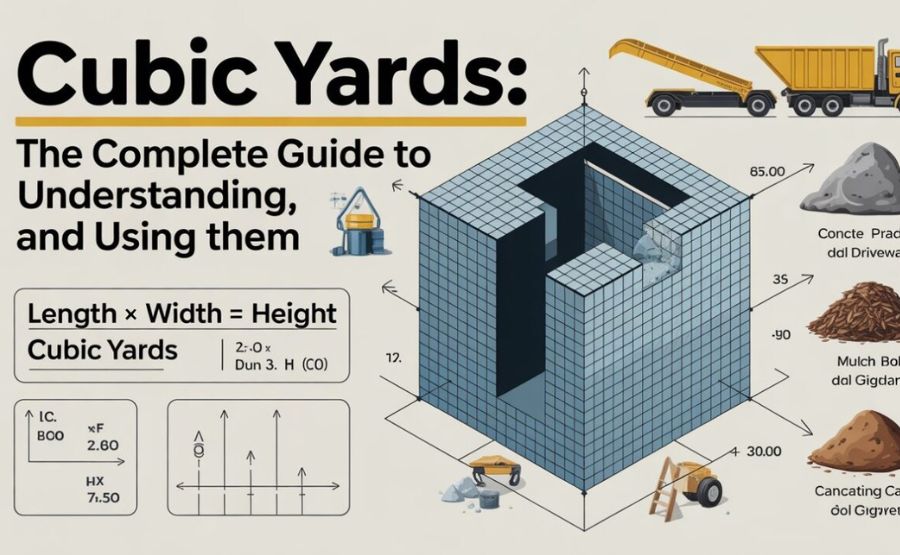
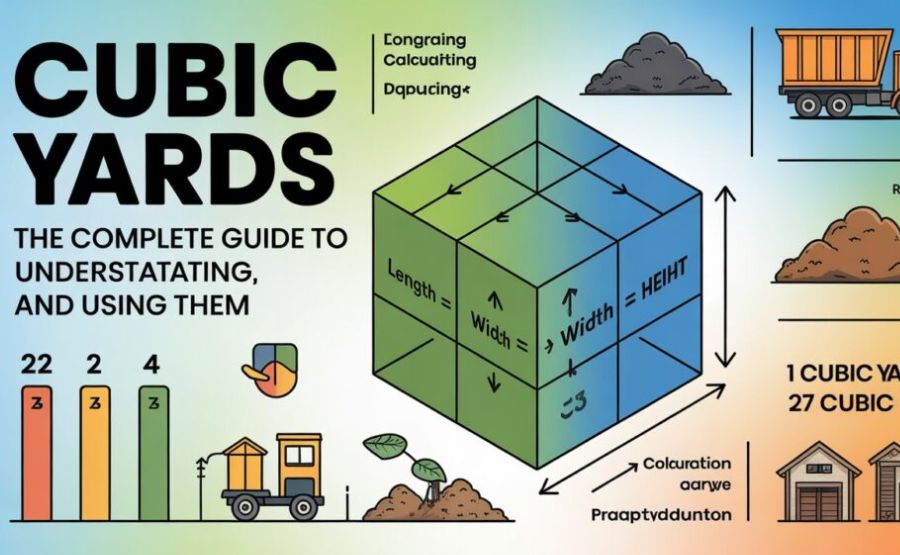
Picture a cardboard box. It’s three feet wide, three feet long, and three feet tall. That box — when full — holds exactly one cubic yard of material.
One yard is equivalent to three feet. So a cubic yard is simply a yard on all three sides.
Now here’s where the number 27 comes from, because people ask about this constantly.
Three feet times three feet times three feet equals 27 cubic feet.Thus, 27 cubic feet are always contained in one cubic yard.That’s not a weird rule. That’s just math.
Every time you calculate cubic yards, that number 27 shows up at the end. It’s the key that unlocks everything.
See also “ACFT Score Chart: The Complete Guide Every Soldier Needs“
The Formula — Broken Down So Simply It’s Almost Unfair
The formula has three steps. That’s it. Three.
Step 1: Measure the length of your space in feet.
Step 2: Measure the width in feet.
Step 3: Measure the depth (or height or thickness) in feet.
Then multiply all three numbers together. That gives you cubic feet.
Then divide that result by 27. That gives you cubic yards.
Written out: Length × Width × Depth ÷ 27 = Cubic Yards
Real example: Say you’re filling a garden bed. It’s 12 feet long, 6 feet wide, and you want 6 inches of soil.
But wait — 6 inches isn’t in feet yet. Divide 6 by 12. You get 0.5 feet.
Now: 12 × 6 × 0.5 = 36 cubic feet. Divide by 27 = 1.33 cubic yards.
Order 1.5 cubic yards. That little bit of extra always pays off.
The Inch Problem That Trips Everyone Up
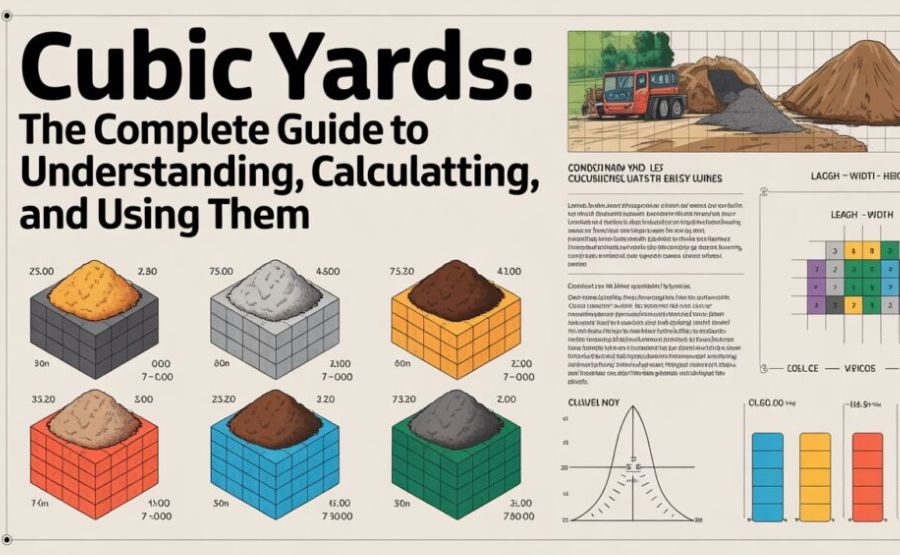
Most people measure their depth in inches, not feet. That’s completely normal.
The problem happens when someone plugs inches directly into the formula without converting first. The result comes out totally wrong and nobody knows why.
The fix is simple. Before you start multiplying anything, convert all your measurements to feet.
To turn inches into feet: divide the inches by 12.
- 3 inches = 0.25 feet
- 4 inches = 0.33 feet
- 6 inches = 0.5 feet
- 12 inches = 1 foot
Once everything is in feet, the formula works perfectly every time.
There’s also a handy shortcut if your depth is already in inches and your length and width are in feet. Multiply length × width × depth in inches, then divide by 324 instead of 27. You get the same answer with one fewer step.
Visualizing a Cubic Yard: What Does It Actually Look Like?
Numbers are useful. But your brain wants an image.
Here are some ways to picture one cubic yard in real life.
A standard washing machine is roughly the size of one cubic yard. Picture carrying that entire machine full of material — that’s what one cubic yard feels like.
One cubic yard also fills about 9 single wheelbarrow loads. So if you ordered 3 cubic yards of topsoil, you’re looking at around 27 wheelbarrow trips.
Put differently: one cubic yard of material would fill a pickup truck bed about halfway — and even then, the weight of most materials would be pushing the truck’s limits long before the volume did.
The final point is more important than most people realize. More on that in a minute.
Why Is 27 the Magic Number?
People ask this all the time and deserve a clear answer.
One yard equals three feet. When you measure in three dimensions — length, width, and height — you multiply those three feet together.
3 × 3 × 3 = 27.
That’s all it is. There’s no mystery. No strange rounding. Just a cube that’s one yard on every side, which happens to contain exactly 27 smaller cubes each measuring one foot on every side.
Once you see it that way, the number 27 stops feeling random and starts feeling obvious.
Common Projects and How Many Cubic Yards You’ll Need
This is the section to bookmark. Real projects, real numbers.
Concrete Driveway or Patio (4 inches thick):
Measure the area in square feet. Multiply by 0.333 (that converts 4 inches to feet). Divide by 27.
A patio of 20 by 20 feet and 4 inches thick requires roughly 5 cubic yards of concrete.
Garden Bed with Topsoil (6 inches deep):
Multiply length × width, then by 0.5 (for 6 inches). Divide by 27.
A 10 × 20-foot garden bed at 6 inches deep needs about 3.7 cubic yards of soil.
Mulch for a Flower Bed (3 inches deep):
To save time, multiply the square footage by the depth in inches, then divide the result by 324.
A 15 × 15-foot bed at 3 inches deep needs about 2 cubic yards of mulch.
Gravel for a Pathway (2 inches deep):
Same shortcut. A 4 × 50-foot path at 2 inches deep needs about 1.23 cubic yards of gravel.
Always order 10% extra. Soil settles. Gravel shifts. A little leftover is far better than running short when the project is half done.
Weight: The Part People Forget Until It’s Too Late
Here’s the thing about cubic yards that surprises first-timers every single time.
The volume of a material and the weight of that material are completely different things.
One cubic yard of dry mulch barely makes a dent — it weighs around 500 to 675 pounds. You could fit several cubic yards in a pickup truck without breaking a sweat.
One cubic yard of concrete? That’s nearly 4,000 pounds. Almost two tons. You cannot haul multiple cubic yards of concrete in a standard half-ton pickup. The truck will protest — loudly.
Here’s a breakdown of common materials:
- Concrete (solid): ~3,915–4,050 lbs per cubic yard
- Asphalt (solid): ~3,960 lbs per cubic yard
- Gravel: ~2,835 lbs per cubic yard (dry)
- Sand: ~2,700 lbs per cubic yard (dry); up to ~3,240 lbs when wet
- Fill dirt: ~2,000–2,700 lbs per cubic yard
- Topsoil: ~1,400–2,000 lbs per cubic yard
- Wood chip mulch: ~675 lbs per cubic yard
- Bark mulch (dry): ~500 lbs per cubic yard
When you’re ordering heavy materials, weight limits matter as much as volume. Your supplier can tell you the weight per cubic yard for whatever material you’re buying. Ask before you order delivery or try to haul it yourself.
Cubic Yards for Irregular Shapes
Not every project is a perfect rectangle. Life rarely is.
Circular Areas (Like a Round Garden):
You need the radius — that’s the distance from the center point to the edge.
Use: 3.14159 × radius² × depth ÷ 27
For instance, the radius of an 8-foot-wide circular bed is 4 feet. At 3 inches deep (0.25 feet):
3.14159 × 16 × 0.25 ÷ 27 = 0.46 cubic yards.
L-Shaped or Irregular Areas:
Break them into smaller rectangles. Calculate each piece separately. Add the totals together.
For example, an L-shaped patio might have one section that’s 10 × 8 feet and another that’s 6 × 4 feet. Calculate both, add the cubic yards together, and you have your total.
Slopes and Uneven Ground:
Take the average depth. Measure the deepest point and shallowest point, add them together, and divide by 2. Use that number as your depth. It gets you near, but it won’t be flawless.
Cubic Yards vs. Cubic Feet vs. Square Yards
People confuse these three constantly. Let’s clear it up once and for all.
Square yards measure area — flat surfaces only. No depth involved. A square yard is 3 feet × 3 feet = 9 square feet. You’d use this for measuring carpet or flooring.
Cubic feet measure volume — three dimensions. Used for smaller amounts of material or when you’re buying bags at a hardware store.
Cubic yards also measure volume — just larger amounts of it. You’d order bulk materials like concrete trucks, landscape supply deliveries, and dumpsters by the cubic yard.
One cubic yard = 27 cubic feet. 1,728 cubic inches is equal to one cubic foot.
If a bag at the store says it contains 2 cubic feet of mulch, you’d need about 13 of those bags to equal one cubic yard. Do that math before you haul 40 bags when three cubic yards delivered to your driveway would have been cheaper and easier.
Dumpsters Are Measured in Cubic Yards Too
Most people don’t realize this connection until they rent a dumpster.
When a company says they’re delivering a “10-yard dumpster,” they mean it holds 10 cubic yards of debris. That’s the volume limit.
But there’s a catch everyone learns the hard way: weight limits are usually lower than the volume limit allows.
A 10-yard dumpster filled completely with broken concrete would be impossibly heavy. The dumpster company sets a weight limit — usually measured in tons — that may be reached long before the container is visually full.
Heavy materials like concrete, dirt, and gravel fill up the weight allowance quickly. You can use more of the volume with lighter materials like cardboard, wood, and insulation.
Always tell your dumpster rental company what type of material you’re disposing of. They’ll help you choose the right size — and help you avoid overage fees that catch people by surprise.
How Concrete Delivery Works (and Why Cubic Yards Matter So Much)
When you order concrete from a mixing truck, you order it by the cubic yard.
Concrete trucks typically carry between 8 and 11 cubic yards per load. If your project needs more than that, you’ll need multiple trucks or plan carefully for pour timing.
Most concrete suppliers charge a “short load” fee if you order fewer than a minimum amount — often 5 cubic yards. If your project only needs 2 cubic yards, expect to pay extra.
Getting the calculation wrong here stings twice. Under-order and the pour stops midway — a serious problem because fresh concrete can’t wait around while you scramble for more. Over-order and you’re paying for wet concrete that has to go somewhere.
Get the math right before you make the call.
Mulch: The Most Forgiving Material to Calculate
Good news for gardeners. Mulch is the most forgiving material when it comes to cubic yard calculations.
If you’re a little off in your estimate, it’s not a crisis. Too much mulch? Pile it a bit deeper or save some for next season. Too little? Order a top-up.
The standard recommendation for flower beds is 2 to 3 inches of depth. Three inches gives better weed suppression and moisture retention. Two inches works fine for established areas.
One cubic yard of mulch covers:
- 324 square feet at 1 inch deep
- 162 square feet at 2 inches deep
- 108 square feet at 3 inches deep
For most average garden beds, 2 to 3 cubic yards handles a reasonable amount of ground. Measure your actual beds though — don’t assume.
Final Words
Here’s the honest truth about cubic yards: it’s one of those things that seems complicated until someone explains it plainly. After that, it’s just multiplication and a division by 27.
Measure your space. Convert everything to feet. Multiply length × width × depth. Divide by 27. Add a 10% buffer.
That sequence handles concrete patios, garden beds, gravel paths, fill dirt, mulch, sand — basically any bulk material project you’ll ever tackle.
The only other thing to remember is weight. Volume and weight are not the same thing. Always check how heavy your material is before you try to haul it yourself or before you fill a dumpster past its limit.
Now you know. Go measure something.
FAQs
1. What exactly is a cubic yard?
One unit of volume is a cubic yard. It’s a cube that measures 3 feet on every side — 3 feet long, 3 feet wide, and 3 feet tall. That cube holds exactly 27 cubic feet of material.
2. How do I calculate cubic yards?
Measure your length, width, and depth in feet.To calculate cubic feet, multiply all three figures. To convert to cubic yards, divide the result by 27.The full formula: (Length × Width × Depth) ÷ 27.
3. My depth is in inches. What should I do?
Divide the inches by 12 to convert to feet before using the formula. For example, 6 inches ÷ 12 = 0.5 feet. Alternatively, use this shortcut: (Length × Width × Depth in inches) ÷ 324.
4. Why do we divide by 27?
Because one yard equals three feet. A cubic yard is 3 × 3 × 3 feet, which equals 27 cubic feet. Dividing by 27 converts cubic feet into cubic yards.
5. How much does a cubic yard weigh?
It depends entirely on the material. Mulch is light — around 500–675 lbs. Topsoil runs 1,400–2,700 lbs. Gravel sits around 2,835 lbs. Concrete can reach nearly 4,000 lbs. Always check the weight for your specific material before hauling.
6. How many square feet does one cubic yard cover?
It depends on the depth. At 1 inch deep, it covers 324 square feet. At 2 inches, 162 square feet. At 3 inches, 108 square feet. At 4 inches, 81 square feet.
7. Can I fit a cubic yard in my pickup truck?
A standard 8-foot truck bed holds about 2.5 cubic yards by volume. But weight matters more. A half-ton truck safely carries 1,000–1,500 lbs. One cubic yard of gravel weighs nearly 3,000 lbs — well over that limit. Only haul light materials like mulch in a standard pickup.
8. How do I calculate cubic yards for a circular area?
Use this formula: 3.14159 × radius² × depth ÷ 27. The radius is half the diameter. Make sure depth is in feet. The result is your cubic yards.
9. How many cubic yards are in a concrete truck?
Most standard concrete mixer trucks carry between 8 and 11 cubic yards per load. Suppliers often charge a short-load fee for orders below a certain minimum, typically around 5 cubic yards.
10. What does a 10-yard dumpster mean?
It holds 10 cubic yards of material by volume. However, dumpsters also have weight limits. Heavy materials like concrete or soil fill the weight allowance before the container is visually full. Tell your rental company what type of debris you’re disposing of before choosing a size.
11. How many bags of mulch equal one cubic yard?
Most bagged mulch at hardware stores comes in 2-cubic-foot bags. You’d need roughly 13 to 14 bags to equal one cubic yard. For larger projects, bulk delivery is almost always cheaper and less work.
12. How much extra material should I order?
Add 10% to your calculated amount. Material settles, the ground is rarely perfectly level, and waste always happens during spreading. Running short midway through a concrete pour or a garden bed fill-in is far more frustrating than having a small surplus.
13. What distinguishes square yards from cubic yards?
Square yards measure flat area — length times width, two dimensions. Cubic yards measure volume — length times width times depth, three dimensions. You’d measure carpet in square yards. You’d order concrete or mulch in cubic yards.
14. How do I calculate cubic yards for an irregular shape?
Break the shape into smaller rectangles or standard shapes. Calculate the cubic yards for each section separately. Add all those numbers together for your total.
15. How many wheelbarrow loads is one cubic yard?
A typical garden wheelbarrow has a capacity of roughly three cubic feet. Since one cubic yard equals 27 cubic feet, you’d need approximately 9 full wheelbarrow loads to move one cubic yard of material.
Explore more, learn more, and think deeper with Theory Magazine.